





Search the Community
Showing results for tags 'OTF Premium'.
Found 749 results
-
LEXINGTON, Ky. — A goal-line stand by the defense and Mason Shipley’s third field goal of the night helped No. 21 Texas avoid a staggering upset on Saturday with a 16-13 overtime road win over Kentucky at Kroger Field. On Texas Football has live coverage of the postgame press conference with coach Steve Sarkisian and the Longhorns.
-
On the eve of No. 21 Texas attempting to build on winning last Saturday’s 23-6 fist fight with Oklahoma when it faces Kentucky on the road (6 p.m., ESPN), what Colin Simmons said on Monday stands out as the theme of the week for Steve Sarkisian’s team. Texas (4-2, 1-1 SEC) wants its suffocation of the Sooners to be the jumping-off point to a prosperous second half of the regular season. Coming off of his most productive game of the season (five tackles and 2.5 sacks), Simmons, who was named SEC Co-Defensive Lineman of the Week for his performance in the win over Oklahoma, was blunt in his response when asked about the challenge of maintaining the mental approach the Longhorns carried into the Red River Shootout. “Well, I'll let you know this right now: We're not here for the emotional roller coaster. We're not here to go up and down,” Simmons said. “We're only here to go up and be consistent.” Simmons, along with the other Texas players who met with the media on Monday, and Sarkisian referred to Saturday’s meeting with the Wildcats as “an SEC Championship Game.” While that might sound disingenuous on the surface, the mantra speaks to the Longhorns' understanding that a loss to Kentucky (2-3, 0-3) would all but put an end to their hopes of returning to Atlanta for the second consecutive season. A start to Saturday’s game that mirrors what happened when Texas got itself into an early 10-0 hole in Gainesville on Oct. 4 (Florida hung on for a 29-21 win that knocked the Longhorns out of the Associated Press Top 25) is one from which the Longhorns might not recover. Mark Stoops has had better teams than the one he’ll lead onto Kroger Field. Still, the Wildcats’ potential to successfully utilize a ground-and-pound style of offense (Kentucky averages 159.4 yards per game and 4.22 yards per attempt on the ground) is the kind of attack capable of protecting a lead. According to College Football Data, the Wildcats average 3.2 line yards per carry, which ranks fifth in the SEC. According to the metric, which distributes a percentage of the credit for an offense’s rushing yards to the offensive line, the Kentucky offensive line gets the job done in the running game better than all but four lines in the conference. For all of the talk about the Texas offense needing to start fast, the defense’s job is just as important in that regard. “We've got to come out and stop the run,” defensive tackle Hero Kanu said on Monday. “That's, obviously, the mindset we’ve got to have.” In the loss to the Gators, Florida gained 94 of its 159 rushing yards in the first quarter. If the Longhorns can replicate what it did against the Sooners — the defense allowed only 80 sack-adjusted rushing yards (3.2 yards per attempt) and, once Texas grabbed the lead in the second half, turned up the heat on John Mateer to the tune of five sacks — it will go a long way toward making sure the team returns home with all of its goals intact. “We've got to force them to have third-and-longs,” Kanu said. “We've got to stop them on first and second down. That's really the mindset we have and we know what we've got to do.”
-
Texas replicating exactly what it did while choking the life out of Oklahoma en route to winning the Red River Shootout for the third time in four years is a formula capable of giving the Longhorns a chance to win their six remaining regular-season games. Specifically, Texas (4-2, 1-1 SEC) would love the manner in which it manhandled the Sooners in the second half to carry over to the back half of the schedule, which begins with Saturday’s road game against Kentucky (6 p.m., ESPN). After trailing Oklahoma at halftime, 6-3, the Longhorns recorded a 20-0 edge on the scoreboard in the second half. Texas had a 188-88 advantage in total yards, racked up 91 net yards and averaged 3.8 yards per attempt on the ground and got a near-flawless performance from Arch Manning (11-for-13, 97 yards and a touchdown). Pete Kwiatkowski’s defense held Oklahoma’s offense to a combined 1-for-10 effort on third and fourth down and an average of 2.9 yards per play after halftime. A defense that failed to record a sack in losses to Ohio State and Florida got to John Mateer five times, with constant pressure (according to Pro Football Focus, Mateer was pressured on 17 of his 47 dropbacks), contributing to the quarterback’s three interceptions. Steve Sarkisian’s club “showed a lot of maturity and mental toughness and resolve and then, ultimately, imposing our will as the game went on,” he said during his press conference on Monday. Now, with Saturday’s trip to Lexington looming, the internal challenge is building on the process that led to the team’s success in Dallas. “Do we get right back to those same habits that we had last week?” Sarkisian said. “With the intent, with the sense of urgency, making every rep count in practice and then playing the brand and a style of football that we're very proud of, which is a physical one?” For Texas to continue being a team that can finish strong, the Longhorns must start becoming one that gets off to faster starts. When analyzing the first three drives for Texas and its opponents in the team’s three games against Power Four competition, the Longhorns have made a habit of putting themselves behind the 8-ball. Texas’ starts against the Power Four: Three games, nine total possessions Texas Points: 7 Total Offense: 45 plays, 178 net yards (3.96 yards per play) Rushing: 23 carries, 68 yards (2.96 yards per attempt) Passing: 15-for-22, 110 yards Third Down: 1-for-10 First Downs: 8 Penalties: Nine for 85 yards Opponents Points: 20 Total Offense: 68 plays, 344 yards (5.06 yards per play) Rushing: 36 carries, 152 yards (4.22 yards per attempt) Passing: 18-for-31, 191 yards, one interception Third Down: 7-for-13 First Downs: 21 Penalties: One for five yards The win over the Sooners was a microcosm of the Longhorns' early-game struggles. For starters, penalties and negative plays plagued their first three possessions. When the dust settled on those drives, Texas mustered only 40 total yards (3.1 yards per play) and was 0-for-3 on third down while facing a minus-6 play differential (19 snaps for Oklahoma to 13 for the Longhorns). When the offense took the field facing a 6-0 deficit with 9:09 remaining on the clock, Texas got it together. A 12-play, 75-yard drive took 4:40 off the clock and ended with a 39-yard Mason Shipley field goal, allowing the Longhorns to break through on the scoreboard. On that series, Texas wasn’t assessed a penalty and, although Quintrevion Wisner was dropped for a 1-yard loss one play after he burned the Sooner defense for 37 yards, Manning’s third-and-10 completion to DeAndre Moore Jr. for 14 yards on third-and-10 was the first of two third-down conversions on the drive. In short, the Longhorns proved that they’re capable of playing complementary football against a formidable opponent. “It's like, 'Guys, can we just execute a little bit and move forward?’ Third-and-6 is a heck of a lot better than third-and-12 or third-and-23 or third-and-whatever. Just give ourselves a chance,” Sarkisian said. “Then, when they start to figure out, 'Hey, this is a lot easier,' Arch is like, 'Wait, this is a lot easier.' "Then what happened? The penalties, all of a sudden, went away," he added. "We're more productive. We have a 12-play drive, a 14-play drive, a 10-play drive — we're controlling the ball. The defense is getting their rest. They're playing with a little bit more energy on defense. That's where the complimentary football piece comes into play.” To build on the win over Oklahoma, and for Texas to avoid getting into a hole against the Wildcats, Sarkisian needs his squad to get into a rhythm and play successfully off each other a lot earlier than it’s taken them to get settled. “We have to be able to take things throughout the week — and then on Friday — that we say, 'Hey, these are going to be things we're going to open the game with, and we've got to execute those things with confidence.' We did it better later in the game than we actually did earlier in the game, so we've got to do a better job as a staff to instill that in them, for them to understand that this is what's going to get called — we don't need to have any anxiety. We had too many breakdowns early in the game, for my liking. That's an area where we have to improve. We should be starting games better than we have been and we need to do that. We've got to — as a staff — find a better way to instill that in those guys.”
-
Steve Sarkisian was available to field questions from the media on Wednesday’s SEC coaches teleconference ahead of No. 21 Texas traveling to Kentucky for a conference road game on Saturday (6 p.m., ESPN). Sarkisian’s normally scheduled obligation occurred one day after the departures of running back Jerrick Gibson and kicker Will Stone from the football program. When asked what went into their respective decisions, Sarkisian didn’t elaborate beyond the facts of the situation. “They wanted to redshirt and transfer,” Sarkisian said. According to Pro Football Focus, the two snaps Gibson logged in last Saturday’s 23-6 win over Oklahoma marked the fourth game in which he’s played this season. The same is true for Stone, who missed the team’s non-conference wins over UTEP and Sam Houston with what Sarkisian indicated was a back ailment. Gibson, the team’s de facto short-yardage back, rushed for 152 yards and a touchdown on 37 carries. Even with C.J. Baxter Jr. on the mend after suffering a hamstring injury in the team’s 27-10 win over UTEP on Sept. 13, Sarkisian expressed confidence in the other running backs on the roster picking up the slack. “Who will take those carries is everybody,” Sarkisian said. “Whether that's Tre [Wisner], whether that's Christian [Clark], whether that's James [Simon], whether that's Cedric when he gets back, we've got ample bodies. We should be OK in that aspect of it all.” Mason Shipley, who handled kickoff duties in the two games Stone missed, will resume those responsibilities, Sarkisian said. While the Longhorns have enough scholarship bodies at most positions to avoid in-season departures crippling depth at a particular spot, Sarkisian isn’t a fan of players who feel forced to make decisions like the ones Gibson and Stone deemed best for themselves. The NCAA appears to be on the verge of granting student-athletes five years to complete five seasons of eligibility, a model dubbed the “5 in 5” plan, which Sarkisian believes would curb situations like the one Texas (4-2, 1-1 SEC) is dealing with while competing for a berth in the SEC Championship Game and a third consecutive trip to the College Football Playoff. “I think it's a terrible position to put these players in to make these decisions right now, but there's money involved, there's revenue sharing, there's NIL — there's different factors,” Sarkisian said. “I think it's putting agents and family members and student-athletes in a difficult position to make business decisions in the middle of the season, but that's where we're at. I'm not really here to complain about it; that's just the reality of the situation we're in. When a player asks to do that, I thank him for their time and I wish them the best of luck. I mean, what else are we supposed to do at that juncture? These are the rules that we've put in place. We've got to operate within the parameters of the rules.”
-
Wanted to carry over the conversation from Twitter to the board for a number of different moments, stats and film studies on Saturday. This will be a new thread going on each day and I hope you all join me in extending dialogue in a positive way. ***
-
With their season on the line, the Texas Longhorns stood tall and delivered in Dallas. Behind an efficient, methodical offense and a defense that feasted on No. 5 Oklahoma’s one-dimensional offense, Texas claimed the Golden Hat for the third time in four years by winning a slugfest with the Sooners, 23-6. The conditions weren’t ripe for an aesthetically pleasing performance. Nevertheless, the Longhorns won the Red River Shootout by winning the battles they needed to win. Quintrevion Wisner churned out a game-high 94 yards on 22 carries, helping Texas (4-2, 1-1 SEC) finish with 136 yards (3.9 yards per carry) on the ground. Pete Kwiatkowski’s defense held Oklahoma (5-1, 1-1) to 48 net yards (1.6 yards per attempt); in the last 29 series meetings, the team that wins the rushing yardage battle is 26-2 (the 2006 game ended with both teams rushing for 124 yards). The Longhorns intercepted three John Mateer passes, part of a rocky return from thumb surgery in his first Red River Shootout. Mateer went 20-for-38 through the air for 202 yards, and after completing seven of his first 11 attempts, only 13 of Mateer’s last 28 passes found the hands of one of his teammates. While the Longhorns failed to score on their three takeaways (although Michael Taaffe came painfully close to a scoop-and-score touchdown on a botched lateral in the fourth quarter), Ryan Niblett’s 75-yard punt return is the kind of non-offensive score a team needs when it’s looking for a spark. Saturday’s win wasn’t a fluke. With its back against the wall, Texas played with a necessary sense of urgency and dominated the Sooners in every phase of the game. *** Brent Venables has nobody to blame but himself for Oklahoma leaving points on the field at the end of the first half. There were 32 seconds on the clock when Jelani McDonald and Zina Umeozulu tackled Isaiah Sategna at the end of a catch-and-run completion for eight yards. The Sooners let 12 seconds tick off the clock before calling a timeout, facing third-and-2 at the Texas 38 with 10 seconds on the clock. Coming out of the timeout, instead of kicking the field goal, Mateer rolled to his right before throwing against the grain. Malik Muhammad’s second interception of the half ensured Mason Shipley’s 22-yard field goal at the end of a 12-play, 75-yard drive would be the last score for either side before halftime. For the first time all season, the Longhorns executed better than their opponent at the end of the half. *** Capitalizing on the momentum, Arch Manning (21-for-27, 166 yards and one touchdown; 34 yards rushing on four carries) and the offense opened the third quarter with their best drive of the season. The 14-play, 75-yard march took 7:11 off the clock and ended when Manning converted on third down for the fourth time on the scoring march, finding DeAndre Moore Jr. (50 yards on three receptions) in the back of the end zone for a 12-yard touchdown. How clutch was Manning on Saturday? He was 11-for-12 for 117 yards with a passing touchdown on third down, also sprinting for a 29-yard run in the fourth quarter to help seal the win. Behind Manning, Texas finished the game 10-for-17 on third down, a tremendous finish after going 2-for-6 on third down with an average to-go distance of 13.2 yards in the first half. *** Wisner was a warrior on Saturday. Along with what he did on the ground, he tallied 34 yards on five receptions, including third-down catches of 13 and 19 yards in the second half. The junior running back put his body on the line in his third Red River Shootout, maximizing runs and making critical plays when the offense needed someone to come through. *** Even on a day when Oklahoma recorded 12 tackles for loss, the Texas offensive line rebounded nicely from last week’s debacle against Florida. The Longhorns ran for 94 yards on 21 carries in the second half, with Nick Brooks and D.J. Campbell getting a push between the tackles at a level the line hasn’t generated against a defense with a pulse. The Sooner defensive line might be the best in the SEC, possibly the country. Still, there was a point in the second half when Texas started leaning on Oklahoma, keeping the offense ahead of the chains; 68 percent of the offense’s snaps occurred on non-passing downs. *** After being docked 25 yards on three penalties in the first quarter, the offense went without an accepted penalty the rest of the way. *** In winning back-to-back games in the series for the first time since 2008 and 2009, Texas has held Oklahoma to 137 net rushing yards (1.98 yards per attempt) in a span of eight quarters. *** You have to earn the right to rush the quarterback. The Longhorns did on Saturday, sacking Mateer five times with Colin Simmons (2.5) and Brad Spence (two) leading the way. With the Sooners unable to run the ball, Texas got to tee off on Mateer. When the Longhorns could utilize their pass rushers, Kwiatkowski let the dogs off the leash and let them attack. *** Texas held the Sooners to a 1-for-7 effort on third down in the second half on a 6-for-17 day. Other than a few early big plays by Oklahoma (3-for-5 on third down in the first quarter), the Longhorns got off the field on schedule en route to the win. *** Before worrying about next week’s trip to Kentucky or how the second half of the season might unfold, the Texas faithful needs to savor this one. It’s been tough to find silver linings in a largely uninspiring five-game stretch to open the season. In the wake of the Florida loss, the outlook was bleak. Saturday’s win is a reminder that a victory over the Sooners can give everyone with skin in the game an emphatic shot in the arm. It can be a tremendous springboard into the remainder of the schedule, providing hope for the rest of the way. In the big picture, Venables has a 1-3 record against Texas, with Sarkisian winning those three games by an average of 32 points. Additionally, in Sarkisian’s three wins over the Sooners (3-2 record), Oklahoma hasn’t scored an offensive touchdown. It was a huge win for Sarkisian, who picked up his fourth victory over a top-10 opponent while leading the Longhorns. Winning Saturday’s game means everything the Longhorns hoped to accomplish in 2025 is still on the table. The bottom line is that Texas responded in a must-win game. As a result, the Longhorns are alive to fight another Saturday in the SEC with a chance to have their goals in front of them when they get back to Royal-Texas Memorial Stadium at the end of the month.
-
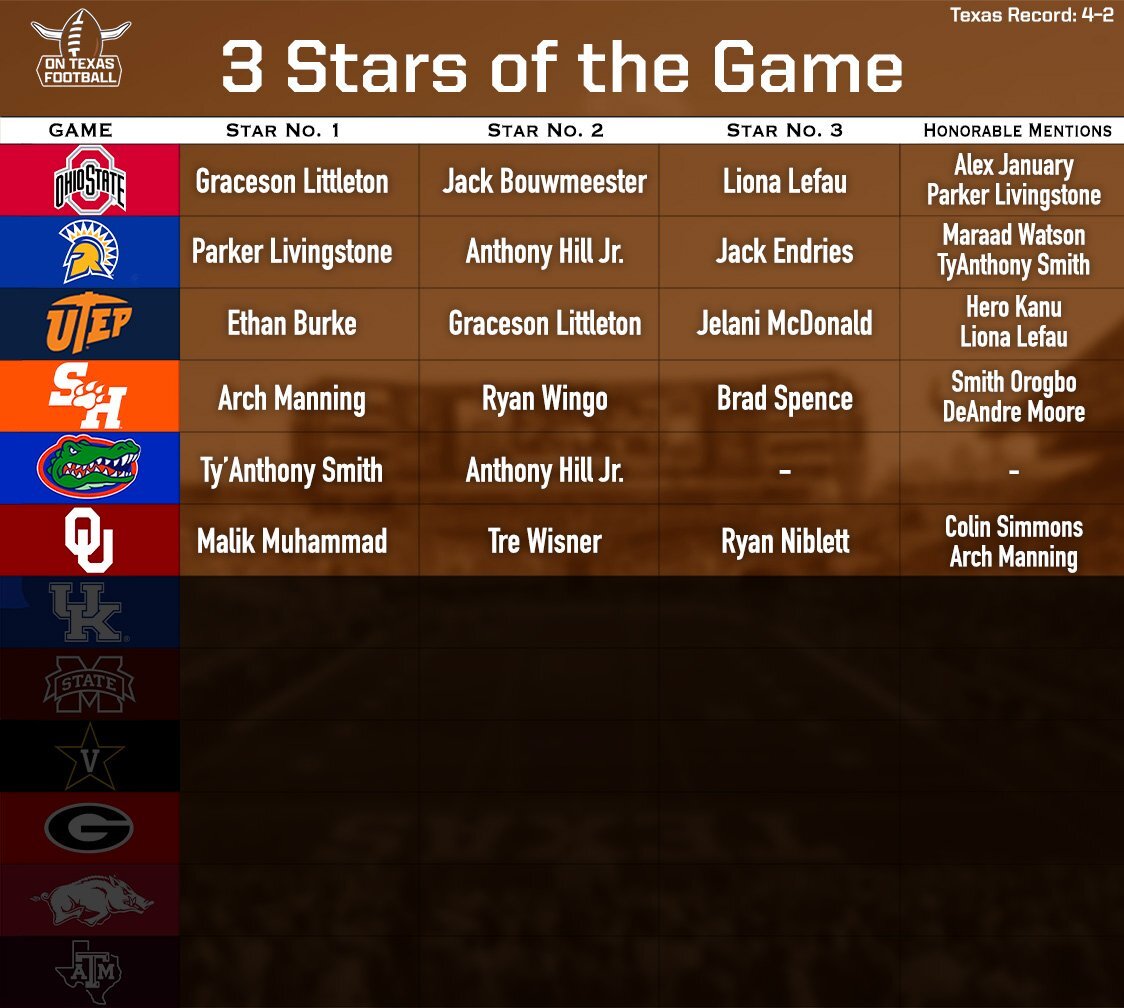
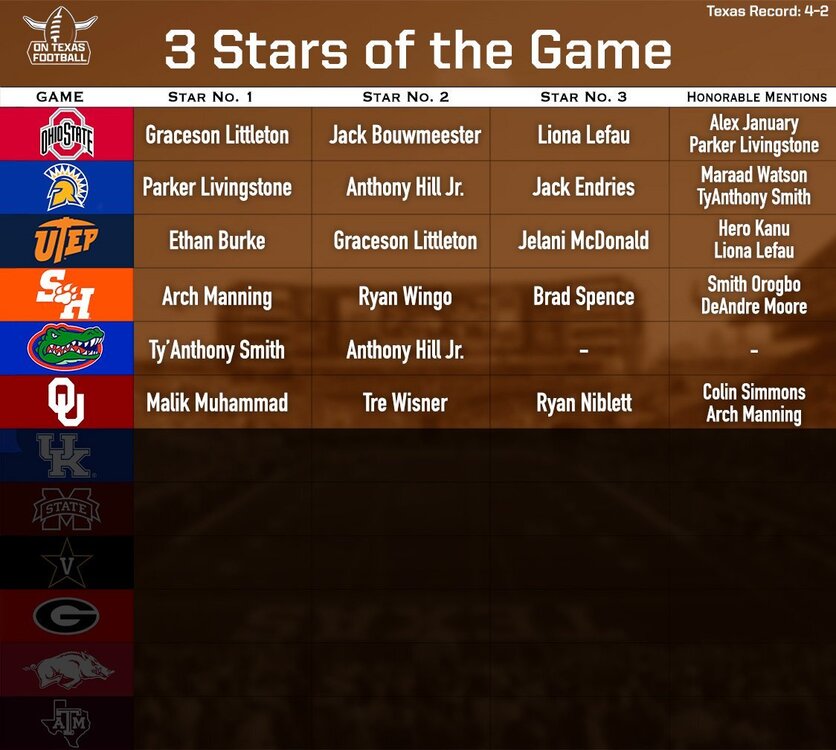
3 Stars of the Game following the Longhorns' 23–6 victory over the Sooners in Dallas. *** Star No. 1. – CB Malik Muhammad What a return to the field it was for Malik Muhammad on Saturday. The two interceptions were clearly the headline, but Muhammad was nails otherwise. Muhammad added another pass breakup and a tackle for loss to his tally on the afternoon. We talk about players taking the jump in their contract year, well, Muhammad is doing exactly that. We saw how the perception of a true CB1 can help the Texas defense a year ago, hopefully it will do the same in 2025 with Muhammad moving forward. Star No. 2 – RB Quintrevion Wisner Something about playing against the big rivals that turns Wisner into an all-world running back. Baxter is 3-3 as a starting running back eclipsing 100 yards from scrimmage against Oklahoma and Texas A&M in his career, and his effort on Saturday was desperately needed. The Longhorns found a solid bit of rhythm with the outside zone game and Wisner's vision and patience was tremendous. Five receptions for 34 yards as well. Star No. 3 – PR Ryan Niblett A moment that will be replayed time and time again in this series moving forward put the exclamation point on this football game for the Texas Longhorns. What a moment for Ryan Niblett, what a moment for Jeff Banks' unit and what a moment for the Longhorns and their fans on Saturday. HM1 Colin Simmons: 2.5 sacks, and a career high number of sacks, Simmons has quietly put together a very solid season through the first half of the year. HM2 Arch Manning: The box score isn't the prettiest, only 166 pass yards, but Arch was nails on 3rd downs and tremendous throwing under pressure. How about being pressured 25 times and taking just one sack. He is growing up right before our eyes.
-
A new 2026 name on the radar One of the 2026 prospects on hand in Dallas for the Texas 23-6 win over Oklahoma was Dylan Waters (Missouri City, Texas/Marshall). The 6-foot-1, 175-pound cornerback is putting together a very impressive senior campaign for the Buffaloes on both sides of the ball. Waters committed to Utah over UCLA June 24 after making official visits to both. Texas cornerbacks coach Mark Orphey stopped by Marshall High prior to the Longhorns flying out to Florida to watch Waters up close in a practice. Since that time, Orphey has been in touch with the circle of Waters in the last week or so. While an offer hasn't been extended to this point, this is a prospect Texas is making an extended senior eval on.
-
Brent Venables is keeping the availability of Oklahoma quarterback John Mateer for Saturday’s Red River Shootout under wraps. When asked on Wednesday’s SEC coaches teleconference about how the No. 6 Sooners planned to list Mateer’s status on the conference’s official injury report, Venables indicated he won’t release anything other than what the league requires coaches to divulge. “That’ll come out tonight and everybody will get it at the same time,” Venables said. Whether it’s Mateer or Michael Hawkins Jr. behind center at the Cotton Bowl, the Texas defense should hit the field hellbent on proving its run-stopping capabilities are greater than how the Longhorns held up in last Saturday’s 29-21 loss to Florida. While the Gators’ final line on the ground (159 yards on 37 carries) isn’t a glaring sign of a leaky run defense on its own, the way Texas (3-2, 0-1 SEC) was gashed in the first half was alarming. After six consecutive games (dating back to last season’s Cotton Bowl loss to Ohio State) in which Pete Kwiatkowski’s defense held its opponents to under 100 net rushing yards, Florida ran roughshod over the Longhorns in the first quarter, tallying 94 yards on an average of 6.7 yards per attempt. “No reason,” linebacker Liona Lefau said on Monday when asked why the Texas defense stumbled out of the blocks in Gainesville. “We just need to do a better job of coming out and playing the best defense that we know we're capable of doing.” While Steve Sarkisian searches for ways to get the Longhorn rushing attack untracked after a forgettable SEC opener (52 net yards on 26 official attempts, including just 16 yards on 11 carries by the running backs), the defense must do its part to help Texas win the line of scrimmage battle against Oklahoma (5-0, 1-0). In the Red River Shootout, winning in the trenches is the best way to ensure a win on the scoreboard when the dust settles. The team that won the rushing yardage battle has won all but three of the last 28 meetings between the Longhorns and Sooners, including Sarkisian’s four Red River games. Texas won the rushing yardage battle decisively en route to a 49-0 rout in 2022 (296-156) and in last season’s 34-3 victory (177-89). On the flip side, Oklahoma’s 55-48 comeback win in 2021 saw the Sooners finish with a plus-211-yard advantage on the ground, while Venables’ team out-rushed Sarkisian's squad by 45 yards (201-156) in a 34-30 Longhorn loss in 2023. Although the Texas running game is reeling, Oklahoma heads into Saturday’s bout with one of the least productive rushing attacks in the SEC. The Sooners are 12th in the conference in rushing yards per game (137.2), 14th in yards per attempt (3.79) and 11th in runs that have gained at least 10 yards (23). With that said, rushing yards from the quarterback position have arguably been the difference in Sarkisian’s two losses to Oklahoma. A 66-yard touchdown run by Caleb Williams ignited his team’s furious rally in 2021, and two years later, Dillion Gabriel’s 113 yards rushing (especially his pulling the ball down and running for big yardage on the Sooners’ game-winning drive) played one of the biggest roles in the outcomes. Whether Mateer is back or Hawkins is called upon to start in Dallas for the second consecutive season, the Longhorn defense knows the path to victory includes minimizing the damage that the quarterback runs (designed runs and scrambles) in Ben Arbuckle’s offense can cause. “We’ve played Hawkins, we haven’t played Mateer, but we kind of have the same scheme for both of them,” linebacker Anthony Hill Jr. said on Monday. “It's going to be interesting to see what plays out throughout the week and get ready for the game.”
-
To what extent Texas can pull the nose up and salvage the 2025 season, which is trending in the wrong direction after last Saturday’s 29-21 road loss to Florida, will depend on what the Longhorns do against No. 6 Oklahoma in the Red River Shootout at the Cotton Bowl on Saturday (2:30 p.m., ABC). A win over the Sooners would position Steve Sarkisian’s squad for a strong finish to the October portion of the schedule, played entirely away from Royal-Texas Memorial Stadium. A loss would be the second in conference play for Texas (3-2, 0-1 SEC) and, with three opponents currently ranked in the Associated Press Top 25 left on the schedule other than Oklahoma (5-0, 1-0), it likely wouldn’t be the Longhorns’ last. Amid the preseason hype that engulfed the program, along with Brent Venables coming off his second losing season among the three in which he’s led the Sooners, Sarkisian’s fifth Texas-OU game seemed like an ideal time for the Longhorns to enjoy a long-overdue run of success against Oklahoma. Sarkisian’s 2-2 record against the Sooners includes two of the most lopsided Texas wins in the history of the series (a 49-0 rout in 2022 and last season’s 34-3 romp) and a pair of last-second losses that were there for the taking. Oklahoma’s current run of dominance over the Longhorns is one of the longest in the history of the series. The Sooners have won 11 of the last 16, including 10 of 15 with the Golden Hat on the line. Beyond how a win over Oklahoma would boost Texas going into the second half of the regular season, changing their Red River fortunes is key to the Longhorns getting over the hump and closer to winning a national championship under Sarkisian. Since Darrell Royal took over the program in 1957, no Texas coach has won a national championship or led the Longhorns to a championship game without simultaneously rattling off a series of wins over the Sooners. A win on Saturday would be the program’s third over Oklahoma in four years. That would be the best stretch of success against the Sooners since Mack Brown’s teams won four of five meetings (2005-09). Brown’s run, which came on the heels of a five-game losing streak to Bob Stoops, included wins in 2005 and 2009. Texas bookended the four seasons with a national championship and a trip to the BCS title game, along with a memorable series win during the 2008 season, one in which the Longhorns were arguably the best team in the country. While leading Texas to undefeated regular seasons in 1977 and 1983, Fred Akers won five of his first seven head-to-head meetings against Barry Switzer’s Oklahoma program. Royal, a Sooner standout for Bud Wilkinson, took over the Longhorns at a time when his mentor had won nine Red River Shootouts over 10 seasons (1948-57), including a victory in Royal’s Red River coaching debut. After the 1957 loss, however, Royal won 12 of the next 13 games against Oklahoma, including wins over the Sooners in each of his three national championship-winning seasons (1963, 1969 and 1970). Given the state of where Texas is coming off the humbling loss to the Gators, and considering the decade-plus of dominance the Sooners have enjoyed against the Longhorns, there would be no better time than Saturday to take a big step toward rectifying an Oklahoma problem that’s existed for far too long.
-
As Saturday’s 29-21 loss to Florida unfolded, it became clear that Texas has significant issues. Some of those issues can be fixed over the seven remaining games on the regular-season schedule, but others will require changes after the season. Still, Saturday’s loss to the Gators came down to the Longhorns losing the line of scrimmage battle in a landslide. From the jump, Florida (2-3, 1-2 SEC) punched Texas (3-2, 0-1) in the mouth up front and never let up. The Gators finished the game with six sacks and seven tackles for loss. While the Longhorn offensive line might not be solely responsible for each of those negative plays, the fact that the Texas running backs ran for 15 yards on 11 carries on a day when the running game tallied 52 net yards on 26 official attempts is a direct reflection of how the offense was soundly defeated at the point of attack. *** Nick Brooks briefly replaced Connor Stroh at left guard in the first half. The true freshman started the second half next to Trevor Goosby, with Steve Sarkisian and Kyle Flood searching for an answer to help generate a push. Although he was flagged for consecutive false starts on a fourth-quarter drive, I could see Sarkisian and Flood giving Brooks another shot. Whether Brooks is in the starting lineup against Oklahoma or not, Saturday’s performance made it clear that the starting offensive line mix — as it was through the first five games of the season — isn’t the answer to getting the offense untracked. *** Offensively, everything Texas couldn’t afford to have happen did. Unable to establish the run, the Longhorns had to put the fate of the offense on Arch Manning’s shoulders. The result was a mixed bag, with Manning (16-for-29, 263 yards, two touchdowns and two interceptions; 37 net yards on 15 official rushing attempts) making his share of plays to keep Texas in the game, along with a few turnovers and a final possession of regulation he’d like to have back. Operating a one-dimensional offense, moving the ball came down to Manning’s ability to make a play. It’ll require a more nuanced evaluation to determine if the mistakes down the stretch were things to worry about or a case of a quarterback trying to make the best of a bad situation. Manning did enough positive things to believe he can truly trend upward in the not-too-distant future. Still, he’s not at a point of elevating everyone around him to the point where he can mask the offense’s deficiencies. *** It doesn’t seem right that I’ve gotten this far into writing my postgame thoughts without talking about the defense. It was disappointing that things played out for the offense the way they did, but it wasn’t a total surprise. I, however, was flabbergasted at how Florida gashed Texas on the ground (159 yards, 4.3 yards per attempt), negated the Longhorn pass rush and gave DJ Lagway (21-for-28, 298 yards, two touchdowns and one interception) enough time to hit six explosive plays (15 or more yards gained through the air). Coming into the game, Texas allowed five rushing attempts to gain 10 or more yards. The Gators had five double-digit-yard runs in the first half (only 13 through their first four games). Only Auburn had fewer 20-yard gains through the air than Florida (10) before Saturday’s game. Lagway connected on four such plays against a Longhorn defense that allowed only six through four games. Jadan Baugh (107 yards and a rushing touchdown on 28 carries) and Dallas Wilson (111 yards and two touchdowns on six catches) made the kinds of plays the Longhorn skill players didn't or couldn't come up with on Saturday. *** The 2021 Iowa State game (a 30-7 loss) is the last loss I can remember Texas suffering in which it lost the line-of-scrimmage battle as it did in the Swamp. You’d have to go back to the Arkansas game that same season to find the last time a Sarkisian-coached Longhorn squad was bullied to the extent the Gators pushed Texas around from start to finish. *** There’s a lot more to digest from the loss than these time-constrained thoughts. Still, the following must be said: Talk of the SEC Championship Game or the College Football Playoff, at this point, is pointless. This is beyond a play-calling issue or a few personnel fixes for this team to become what it hoped to grow into by season's end. Against a desperate team, coming off a bye and knowing the kind of road environment they’d be going into, the Longhorns lost a game in which they were soundly defeated in all three phases. Considering the circumstances, and with Texas still unable to play disciplined (10 penalties for 70 yards) and/or complementary football, an argument can be made that this was the worst loss of Sarkisian’s tenure. While I have recently given Sarkisian credit for not suffering a head-scratching loss, my trust in the staff to avoid an unnecessary toe stub the rest of the way must be rebuilt after Saturday. The Longhorns can still be a good team. But Saturday’s performance didn’t inspire any confidence that Texas can turn the corner any time soon.
-
DJ Lagway had the 4th shortest time to throw rate in the country for week six quarterbacks. The average time from snap to release of the football took just 2.32 seconds. As a result, the Texas pass rush was able to generate a season low six pressures on the quarterback. Four of which coming from Colin Simmons. The Longhorns did not sack the quarterback for the second time this season, both of which occurring in losses. Lagway was 15-16 on passes under ten yards downfield for 109 yards and most importantly, zero passes were put in harms way. *** I guess my biggest question to this is, after two weeks of game planning for a team that was the very worst in the country in attempting and completing deep shots, what did you expect was going to happen in this game?
-
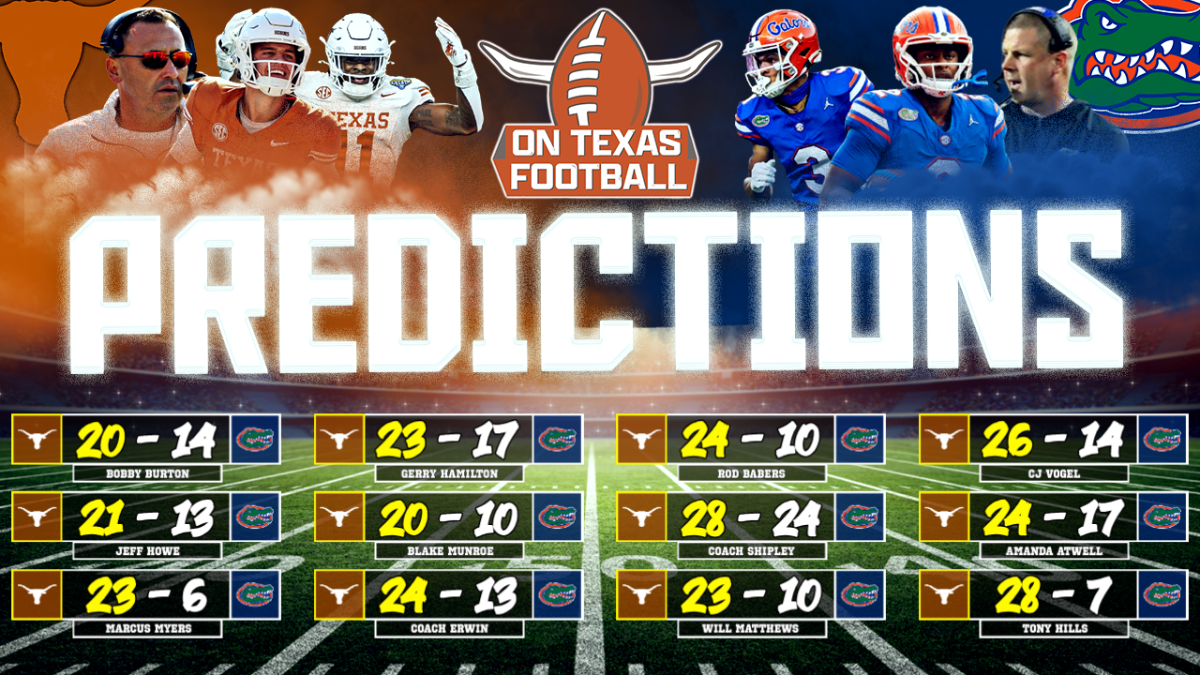
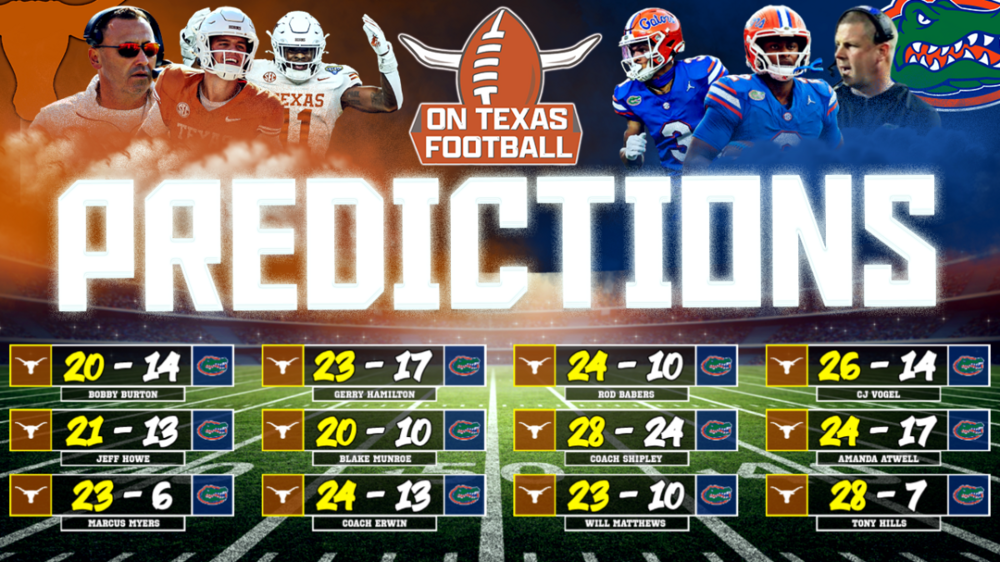
The OTF staff has finalized their score predictions for the Texas-Florida meeting tomorrow afternoon in The Swamp!
-
Texas commitment injury update OnTexasFootball stopped by Shadow Creek High earlier this week to check on 4-star wide receiver commit Chris Stewart. Stewart was not at practice the day I stopped by. He was at a shoulder doctor getting looked at. The 6-foot, 175-pounder injured his shoulder in the season opener August 29, took a little time off, and came back against Manvel High September 19. Since that time, the injury has flared back up. The next few games are in doubt for the Houston area senior. No word on if a shoulder procedure will be needed, as of Thursday afternoon. Stewart has 14 receptions for 252 yards and a TD, plus two returns for TD's in parts of three games this season.
-
With Emmett Mosley V hopefully making his Texas debut on Saturday, when the ninth-ranked Longhorns travel to the Swamp to face Florida (2:30 p.m., ESPN), and the Gators expected to have true freshman Dallas Wilson available for the first time this season, Arch Manning and DJ Lagway could get some much-needed perimeter weaponry for their respective offenses. If Mosley and Wilson are on the field, the wide receivers might do more than beef up the Texas (3-1) and Florida (1-3, 0-1 SEC) passing games. Stressing the opposing defense enough to give the running game a boost could be the difference between winning and losing, especially if the weather gets sloppy and the ground attacks become more of a factor. Neither running game has set the world on fire through four games. Based on the raw yardage output, the Longhorns have been good, ranking 37th nationally and seventh in the SEC in rushing yards per game (202.8). Still, the team’s average yards per rushing attempt (4.89) is behind last season’s pace (5.01) with one quarter of the regular season in the books. Getting Quintrevion Wisner and potentially C.J. Baxter Jr. back will give Texas two proven commodities in the backfield. The return of either runner will take some of the running game burden away from Arch Manning, although his legs will likely continue to be a major part of Steve Sarkisian's game plan. Where Wisner and Baxter need to make an impact is their ability to maximize runs. That’s one way to bring some juice to a running game lacking explosiveness. Texas has 24 rushing attempts that have gone for 10 or more yards this season, which ranks ninth in the SEC. Alabama and Oklahoma are the only SEC clubs with fewer rushing attempts that have gained 20 or more yards than the Longhorns (three), none of which have come from running backs. Manning’s 20-yard touchdown run on a scramble against San Jose State and two big gains in the Sam Houston game by Ryan Wingo (32 yards on an end-around) and Matthew Caldwell (an option keeper for 50 yards) account for the offense’s three longest rushing attempts from scrimmage. Baxter had an 18-yard run against San Jose State, which is the longest by a Texas running back this season. With running backs Jaden Baugh and Ja’Kobi Jackson back from last season, along with four starting offensive linemen (preseason All-American Jake Slaughter and preseason All-SEC pick Austin Barber among them), Florida’s running game has the pieces to be arguably the best in the SEC. Instead, the Gators are averaging 123 yards per game, which is the third-worst in the conference and No. 106 in FBS. Florida averages less than four yards per rushing attempt (3.94) and, like Texas, hasn’t been able to lean on big plays on the ground. Alabama’s offense is the only SEC attack with fewer rushing attempts that have gained 10 or more yards than the Gators (13), who’ve matched the Longhorns’ three gains from scrimmage of 20 or more yards (a 27-yard run by Jackson in a road loss to Miami is the longest gain on the ground for Florida through four games). Whether either running game gets untracked on Saturday will be easier said than done. Texas is No. 3 nationally against the run (59.8 yards per game allowed), leads the SEC in yards per rushing attempt allowed (2.13), has held five consecutive opponents to under 100 yards rushing and has allowed only five rushing attempts to go for 10 or more yards. The Gators are a top-40 defense nationally against the run (111.3 yards per game and 3.37 yards per attempt allowed) with a Pro Football Focus team tackling grade of 85.7, which is the second-best in the SEC and ranks No. 6 in the country. While the Longhorns cruised to a win in last year’s meeting with Florida, with a 49-17 drubbing in Austin, Anthony Hill Jr. remembers the Gators rushing for 197 yards. Florida’s output was second to Arizona State’s 214-yard effort in the Peach Bowl for the most rushing yards allowed by the Texas defense in 2024. With Billy Napier’s offense returning a lot of the pieces the Longhorns saw last season, they're preparing for a fierce trench battle on Saturday. “We know the type of athletes they have,” Hill said on Monday. “We know who they recruit — we've probably lost some recruits to them — so we know they have the athletes. We're just going to go out there and play the best football we can.”
-
We will see an official statement tonight when Texas drops its injury availability report through the SEC, but wanted to drop some intel. RB Quintrevion Wisner has been moving well in practice I have learned. Wisner has not seen action since the season opener against Ohio State, but the expectation is he sees the field in a healthy amount come Saturday. As for RB CJ Baxter, there remains some room for increased usage coming off of his injury sustained against UTEP. I lean towards doubtful with the 3rd year running back, who would be playing in his home state this weekend. The injury report should give a deeper idea of what Baxter's availability will be, but as of Wednesday afternoon, I am not expecting a ton.
-
Texas and Clemson 4-star commit Dre Quinn OnTexasFootball can report that the Texas staff definitely remains in contact with 4-star+ EDGE and Clemson verbal Dre Quinn (Buford, Ga./High). Quinn was recently on a visit to Tennessee for the Georgia game. The Vols are a serious player. Quinn picked Clemson over Texas June 19, due in part to Texas having a loaded EDGE depth chart. We shall see if that thought process changes, but OTF feels comfortable saying the Texas staff would certainly entertain a flip of the 6-4, 230-pounder wanted to play for the Longhorns.
-
When the dust settles on Saturday’s SEC action, including a pair of top-25 showdowns — No. 13 Ole Miss hosts No. 4 LSU in Oxford and No. 5 Georgia welcomes No. 17 Alabama to Athens — everyone will get a better feel for the conference pecking order entering October. The good news for Texas, even with an open date on the schedule, is that more football must be played before clear-cut frontrunners for SEC Championship Game berths emerge. The Longhorns, who’ve spent 36 consecutive weeks ranked in the top 10 of the Associated Press Top 25, might not get another chance to prove themselves to the rest of the country as a championship-caliber squad until Nov. 15, which will mark their third meeting with Kirby Smart’s Bulldogs in 393 days. If Texas dispatches a reeling Florida squad in Gainesville next Saturday, upends an Oklahoma club without the services of John Mateer and gets through a run of games against Kentucky, Mississippi State and Vanderbilt unscathed, it won’t move the needle nationally. Still, even if the Longhorns get the Gators’ best shot, the Sooners get Mateer back from his recent hand surgery in time for the Red River Shootout and the Wildcats, Bulldogs and Commodores prove themselves to be more formidable foes than what they appear to be on paper, it shouldn’t matter to Steve Sarkisian or anyone else inside the Moncrief Complex. With all due respect to the team’s upcoming SEC opponents, Texas must continue to look within and focus on self-improvement. Failing to embody the “being enamored us” mantra that’s driven the Longhorns to 28 wins in their last 34 games would greatly enhance the odds of Texas slipping up before the team’s second bye week (Nov. 8). Last Saturday’s 55-0 win over Sam Houston didn’t put the Longhorns in the fast lane to Atlanta in and of itself. Nevertheless, there were enough positive things that happened in the game that, if built on properly, can form an identity Texas could ride into the College Football Playoff. Specifically, the split zone RPO, which is enhanced by Arch Manning’s running ability, has the makings to be the focal point of the offense’s identity in the red zone. Instead of waiting, hoping the offensive line gets to a point where it can consistently win in short-yardage situations, the split zone RPO gives Kyle Flood’s group much-needed margin for error. DeAndre Moore Jr.’s return from injury provided a huge lift for the offense last Saturday. How much higher is the offense’s ceiling when Moore, C.J. Baxter Jr., Quintrevion Wisner and Emmett Mosley V are a part of Sarkisian’s game plan? Then there’s Pete Kwiatkowski’s defense, which has held its last five opponents to under 100 yards rushing, including Ohio State twice. The Longhorns have forced six turnovers in their last three games. The takeaways were evenly split between fumble recoveries (three) and interceptions (three), proving the defense can dominate the ball in multiple ways. Even with Anthony Hill Jr. (16 tackles, one tackle for loss and two fumble recoveries) and Colin Simmons (six tackles, 1.5 tackles for loss, 1.5 sacks and three quarterback hurries) off to slow starts, Texas is holding opponents to an SEC-leading 3.58 yards per play (No. 5 nationally in total defense, allowing 211 yards per game). The Longhorns lead the conference in scoring defense (7.8 points per game allowed, which is No. 4 in FBS) and is among the top 10 nationally against the run, the pass and on third down. Texas can't do anything about the state in which their next five opponents arrive on game day. With that said, if the Longhorns handle their business and start to establish consistency, the last three games of the regular season will look a lot less daunting than they might appear, while positioning Texas for a finish befitting a team that benefitted from early-season growing pains.
-
At some point, opposing quarterbacks must stop picking on Jelani McDonald. According to Pro Football Focus, McDonald has been targeted 15 times in coverage through four games. That’s No. 1 among SEC safeties, and tied for 20th among FBS safeties, but McDonald has made teams pay for throwing in his direction. McDonald has allowed eight receptions for 76 yards (9.5 yards per reception). With two interceptions (PFF also has him down for one dropped interception), McDonald has held opposing quarterbacks to a paltry 28.1 NFL passer rating when targeting him. A dynamic athlete Texas recruited out of Waco Connally in the 2023 cycle, McDonald has thankfully found a position where he’s flourishing, quickly growing into one of the most impactful defensive backs in the SEC. “When we recruited him out of high school, we didn't really know what [position] we were going to play him,” Steve Sarkisian said after McDonald intercepted a pass and recorded a tackle for loss in last Saturday’s 55-0 win over Sam Houston. McDonald is targeted once every 7.2 coverage snaps, which ranks 14th among SEC safeties who’ve logged at least 20 coverage snaps, according to PFF. McDonald, whose 115 coverage snaps are the fifth-most by an SEC safety, has cushioned the blow the safety room absorbed when Andrew Mukuba’s eligibility expired at the end of the 2024 season. “He was playing high school quarterback and, initially, we thought he was going to be a linebacker. When he got here, we moved him to corner, then he found his way back at safety, so his development has been different,” Sarkisian said regarding McDonald’s development. “He's always been very physically gifted, but learning to play the game from that perspective is a little bit different when you've been an offensive type of player. But, to his credit, he's worked on his craft.” The Longhorns will face tougher challenges when the conference schedule begins next Saturday, when No. 10 Texas hits the road to face Florida (2:30 p.m., ABC). Still, with Michael Taaffe owning PFF's eighth-best coverage grade among SEC safeties (80.2), a top-tier safety tandem will go a long way toward the Longhorns developing into a championship-caliber pass defense, especially if McDonald continues his current upward trajectory. "Jelani has his physical ability, but now he's really tapping into the mental side of the game," Sarkisian said. "He's communicating at a high level, but his play-making ability is obviously elite. He's a great tackler — probably one of our best tacklers on our team. His ball skills are really good. I just think his confidence and who he's become as a leader, I think, has probably been the most impressive thing. This guy's a real leader on our team — he was a captain tonight — so I'm just really proud of all that he's done to get to this point in his career."
-
The Texas offense didn’t resolve all of its issues in last Saturday’s 55-0 win over Sam Houston. Still, getting DeAndre Moore Jr. back from injury went a long way toward helping the Longhorns cultivate an offensive identity heading into SEC play. A player that Steve Sarkisian said on Monday is “part of our personality,” Moore returned to action following an injury sustained during the team’s 38-7 win over San Jose State on Sept. 6, which caused him to miss the 27-10 win over UTEP on Sept. 13, with a five-catch, 79-yard effort in the victory, closing out the team's non-conference schedule with a bang. Moore's five receptions came on five targets, showing his value in the passing game by catching ball within each of the four passing depths tracked by Pro Football Focus: one catch for eight yards behind the line of scrimmage, two catches for 17 yards on short (0-9 yards down the field) passes, one catch for 16 yards on intermediate throws (10-19 yards) and a 38-yard catch on a deep (20 or more yards) ball from Arch Manning. Moore has a season-long PFF receiving grade of 72.6, which leads all Texas wideouts and ranks second to Emaree Winston (84.6) among all Longhorns on offense. Of Moore’s 13 targets, five have been behind the line of scrimmage (five catches for 18 yards, with 33 yards after the catch), three have been on short throws (26 yards on three receptions), four have come on intermediate throws (two receptions for 33 yards) and the deep shot against Sam Houston is the only time Moore has been targeted 20 or more yards down the field. Where Manning has struggled, and where Moore can help him evolve as a quarterback capable of attacking multiple levels of the field, is in the intermediate game. Before the Sam Houston game, Manning was 7-for-21 for 115 yards with a touchdown, two interceptions and two turnover-worthy plays (according to PFF, a TWP is a pass that has a high percentage chance to be intercepted or a poor job of taking care of the ball and fumbling) on intermediate throws. In the win over the Bearkats, Manning’s 16-yard connection with Moore was part of a 5-for-6, 77-yard night with a touchdown (a 13-yard RPO glance to Ryan Wingo) and no turnover-worthy plays. Along with the 16-yard catch, Moore was 21 yards down the field when Manning hit him for the 38-yarder, which was highlighted by Moore gaining 17 yards after the catch. “What DeAndre brings is our ability to work the middle of the field really well, and I think we saw that tonight,” Sarkisian said after the game. He highlighted Moore’s 16-yard catch, which came on third-and-9 on the offense’s first possession, a 12-play, 76-yard drive capped by Jerrick Gibson’s 13-yard touchdown run. Moore has turned 84.6 percent of his targets into receptions, which is a higher percentage than Parker Livingstone (73.3), Jack Endries (70) or Wingo (44.8) have turned in among Texas players who’ve been targeted at least 10 times. Along with the consistency Moore brings to the passing game, he upgraded the team’s perimeter blocking upon his return. In Monday’s film session with the team, Sarkisian said he celebrated the job Moore and Wingo did blocking on a bubble screen to spring Daylan McCutcheon for a 21-yard gain. For an offense in desperate need of confidence and energy entering the non-conference finale, Moore’s return came in the nick of time. The Longhorns got a much-needed shot in the arm before the SEC opener against Florida on Oct. 4, which Sarkisian expects to last beyond the Sam Houston game with Moore back on the field. “It's the confidence that DeAndre brings,” Sarkisian said after the game. “He's played a lot of football. This guy goes to practice with a great deal of energy, with a great deal of detail and he's hard on the guys around him about what they're supposed to do and how they're supposed to do it, whether he's in the play or not. “For DeAndre to be in practice all week, I think, kind of set the tone for what the expectation was.”
-
Yes, it was against a woeful Sam Houston squad. No, the Texas offense isn't ready to be considered a juggernaut. Nevertheless, piling up 607 total yards, averaging 8.8 yards per play and scoring on nine consecutive possessions in Saturday’s 55-0 win over the Bearkats was the perfect palate cleanser for the Longhorn offense ahead of SEC play. An offense that hasn’t been able to get out of its own way through the first three games of the season executed as expected against an overmatched opponent. For a team that’s had a hard time playing up to its lofty internal standard, Texas (3-1) annihilating Sam Houston (0-4) should allow everyone inside the Moncrief Complex to exhale, sleep well and turn the page to the team’s Oct. 4 trip to Florida with some much-needed confidence. — The offense will continue to dominate the conversation regarding the team’s chances to compete for the SEC title. What doesn’t need to get lost in the shuffle, however, is the dominant night enjoyed by Pete Kwiatkowski’s defense (113 total yards, 2.2 yards per play and 27 yards on the ground allowed). The Bearkats went three-and-out on their first five possessions and finished the game 2-for-15 on third down (0-for-2 on fourth down). The Longhorns recorded a season-high five sacks, with Colin Simmons notching his first full sack of the season on the opening drive of the game. Steve Sarkisian wanted Texas to win the turnover battle, which it did, 1-0. Although the offense’s turnover-free night is the most notable part of winning the turnover margin, Jelani McDonald’s leaping interception on a heave toward the end zone on the last play of the first half was one of the defense's many highlights throughout the night. Shutting someone out in college football, no matter the caliber of opponent, should be celebrated. — How do you bounce back from a performance in which you fired 10 consecutive incompletions? For Arch Manning, it was ending an 18-for-21, 309-yard night through the air (with three touchdowns and no interceptions) with 13 consecutive completions. Sandwiched between a 1-yard gain on a tight end screen pass to Jordan Washington were two touchdown connections with Ryan Wingo — a 53-yard bomb down the middle of the field (Manning dropped the throw into a bucket over Wingo’s shoulder) and a 13-yard strike on an RPO glance, a staple play in Sarkisian’s offense. He’s still getting a feel for the screen game, and he’ll find things on the tape he’ll wish he had back. Regardless, Manning put the ball where it needed to be more often than not, made plenty of plays with his legs (he stepped up to escape pressure on his 32-yard touchdown pass to Washington) and, hopefully, regained some of the confidence and swagger he didn’t play with in the first three games. — As Manning goes, so goes the Longhorn offense. He set the tone for the game with his boisterous reaction to a 5-yard touchdown run in the first quarter, after which Texas never looked back. — Manning and Wingo needed a game where they were on the same page. Wingo’s six targets turned into a four-catch, 93-yard performance, with a 32-yard gain on an end-around giving the sophomore a game-high 125 all-purpose yards. With that said, DeAndre Moore Jr.’s return made a huge difference from a personnel standpoint. Moore caught five passes for 79 yards after missing the UTEP game, serving as Manning’s go-to target on intermediate throws and providing the kind of perimeter blocking the Longhorns lacked in his absence. — Wingo’s big run and a 50-yard jaunt by Matthew Caldwell bolstered the running game’s final line (41 carries for 264 yards and four touchdowns, one each for Christian Clark and Jerrick Gibson). While five tackles for loss allowed contributed to seven rushing attempts going for no gain or a loss, the running backs averaged five yards per carry. Clark (62 yards on 13 carries), Gibson (11 carries for 53 yards) and James Simon (nine carries for 50 yards) each went over 50 yards on the night, showing varying levels of improvement from last week’s showing, one in which Texas was forced to lean on the ground attack. — The offensive line didn't overwhelm Sam Houston. Still, the Longhorns are gaining confidence in concepts (specifically, their pin-and-pull and outside zone runs) that can make for a serviceable running game. Just like Moore’s return gave the passing game a boost, Quintrevion Wisner’s ability to maximize runs as a proven commodity in the SEC should increase the offensive line’s margin for error. — Brad Spence, who came close to making several big plays against San Jose State and UTEP, was rewarded for his effort on Saturday, knifing into the backfield for a tackle for loss on a fourth-and-2 in the third quarter. — The biggest negative from the game? Nine penalties for 70 yards, including multiple pre-snap penalties on offense.
-
The focus regarding which phase of the game most needs to turn things around when No. 8 Texas faces Sam Houston at Royal-Texas Memorial Stadium on Saturday (7 p.m., ESPN+/SEC Network+) has centered around the Longhorn offense. Still, as good as the Texas defense has been through the first three games, Pete Kwiatkowski’s side of the ball could use a tune-up. Specifically, the last game before jumping into SEC play is an opportunity to improve the pass rush by putting heat on Bearkat quarterbacks Hunter Watson and Mabrey Mettauer. As far as Steve Sarkisian is concerned, the issue has more to do with the Longhorns adjusting to how opponents are trying to neutralize the impact Colin Simmons and the bevy of pass rushers Texas has on hand, rather than personnel deficiencies. “I think the ball came out Saturday, on average, 1.8 seconds,” Sarkisian said on Monday when he was asked about the pass rush, referencing the pressure the defense put on Malachi Nelson last Saturday in a 27-10 win over UTEP. “You can only get so far with somebody in front of you in 1.8 seconds. It's just difficult. “People are going to try to attack the holes in our game and they're going to try not to get exploited by the strengths that we have in our game. One of our strengths are our edges,” he added. “One of our strengths is our pass rush and the multitude of ways that we can get to a quarterback. We have to anticipate what they're going to do to try to combat that, and part of that is getting the ball out of their hands quickly. Part of that might be moving the pocket some.” The Longhorns came into the season with the tools to field arguably the fiercest pass rush in the country. While the Texas pass rush hasn’t been woeful, by any stretch, it hasn’t been as impactful as expected. With six sacks through three games, the Longhorns are tied with Missouri for ninth sacks in the SEC, which is good enough to be tied for No. 69 among FBS defenses. They’re in the same realm regarding pressures generated; Pro Football Focus has credited the Texas defense with 46 pressures, which is tied with Texas A&M for the seventh-most in the SEC. Skewing the numbers is the plan Ryan Day and Brian Hartline devised for Julian Sayin to execute in the season opener. In Ohio State’s 14-7 win, Sayin only dropped back to throw the ball 20 times, according to PFF, with the Longhorns pressuring him on just five of his dropbacks. There have been more opportunities to rush the passer in the team’s last two games, resulting in 39 total pressures and all of the defense’s sacks. Even though Nelson got the ball out quickly, Texas pressured him 11 on time 39 dropbacks, according to PFF, which almost equaled the number of times Nelson had been pressured through two games (Nelson was pressured on 12 of 56 dropbacks entering last week’s game). The Longhorns can have success building on the pressure they've generated, with conditions ripe to pin their ears back and get after the quarterback on Saturday. According to PFF’s pass blocking efficiency rankings for offensive lines, Sam Houston is tied for 108th nationally out of 136 FBS offensive lines. The Bearkats have allowed 33 pressures through three games under first-year coach Phil Longo; only nine FBS offenses have allowed more pressures than Sam Houston, according to PFF. Watson has been pressured on 38.2 percent of his dropbacks (26 of 68). Mettauer has been pressured 15 times on 48 dropbacks (31.3 percent), and his pressure-to-sack percentage (33.3) means one in every three pressures Sam Houston’s opponents have gotten against the Wisconsin transfer have made it home. Sarkisian believes the defense left upwards of three sacks on the field in the team’s 38-7 win over San Jose State on Sept. 7. For more fruitful returns on the pass-rushing opportunities Texas gets, Sarkisian has stressed to the defense the importance of maintaining their rush lane integrity and utilizing a disciplined pass rush. “Maybe it's not how many opportunities you get to get the quarterback on the ground, but making the most of the opportunities when you do get them,” Sarkisian said. “That's what we're trying to train our guys to do.”
-
The Texas offense’s inability to move the ball consistently and maximize scoring opportunities through three games is staggering. The Longhorns enter the non-conference finale at home against a 0-3 Sam Houston club on Saturday (7 p.m., SEC Network+), averaging 24 points per game and 5.39 yards per play. Steve Sarkisian’s fifth season running the program is off to the worst three-game start Texas has experienced on offense since 2014, when Shawn Watson’s unit averaged 20.7 points per game and 4.57 yards per play through the first three games of the Charlie Strong era. The reality of where the Longhorns are offensively, 18 days away from a trip to Florida for the SEC opener, is sobering. Injuries have sidelined Quintrevion Wisner, C.J. Baxter Jr., DeAndre Moore Jr. and Emmett Mosley V through the non-conference schedule, compounding the experience issues Sarkisian knew existed on offense, even if Arch Manning had a full complement of weapons around him. “I'm not naive to think we wouldn't have some growing pains,” Sarkisian said during his weekly news conference on Monday. “I just want those growing pains to... I want to get tall as fast as we can and feel good and start playing. That's the race that we're in. I'm comfortable in saying we're going to get there. I just want to get there sooner rather than later.” Manning has been under the gun publicly since he put up a clunker in last Saturday’s 27-10 win over UTEP, with an 11-for-25, 114-yard performance through the air. While he accounted for the offense’s three touchdowns (one passing and two rushing), the fifth start of Manning’s career was marred by a forgettable second quarter, one in which he went 2-for-12, including 10 consecutive incomplete passes, for 15 yards and an interception. When it comes to helping Manning get back on the right track, Sarkisian said he feels “good about the process that we're in right now,” adding that Manning “had a great practice this [Monday] morning.” “So many times, what happens is you can start looking at yourself, beating yourself up, focusing on yourself. Well, it's already hard enough. The other team is already trying to beat you up,” Sarkisian said. “The other team is already trying to knock you down, so let's not self-inflict wounds. “Let's take some of that frustration and anger out on them.” Nothing Sarkisian said throughout training camp foreshadowed the struggles the No. 1 team in the preseason Associated Press Top 25, a club whose players spoke openly about their national championship aspirations while being quarterbacked by the odds-on favorite for the Heisman Trophy, has experienced. Still, what he said roughly four minutes into his post-practice availability on Aug. 5 could be a massive red flag missed by virtually everyone with a pulse on the squad, especially since it might be the best way to describe the current state of the Texas offense. “One thing for us that I think, with players that are trying really hard, we have to learn to feel... we have to learn how to deal with disappointment a little bit better. What I mean by disappointment is not every play is going to go perfect,” Sarkisian said. “You might miss a block, you might not catch that ball, you might not get the yardage you thought you were going to get on the run, but you've got to get onto the next play. You’ve got to give the next play the credit it deserves because that next play has a life of its own. I think, right now, a little bit on offense, we're trying so hard that there's this level of disappointment, that we're carrying some of that to the next play and some of those mistakes are compounding on top of one another for certain players. We've got to improve upon that and, as a coach, once you can identify that, we can talk to that, we can coach to that, but I think that's something we can improve upon.” Even if Sarkisian, his assistant coaches and other staff members did everything they could to resolve the problem at the time, the Longhorns are still working through it on some level. This is a time when offensive leadership must step up. Unfortunately, the leaders on that side of the ball are on the mend physically (Cole Hutson is on the list of players whose health will be monitored leading up to Saturday’s game, along with Baxter, Moore and Wisner), aren’t playing up to their potential (along with Manning and Ryan Wingo’s struggles, D.J. Campbell has the second-most accepted penalties against him among FBS offensive linemen with five, according to Pro Football Focus) or are gaining the experience they need to maximize their leadership capabilities. The Longhorns won’t get out of their current predicament overnight. Sarkisian said on Monday that “leadership always starts with us as coaches." He remains confident that the offense will eventually get over the current dilemma. Nevertheless, with only one opportunity left to work on itself before entering the SEC portion of its schedule, Texas needs a heightened sense of urgency when analyzing and attacking its problems. “We want to see a well-oiled machine offensively, on special teams, on defense, playing our best football when our best is needed,” Sarkisian said. “We've got to get there as quickly as possible.”
-
A look at the Texas snap counts vs. Ohio State on Saturday. *** Defense Out of 59 defensive snaps. 59 – Jelani McDonald, Michael Taaffe 55 – Malik Muhammad 54 – Anthony Hill Jr. 45 – Jaylon Guilbeau 39 – Liona Lefau 37 – Ethan Burke, Hero Kanu, Trey Moore 35 – Colin Simmons 30 – Maraad Watson 26 – Alex January 24 – Cole Brevard 21 – Ty'Anthony Smith 19 – Travis Shaw, Graceson Littleton 16 – Kobe Black 12 – Derek Williams Jr. 7 – Lance Jackson 6 – Zina Umeozulu 5 – Brad Spence 4 – Colton Vasek 3 – Xavier Filsiame, Justus Terry Texas only deployed 24 players on the defensive side of the ball in the season opener, right where I expected them to be. I did not expect to see 37 snaps from Hero Kanu, leading the way for the interior defensive linemen. 19 snaps for Graceson Littleton is a number that rivals Colin Simmons vs. Michigan and Anthony Hill vs. Alabama, a great sign for the frosh. *** Offense Out of 67 offensive snaps. 67 – Ryan Wingo, Brandon Baker, Trevor Goosby, Arch Manning, DJ Campbell, Cole Hutson 65 – Parker Livingstone 60 – Jack Endries 56 – Connor Stroh 51 – DeAndre Moore 41 – Quintrevion Wisner 26 – CJ Baxter 19 – Spencer Shannon 11 – Neto Umeozulu 3 – Jordan Washington 2 – Daylan McCutcheon 1 – Nick Townsend Four tight ends saw time on the field. Only two running backs were on the field for the offense. With how often Texas was under center, I was surprised to not see any 2-back looks from Sarkisian.
-
The Texas offense is bad. I won’t declare it broken. I believe it can be repaired and that the Longhorns can put a product on the field capable of helping them win games in the SEC. But Steve Sarkisian’s offense regressed from a middle-of-the-road performance against San Jose State to a clunker in Saturday’s 27-10 win over UTEP. After three games, Texas is 12-for-42 on third down, 5-for-12 on fourth down and 8-for-13 in the red zone with six touchdowns, two field goals, two interceptions and three turnovers on downs. The Miners outperformed the Longhorns on first down (5.3 yards per play for UTEP to 4.5 for Texas), committed fewer penalties (six penalties for 34 yards for the Miners, while the Longhorns were docked 81 yards on seven penalties), got a more efficient day throwing the football from Malachi Nelson (24-for-36, 209 yards and two interceptions) than the one Texas got from Arch Manning (11-for-25, 114 yards, one touchdown and one interception) and averaged more yards per play (4.4 to 4.2 for the Longhorns). Scotty Walden and his staff deserve a lot of credit for showing up ready to play. UTEP wasn’t intimidated by Texas, came to town with a sound game plan and made the Longhorns work for 60 minutes. The 4.2 yards per play by the Texas offense marked the fifth-worst single-game output under Sarkisian. The only games in which the Longhorns have been worse under Sarkisian were losses to Arkansas (4.0 yards per play) and Iowa State (3.2) in 2021, TCU (3.3) in 2022 and last season's regular-season meeting with Georgia (3.4). The issues on offense exist beyond failing to play to a standard or the personnel Texas didn’t have (Quintrevion Wisner, DeAndre Moore Jr. and Emmett Mosley V were out and C.J. Baxter Jr.’s day was done after one carry). Sarkisian’s attack lacks an identity and whether it was Manning’s erratic afternoon (10 consecutive incompletions at one point), the times the offensive line lost the battle at the point of attack (the Miners didn’t record a sack, but they had five tackles for loss and 12 of the Longhorns’ 56 official rushing attempts either lost yards or went for no gain) or poor situational execution, the Texas offense found different ways to stumble throughout the day. The week leading up to the Sam Houston game next Saturday (7 p.m., SEC Network+) will be a time when Sarkisian must look in the mirror and determine a course of action on offense. The offense Sarkisian wants (and the one a lot of other people, myself included) isn’t one the Longhorns can have right now. With one non-conference game left, Sarkisian must take the information he’s gathered so far and try to build confidence across the board by building on what the offense can do well. It might mean that Manning runs the ball more than what Sarkisian initially expected (he ran for two touchdowns, and he and Matthew Caldwell had the longest runs from scrimmage on Saturday, both recording 14-yard gains). It could mean figuring out which portions of the short passing game can get Manning in a rhythm early in the game so that the defense doesn’t automatically play coverage to prevent the deep ball, rendering the passing game helpless, which is what it was for almost the entirety of the UTEP game. Sarkisian and Kyle Flood could examine personnel along the offensive line and try a different combination. Whatever answers Sarkisian comes up with, Texas can’t have a repeat performance of Saturday’s debacle the rest of the way. Even though the defense held up their end of the bargain (six tackles for loss, sacks by Hero Kanu and Zina Umeozulu and interceptions by Jelani McDonald and Graceson Littleton while holding the Miners to a 4-for-13 performance on third down and an 0-for-3 effort on fourth down) and the kicking game is showing signs of growth (Jack Bouwmeester got back on track with a 47.8-yard net punting average, Mason Shipley went 2-for-2 on field goals and Ryan Niblett had a 49-yard punt return), the offense is operating at a level so far below a championship standard that it’s hard to look beyond the next game on the schedule when envisioning the trajectory on that side of the ball.