






Search the Community
Showing results for tags 'OTF Premium'.
Found 748 results
-
With Texas set for its first preseason practice on Wednesday, there are four things on my mind. — Typically, when reports about live portions of practice come out from behind the burnt orange curtain, the defense is ahead of the offense. I’m preparing for that to be the case this month, especially given the time several key cogs in the offense missed during spring practice. A lot of that focus has rightfully gone to the offensive line, where Laurence Seymore will attempt to win the left guard job while playing between Trevor Goosby (who spent most of the spring recovering from shoulder surgery) and Connor Robertson. Beyond the left guard battle, however, camp will be a great opportunity for Goosby, Arch Manning and Ryan Wingo to knock the rust off while learning how to operate with the new pieces around them. It’s not like the offense is starting at a deficit because there's no substitute for the live snaps and overall experience that Goosby, Manning and Wingo have in Steve Sarkisian’s system. Still, with everybody healthy and ready to go, Sarkisian has a full slate of practices to ensure his offense is better prepared to step on the field than the unit was at this time last year, the importance of which can’t be overstated. I don’t know if anyone reading this can handle the offense trudging through any portion of the September schedule, let alone the first half of the season before finding its groove. — The competition to enter Sarkisian’s circle of trust at wide receiver and the battle between Michael Masunas and Spencer Shannon to be the No. 1 in-line tight end shouldn’t be overlooked. The same can be said for the running back pecking order, where not enough is being said about Derrek Cooper pushing Raleek Brown and Hollywood Smothers for playing time. Cooper’s stature (6-1, 212) is more in line with the type of bell-cow running back Sarkisian has typically preferred to see emerge. He drew rave reviews as a pass protector during spring practice and Cooper has the kind of physical running style and forward body lean that could be a key ingredient to resolving the offense’s long-running short-yardage and red-zone issues. The 2026 Texas ground attack could mirror what Sarkisian had at USC in 2007 and 2008, when he called plays for an offense that produced three running backs with 500 or more rushing yards in back-to-back seasons. Or Cooper could be the latest in a long line of Longhorn freshman running backs who grabbed the bull by the horns right out of the gate, leaving those outside the top three spots on the depth chart fighting tooth and nail for the remaining consequential snaps. — For all of the talk about a disruptive defensive line presence emerging to go along with Colin Simmons, a healthy Maraad Watson could go a long way toward solidifying the rotation and allowing Will Muschamp to get creative with how he utilizes an embarrassment of riches at EDGE. The 333-pound Watson worked with the nose tackles and with the tackle group in the spring. If he’s truly a 330-plus-pound defender who can play multiple shades, Watson would become one of Muschamp’s most valuable chess pieces. In theory, Watson could play next to Ian Geffrard when the situation calls for Texas to beef up the front. Watson could also be paired with Alex January and Hero Kanu on standard downs and then be lined up with Justus Terry and Muschamp’s plethora of edge defenders on more predictable passing downs. For me, Watson is in a group with Cooper, Terry, Brandon Baker, Jermaine Bishop Jr., Ty’Anthony Smith, Brad Spence and Bo Mascoe as players who can raise the Longhorns’ ceiling. — When the On Texas Football staff picked the player they were most excited to see in camp for our latest "Sideline Debate," I almost picked Xavier Filsaime. As good as Graceson Littleton was as a true freshman, I can’t get over Sarkisian going out of his way to mention Filsaime as a nickel candidate while addressing the Muschamp hire last December. While surgery after the Citrus Bowl had the 6-foot-1-inch, 193-pound Filsaime on the mend during spring practice, he fits the physical profile of the bigger-bodied nickel Muschamp has typically preferred. While I don’t think Muschamp will experiment with Littleton at safety (even though I think he’d thrive there in Muschamp’s scheme because of his instincts and ball skills), the idea of Littleton getting freed up to solidify an area of concern with Filsaime occupying the nickel role is intriguing, to say the least. Regardless, if Filsaime approached Muschamp’s arrival and the return of Blake Gideon to the Forty Acres like a man who has a new lease on life, he has a chance to remind people why several elite defensive back evaluators (Corey Raymond, Nick Saban and Brent Venables among them) thought so highly of him during the 2024 recruiting cycle.
-
With the Longhorns set to hit the field for the start of preseason practice next week, it’s time for On Texas Football to provide a pre-camp snapshot of the Texas depth chart. This is what we expect the depth chart to look like when the Longhorns open camp, not a projection of what it will look like when the first official depth chart is released for the Sept. 5 season opener against Texas State. The high school signees (including John Meredith III) and additional players picked up from the transfer portal who weren’t with the team for spring practice have been added to the depth chart, as they weren't included in our post-spring practice snapshot. According to Steve Sarkisian, Texas will enter camp with a healthy team. Except for offensive lineman Kaden Scherer, who suffered a serious knee injury early in spring practice, the players who missed all or parts of spring practice while recovering from surgery or injuries are on the depth chart. OFFENSE QUARTERBACK 1. (16) Arch Manning (6-4, 222, Jr.-2L) 2. (9) KJ Lacey (6-0, 188, RS-Fr.) 3. (19) MJ Morris (6-1, 201, Sr.-TR) 4. (6) Dia Bell (6-3, 206, Fr.-HS) RUNNING BACK 1. (0) Raleek Brown (5-9, 193, Sr.-TR) — OR — (2) Hollywood Smothers (5-11, 193, Jr.-TR) 2. (5) Derrek Cooper (6-1, 212, Fr.-HS) 3. (21) Ryan Niblett (5-9, 189, Jr.-1L) 4. (31) James Simon (5-11, 208, RS-Fr.) 5. (11) Michael Terry III (6-3, 229, RS-Fr.) 6. (28) Jett Walker (6-2, 224, Fr.-HS) WIDE RECEIVER (X) 1. (8) Cam Coleman (6-3, 204, Jr.-TR) 2. (18) Sterling Berkhalter (6-3, 196, Sr.-TR) — OR — (7) Kaliq Lockett (6-2, 181, RS-Fr.) WIDE RECEIVER (Z) 1. (1) Ryan Wingo (6-2, 214, Jr.-2L) 3. (13) Kohen Brown (6-0, 202, Fr.-HS) 4. (14) Chris Stewart (6-0, 184, Fr.-HS) WIDE RECEIVER (H) 1. (3) Emmett Mosley V (6-2, 199, Jr.-1L) 2. (4) Jermaine Bishop Jr. (6-0, 166, Fr.-HS) — OR — (17) Daylan McCutcheon (5-11, 183, Soph.-1L) TIGHT END (Y) 1. (15) Michael Masunas (6-5, 259, Sr.-TR) — OR — (83) Spencer Shannon (6-7, 260, Jr.-2L) 2. (88) Charlie Jilek (6-5, 238, Fr.-HS) TIGHT END (H) 1. (81) Nick Townsend (6-3, 250, Soph.-1L) 2. (85) Emaree Winston (6-1, 245, Soph.-1L) 3. (87) Will Randle (6-4, 249, Jr.-SQ) LEFT TACKLE 1. (74) Trevor Goosby (6-7, 325, Jr.-2L) 2. (78) Jordan Coleman (6-5, 356, RS-Fr.) 3. (51) John Turntine III (6-4, 295, Fr.-HS) LEFT GUARD 1. (75) Jaydon Chatman (6-4, 330, Jr.-2L) 2. (56) Dylan Sikorski (6-4, 335, Soph.-TR) 3. (50) Laurence Seymore (6-2, 316, Sr.-TR) 4. (76) Jackson Christian (6-5, 308, RS-Fr.) CENTER 1. (62) Connor Robertson (6-4, 316, Sr.-3L) 2. (76) Jackson Christian (6-5, 308, RS-Fr.) 3. (56) Dylan Sikorski (6-4, 335, Soph.-TR) RIGHT GUARD 1. (73) Brandon Baker (6-4, 315, Jr.-2L) 2. (58) Devin Coleman (6-5, 340, RS-Fr.) 3. (68) Paris Patterson Jr. (6-5, 354, Jr.-TR) 4. (72) Nicholas Robertson (6-3, 349, Fr.-HS) 5. (70) Kaden Scherer (6-6, 291, Fr.-HS) RIGHT TACKLE 1. (71) Melvin Siani (6-6, 317, Sr.-TR) 2. (77) Andre Cojoe (6-6, 339, Soph.-1L) 3. (79) Jonte Newman (6-4, 310, RSFr.-TR) DEFENSE NOSE TACKLE 1. (95) Ian Geffrard (6-5, 375, Sr.-TR) 2. (88) Maraad Watson (6-3, 333, Jr.-1L) 3. (90) Josiah Sharma (6-4, 341, RS-Fr.) 4. (96) Zion Williams (6-4, 370, RSFr.-TR) DEFENSIVE TACKLE 1. (93) Hero Kanu (6-5, 309, Sr.-1L) 2. (15) Justus Terry (6-5, 289, Soph.-1L) 3. (52) James Johnson (6-3, 279, Fr.-HS) 4. (55) Elijah Ali (6-4, 306, Fr.-HS) DEFENSIVE TACKLE 1. (97) Alex January (6-5, 308, Jr.-2L) 2. (33) Myron Charles (6-4, 312, RS-Fr.) JACK 1. (1) Colin Simmons (6-3, 246, Jr.-2L) 2. (92) Colton Vasek (6-5, 252, Jr.-2L) 3. (46) Smith Orogbo (6-4, 238, RS-Fr.) — OR — (99) Richard Wesley (6-4, 258, Fr.-HS)\ 4. (80) Brinley Tita (6-4, 252, Fr.-HS) END 1. (40) Lance Jackson (6-5, 274, Soph.-1L) 2. (19) Zina Umeozulu (6-5, 272, Soph.-1L) 3. (94) Jamarion Carlton (6-5, 280, Fr.-HS) WLB 1. (3) Rasheem Biles (6-1, 222, Sr.-TR) 2. (30) Rocky Cummings (6-4, 227, Fr.-HS) 3. (37) Jonathan Cunningham (6-2, 198, RS-Fr.) — OR — (45) Darius Snow (6-1, 219, Sr.-TR) SLB 1. (14) Brad Spence (6-2, 249, Sr.-1L) 2. (18) Kosi Okpala (6-3, 235, Fr.-HS) MLB 1. (26) Ty’Anthony Smith (6-1, 214, Jr.-2L) 2. (28) Justin Cryer (6-1, 241, Sr.-TR) 3. (16) Tyler Atkinson (6-1, 219, Fr.-HS) 4. (44) Markus Boswell (6-1, 228, Soph.-TR) NICKEL 1. (29) Graceson Littleton (6-0, 182, Soph.-1L) 2. (27) Wardell Mack (6-0, 183, Soph.-1L) — OR — (17) Xavier Filsaime (6-1, 193, Jr.-2L) CORNERBACK 1. (6) Kobe Black (6-2, 202, Jr.-2L) — OR — (8) Kade Phillips (6-0, 191, Soph.-1L) 2. (21) Hayward Howard Jr. (6-2, 182, Fr.-HS) 3. John Meredith III (Fr.-HS) CORNERBACK 1. (5) Bo Mascoe (5-11, 199, Sr.-TR) 2. (24) Warren Roberson (6-0, 189, Jr.-2L) 3. (11) Samari Matthews (6-1, 197, Fr.-HS) 4. (36) Nick Hudson (5-10, 179, Sr.-TR) FREE SAFETY 1. (4) Jelani McDonald (6-2, 210, Sr.-3L) 2. (23) Jordon Johnson-Rubell (5-10, 212, Jr.-2L) 3. (25) Toray Davis (6-1, 197, Fr.-HS) 4. (13) Zelus Hicks (6-2, 183, RS-Fr.) STRONG SAFETY 1. (2) Derek Williams Jr. (6-2, 199, Jr.-2L) 2. (17) Xavier Filsaime (6-1, 193, Jr.-2L) 3. (6) Kobe Black (6-2, 202, Jr.-2L) — OR — (37) Jonathan Cunningham (6-2, 198, RS-Fr.) 4. (9) Jonah Williams (6-3, 210, Soph.-1L) 5. (31) Yaheim Riley (5-11, 187, Fr.-HS) PUNTER 1. (43) Mac Chuimento (6-4, 228, Sr.-TR) 2. (45) Mikey Bukauskus (6-2, 210, Fr.-HS) KICKER 1. (44) Gianni Spetic (6-3, 221, Sr.-TR) 2. (46) Spencer Barnett (6-0, 215, Soph.-1L) 3. (49) Jake Collett (6-0, 182, Fr.-HS) PUNT RETURN 1. (21) Ryan Niblett (5-9, 189, Jr.-1L) 2. (0) Raleek Brown (5-9, 193, Sr.-TR) 3. (17) Daylan McCutcheon (5-11, 183, Soph.-1L) KICKOFF RETURN 1. (0) Raleek Brown (5-9, 193, Sr.-TR) — AND — (4) Jermaine Bishop Jr. (6-0, 166, Fr.-HS) 2. (5) Derrek Cooper (6-1, 212, Fr.-HS) — AND — (11) Michael Terry III (6-3, 229, RS-Fr.)
-
Friday Team notes: WR OnTexasFootball checked in with a couple of sources in the last half of the week on the wide receiver position. One source said the group looked "phenomenal" in the last few workouts. OTF has reported on Emmett Mosley V has looked very good this summer. That was relayed to OTF this week again. A source said the 6-2, 200-pound junior has had the look of a wide receiver that would be a No. 1 at many Power 4 schools the last part of the summer. OTF has mentioned that there is a thought Mosley V could lead the team in receptions this season. That was reiterated this week as a possibility. There is also a belief within the program that Mosley V could be a big ascender in the 2027 NFL draft with a healthy season. The last part is they key, obviously. The toughest task for Steve Sarkisian and the offensive staff this season will be getting the backups, or WR No. 4 and 5, reps if Cam Coleman, Ryan Wingo and Emmett Mosley V are healthy and play at the level expected. And to add, Sterling Berkhalter, Daylan McCutcheon and Kaliq Lockett have a freshman Jermaine Bishop Jr. that is very likely to take reps as the season moves along. All three have enjoyed strong summers. As Rod Babers always talks about on OTF shows, Sarkisian has a small circle at the position that play in games. This season will test how many WR's can be included in the "circle of trust", and just as important how many reps are there playing this 2026 schedule. The source said the entire room has been very impressive the last half of the summer. OTF will also reiterate that Chris Stewart came up again as a player that is doing all the right things, and is showing the signs he has the chance to be a quality player. His attention to detail as a route runner have stood out. Kohen Brown's work ethic, strength and speed was mentioned once again.
-
Over the course of the next month, I wanted to check in on a few members of the 2026 Texas rookie class in the NFL. Today, the focus is on Baltimore Ravens EDGE rusher Ethan Burke, who found his new home out on the east coast quickly after going undrafted in April. Burke was born in Baltimore and still has family in the Maryland area, not to mention he was originally committed to the Terps to play lacrosse before opting for a football career at Texas. As a result, he a strong support system in place as he tries to crack the 53-man roster as an undrafted free agent. One of the largest developments for Burkes was dropping about 11 pounds from his final snaps at Texas to now. OTF was told he is right around 265 pounds and was listed at 267 on the Ravens' camp roster. A source said Burke is moving at his absolute best since beginning his football-only career. He is stronger and moving better than ever before. From what I understand, a lot of the focus following the season was to fixate completely on physical adjustments. First, getting completely healthy and two, slimming down as he embarks on his professional career. A writer from SBNation's Baltimore Beatdown noted Burke was pressuring Lamar Jackson throughout the day during practice Thursday morning. Hope to keep you all updated on what's ahead for Burke and plenty of other Texas rookies as training camp heats up and preseason games begin. Feels good to talk about football!
-
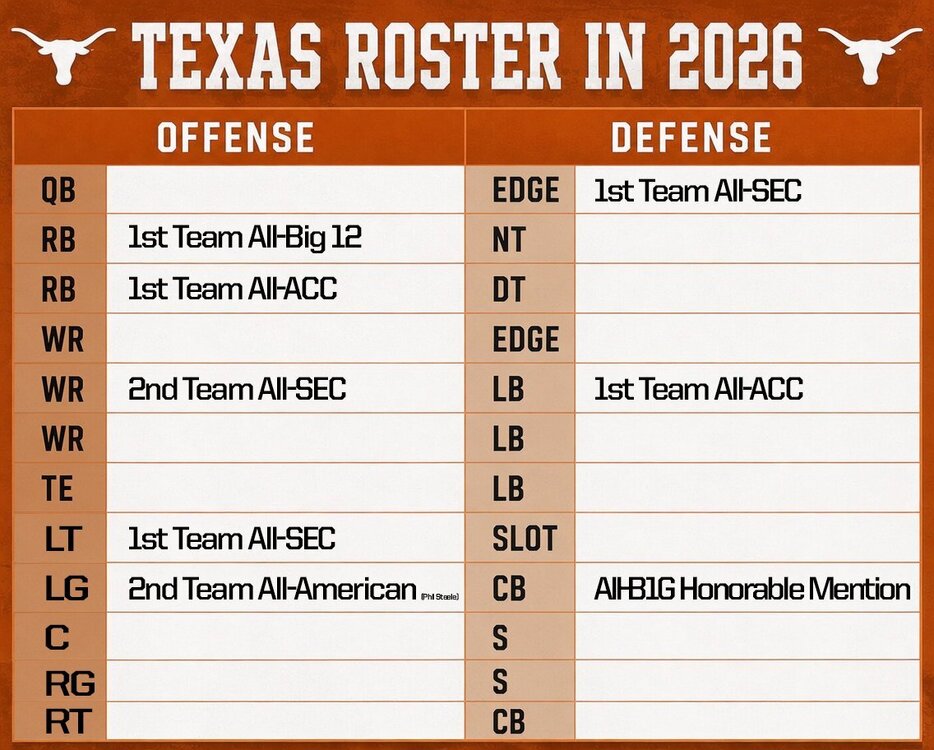
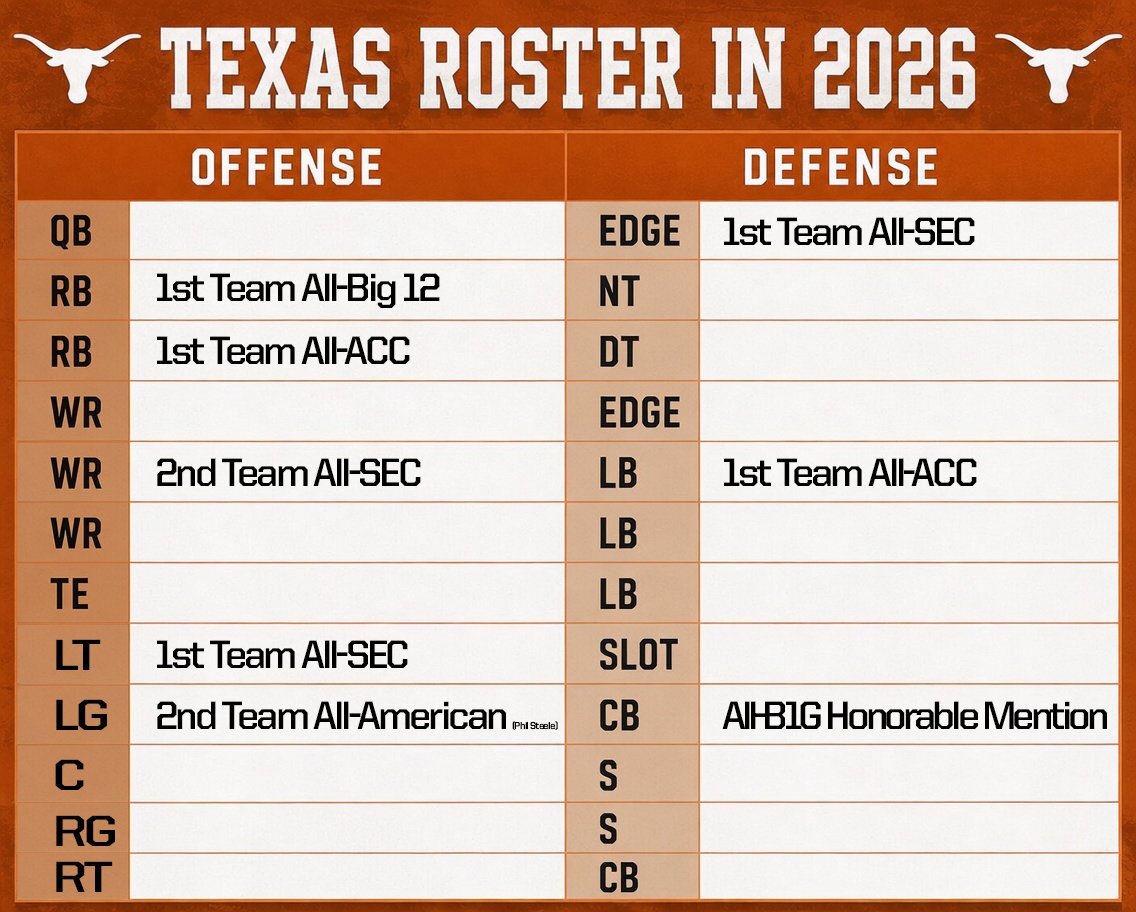
Steve Sarkisian often touts how much he loves the pageantry of college football. The best example supporting Sarkisian’s position is how seriously the Texas head coach takes the program’s rivalry games. For Sarkisian, it’s not just another game whenever the Longhorns line up against Oklahoma or Texas A&M. At SEC Media Days in Tampa, Sarkisian didn’t mince words when he was asked what it’ll be like to face former Texas wideout Parker Livingstone whenever the Longhorns and Sooners meet in Dallas on Oct. 10. At the end of the day, Sarkisian said, personal feelings get put to the side when the Golden Hat is on the line. “I hope we kick his ass,” Sarkisian said. “I mean, it’s the Red River Rivalry. You know what I mean? He chose to go there. He’s on the other side. That’s the way the game goes. “At the end of the day, it’s competition,” he added. “After the game, I’m sure I’ll give him a big hug. Before that, we’re trying to beat his ass. That’s the way it goes.” The recently-revived series with the Aggies is no different. Even Sarkisian’s admission that he “was not happy” that the Royal-Texas Memorial Stadium in-game operations staff played a clip of Mike Elko referring to Texas A&M as the state’s flagship program on the video board after Texas secured a 27-17 victory last November shed light on what’s allowed Sarkisian to enter his sixth season on the Forty Acres with a combined 5-2 record against the program’s two primary rivals. “Emotions run high in those games,” said Sarkisian, who put the kibosh on a potentially volatile on-field celebration after the Longhorns’ 17-7 win over the Aggies at Kyle Field in 2024, which had the potential to get out of hand. “We had a team that was trying to think about going and planting the flag two years ago and I wouldn't let that happen. I respect the game of football and I respect college football and I respect the football gods and there's a way to go about our business and there's a way not. Rivalries are great, but we've got to be able to fight the emotions that come with the rivalry.” With all due respect to Arkansas, who the Longhorns have faced just eight times since the Razorbacks left the Southwest Conference for the SEC in 1992, Sarkisian and other Texas coaches are judged by what they do against Oklahoma and Texas A&M, for better or worse. While Sarkisian hasn’t been perfect in his tenure, he’s more often than not had his squad ready for the games that matter to the burnt orange faithful. Sarkisian has won three of his first five meetings with the Sooners, with two losses that were there for the taking. The Longhorns had a 21-point first-half lead in Sarkisian’s Red River debut and took an 11-point lead into the fourth quarter before suffering a 55-48 loss; Texas also had a 30-27 lead with 1:17 to play in the 2023 game, which Oklahoma won on a last-second touchdown, 34-30. Even with the two losses, Sarkisian’s 3-2 record is only topped by Darrell Royal and Fred Akers for the best five-game start to the Red River series among the nine Longhorn coaches in the AP Poll era (since 1936) who’ve coached at least five games in the series. Royal and Akers both won four of their first five games against the Sooners; Akers won five of his first seven (5-4-1 overall record), while Royal won eight in a row (1958-65) and 12 of 13 (1958-70) en route to a 12-7-1 mark against his alma mater. Sarkisian's three wins in Texas' last four clashes with the Sooners ended Oklahoma's dominant stretch of 10 wins in 13 meetings. The Longhorns' historic 49-0 rout in 2022 is the largest shutout victory in series history and is part of Texas' 136-43 scoring advantage in the last four games, three of which the Sooners have failed to score a touchdown. Among the nine Longhorn coaches in the AP Poll era to coach at least two games against the Aggies, Sarkisian, Royal and Akers are the only three to enjoy a 2-0 series start. Nobody should expect Sarkisian to rival Royal’s 17-3 mark against Texas A&M, which included winning streaks of 10 (1957-66) and seven (1968-74) games, respectively. Nevertheless, Sarkisian has a good start in potentially joining Royal, Mack Brown (10-4), Ed Price (4-2) and Dana X. Bible (8-2) as the only Texas coaches in the AP Poll era to finish their careers with a winning record against the Aggies. Include Sarkisian’s two wins over Arkansas (a 2-1 record after a forgettable 40-21 loss to the Razorbacks in Fayetteville in 2021) and he’s 7-3 in rivalry games through his first five seasons. On top of building championship-caliber rosters, Sarkisian can set Texas up for continued success in those games if his team keeps walking the fine line between playing with emotion and having it spill over. “I think that's why we've had success in some of our rivalry games, whether it's A&M or OU or Arkansas,” Sarkisian said. “I think we do a good job of managing our emotions. That's a real challenge when you get into games like that.”TAMPA, Fla. — Trevor Goosby didn’t mince words at SEC Media Days when asked to describe what went wrong when Texas tried to run the football in 2025. “Sometimes, first and foremost, we weren't physical enough,” Goosby said. “Obviously, we weren't moving bodies the way that we should have. And then, sometimes, I felt like we were just kind of playing as five individuals rather than five as one. “It was just kind of five offensive linemen out there rather than one offensive line unit,” he added. “That's kind of how I felt about last year.” There were indeed issues along the offensive line, which played a significant role in the Longhorns managing just 137.8 rushing yards per game (90th in FBS and the program’s lowest output since 2017) and averaging 4.19 yards per rushing attempt (No. 84 nationally and the worst on the Forty Acres since 2018). However, multiple parties must be held responsible for the worst season on the ground for an FBS offense led by Steve Sarkisian since his first season as Washington’s coach in 2009. Sarkisian overhauled the running back room’s personnel with Raleek Brown and Hollywood Smothers from the transfer portal and Derrek Cooper from the high school ranks. A leadership change has also made a difference for a position group that lacked consistency and explosiveness last season, with Jabbar Juluke’s arrival injecting the offense with some much-needed juice. “Coach Juluke is always bringing that energy with the running backs,” Goosby said. “I can really feel it from the running back group. They're always bringing that energy.” Goosby likes what Sarkisian and the front office did to elevate the tight end room with the additions of Michigan State transfer Michael Masunas and former Michigan co-offensive coordinator Steve Casula. “Really, just kind of a development for not only the pass game, but also the run game, and just getting more physical,” Goosby said. “We're getting a lot more out of those guys, for sure. Coach (Jeff) Banks and Coach Casula have done a great job of really bringing those guys along.” Sarkisian and Kyle Flood utilizing the transfer portal to beef up the offensive line has helped bring the unit together, Goosby said Thursday. Melvin Siani has proven himself to be “a really athletic tackle” who “is really quick on his feet,” according to Goosby, who described June arrival Laurence Seymore as “a really tenacious, athletic run blocker (and) pass blocker.” Will the changes made after taking stock of a largely forgettable season on the ground lead to Texas having an attack capable of taking pressure off Arch Manning and that can be counted on to execute in critical situations? To ensure everyone in the offensive line room understands how unacceptable last season was and what they need to do as a group to help put a better product on the field, Goosby has made it a point to lead the charge. At the end of the day, Goosby said, turning things around will require his fellow linemen to get their minds wrapped around winning the line of scrimmage battle by moving another man against his will. “I think it's more of a mental thing; mentality thing rather than a technique thing,” Goosby said. Obviously, we're going to do our technique drills and do our individual and stuff, but for me personally, sometimes I'll bring the guys in and we'll watch plays where it didn't work because of us. Plays where we needed to be more physical and just pushing that narrative to the guys. “That's kind of the biggest thing that we've done this offseason.”TAMPA, Fla. — The best sign of Colin Simmons’ growth as a player, a man and a leader are his personal goals for the 2026 season. After making it known that he was aiming for Kiki DeAyala’s single-season school sack record (22.5 in 1982) heading into 2025, Simmons isn’t concerned with splattering his name all over the Texas record books. Instead, Simmons would rather put a number on the wall signifying how the Longhorns fulfilled their promise in what’s expected to be his last season on the Forty Acres. “Honestly, my individual goals are the team goals,” Simmons said at SEC Media Days in Tampa on Thursday. “It's the team's success. Winning. Winning a national championship. "Everything that comes with it.” Thanks to a furious finish, which saw him racking up 10.5 sacks over the last eight games of the season, including a career-high three in a 16-13 overtime road win over Kentucky on Oct. 18, only Jackson Jeffcoat and Alex Okafor have gotten closer to DeAyala’s seemingly untouchable mark than Simmons did last season. The second-team All-American and first-team All-SEC defender’s 12 sacks tied him with DeAyala (1981), Steve McMichael (1977) and Tony Degrate (1984) for the eighth-best single-season sack total since 1975, which is when Texas began tracking sacks as an official statistic. While Simmons was noticeably pressing early in the season, the sacks started to come when his focus shifted from piling up numbers to loving the game. The approach also helped Simmons come into his own as a leader with a style that’s positioned him to be everything Will Muschamp needs him to be in the first season of his second stint as the program’s defensive coordinator. “Being myself, showing my teammates that they can just be themselves,” Simmons said when describing his leadership style. “They don't have to change. They don't have to impress nobody. People are going to have opinions regardless of what it is, good or bad, but at the end of the day, as long as you stay true to yourself, nothing can move you.” The only person who should be able to move Simmons is Muschamp, who has unleashed top-notch edge rushers like Simmons throughout his career as a defensive coordinator. With 21 sacks through two seasons, Simmons is nine away from joining DeAyala, Degrate and Tim Campbell as the only Longhorns to record at least 30 career sacks, highlighting the Duncanville product’s pass-rushing prowess. Steve Sarkisian hired Muschamp to ensure the Longhorns play defense with more of “an aggressive, in-your-face, tighter coverage kind of approach to things,” he said Thursday. Simmons stands to benefit the most from the leadership change; according to Pro Football Focus, Simmons’ 74 coverage snaps were tied for the 26th most among FBS edge defenders and the fifth most among edge rushers in the SEC. Simmons attacking downhill toward the line of scrimmage more often should be a net positive for the Texas defense. The mindset change Muschamp promotes, and the physicality he demands, have Simmons champing at the bit to show what he can do in the new scheme. “I'm not going to lie, I'm happy to be part of this defense,” Simmons said. “I'm happy to be coached under him.” Even then, Simmons remains steadfast in maintaining a team-first approach to what could be a historic junior season. “Representing the Longhorns is like representing the name on your back,” Simmons said. “You've got to represent it with pride because at the end of the day that's your family and you're representing your family. Just like I represent my mom, I’ve got to represent the Longhorns.”TAMPA, Fla. — If book excerpts and off-the-cuff remarks have damaged the relationship between Steve Sarkisian and Ole Miss coach Pete Golding, neither coach is admitting it publicly. Golding spoke of Sarkisian only with reverence while making the rounds at SEC Media Days in Tampa on Wednesday. “I've always been a super-big fan of Steve Sarkisian. I was able to get really close to him in his time at Tuscaloosa and always had really, really admired him, even prior to that,” said Golding, who worked alongside Sarkisian on Nick Saban’s Alabama staff in 2019 and 2020. “But to see him and how he works on a daily basis and his love of the game and his rapport with his players when he was the coordinator there, the ability to bring people around him with him from a leadership standpoint. I always thought he was one of the best game-day play-callers out there, and packaging plays and seeing things and the way he window dresses things to be able to get certain guys — as they're moving — the ball, which I think is very, very unique.” Golding also made note of what Sarkisian and the Texas staff have done on the recruiting trail, quipping during his main press conference that he’s not fond of the Longhorns’ effort to recruit deep into the SEC footprint, specifically the state of Mississippi. “I tell Sark all the time, ‘Dude, you’ve got plenty of guys in Texas. Get out of our state,’” said Golding, who suffered an in-state recruiting loss to Texas when Brookhaven (Miss.) EDGE Derwin Fields committed to the Longhorns over other suitors, including Ole Miss, in April. “They’re everywhere.” All joking aside, both parties have taken their share of shots in the last year, some more hurtful than others The first indication of possible friction between Sarkisian and Golding came in August 2025, courtesy of an excerpt from Seth Wickersham’s book “American Kings: A Biography of the Quarterback.” According to the excerpt, Golding reportedly tried to use Sarkisian’s battle with alcoholism to sway the hotly contested race for Arch Manning in Alabama’s favor (Manning committed to Texas on June 23, 2022). After the dust settled, Sarkisian took what could be considered a swipe at Golding’s program while voicing his issues with transfer portal recruiting in a wide-ranging interview with Matt Hayes of USA Today. “All you have to do is take basket weaving, and you can get an Ole Miss degree,” Sarkisian said. He admitted during his appearance at the Touchdown Club of Houston’s annual Texas luncheon in May that he shouldn’t have used that specific example while trying to frame big-picture issues in college football. Since then, Sarkisian has been complimentary of Golding, touting their friendship. For his part, Golding is returning the favor, praising Sarkisian and the Longhorns on Wednesday for the challenge awaiting the Rebels when they visit Royal-Texas Memorial Stadium on Oct. 24. “I think it's going to be a really, really tough game. They're a very talented football team,” said Golding, who will continue to call the defense for Ole Miss, making the game a true head-to-head battle with Sarkisian. “(Sarkisian has) put together a really good staff. I've worked with a lot of those guys; a lot of respect for them. Really good relationship, obviously, with Arch. Playing down there is going to be tough. “We've definitely done our homework; you have to with Sark,” he added. “You're going to get certain plays, but you've just got to contest those, man, and spot the ball and play the next one. Super excited about the opportunity.”TAMPA, Fla. — Arch Manning’s goal coming out of the 2025 season and entering his second campaign as QB1 on the Forty Acres was simple. “Stay present,” Manning said while making the rounds at SEC Media Days in Tampa on Thursday. “Take it one day at a time.” For Manning, who was under a white-hot spotlight before he ever took a snap in a Texas uniform, that’s easier said than done. Still, Manning has grown while learning how to deal with life in a fishbowl ahead of what figures to be his last season with the Longhorns. He believes it’s the biggest difference between the player he is now and who Manning was before leading No. 1-ranked Texas into last season’s opening game on the road against reigning national champion Ohio State. “I think I've become more present,” Manning said. “I've obviously matured. I think going through those rough times, I learned a lot about myself and I've become a better man because of it and, hopefully, a better player.” Manning joked that he isn’t aiming for a repeat performance against the Buckeyes, when he threw for 170 yards, one touchdown and an interception on a 17-for-30 afternoon throwing the football in a 14-7 loss. The loss was part of a turbulent first half of the season for Manning, whose play inspired an article published by "The Athletic" openly pondering if Manning was college football’s first flop. After a 16-13 overtime win over Kentucky in which the offense posted season-low totals for total yards (179), yards per play (3.3) and first downs (eight), Manning was, statistically, one of the least productive quarterbacks in the SEC. His 207 passing yards per game entering the team’s next game against Mississippi State ranked 71st nationally and 13th in the SEC among 16 qualifying quarterbacks. He also ranked 91st in FBS and last in the conference in completion percentage (60.3), while his 140.4 pass efficiency rating ranked 63rd nationally and 11th in the SEC. Things changed, however, after Manning led a furious second-half rally in a 45-38 overtime win over Mississippi State the week following the woeful performance against the Wildcats. In November, which included wins over Vanderbilt, Arkansas and Texas A&M (along with a loss to Georgia), Diego Pavia and Trinidad Chambliss were the only SEC quarterbacks with more passing yards per game than Manning's 286.8. Over the last four games of the regular season, Manning completed 62.2 percent of his passes and tied Chambliss for the third-most passing touchdowns among SEC quarterbacks (nine) while throwing only one interception. Coming off a turnover-free performance with 376 total yards and four touchdowns in a Citrus Bowl win over Michigan and fully recovered from postseason foot surgery, Manning isn’t changing his live-in-the-now mindset in the face of sky-high expectations. “I'm not really worried about the outside world,” Manning said. “That's what I'll continue to try to do.”HOUSTON — If Texas wins the national championship in 2026, Steve Sarkisian will become college football's first head coach in the College Football Playoff era to win the title while calling his team’s offensive plays. Jimbo Fisher was the last play-calling head coach to win it all, doing so at Florida State in 2013. Sarkisian, Fisher, Lincoln Riley and Ryan Day led their respective teams to the CFP semifinals in the four-team format (2014-23). Day guided Ohio State to the championship game in 2020 (the Buckeyes lost to Alabama, with Sarkisian calling the Crimson Tide’s plays en route to Nick Saban’s last national championship), making him the only play-calling head coach in the CFP era to clear the semifinal hurdle. Day turned play-calling over to Chip Kelly during the Buckeyes’ run to the national title in 2024. Sarkisian isn’t ready to relinquish those responsibilities. During his press conference at the Texas High School Coaches Association Convention in Houston on Sunday, Sarkisian pointed out a few advantages he believes he has as a play-calling head coach. “I'm coaching these guys, I'm installing plays, I'm around them, we're talking game plans, so I think from a connection standpoint, that helps,” Sarkisian said. “I think on game day, trying to manage the game and control the game of when you want to speed up, maybe when you want to slow down. When you go for it on fourth down, when you don't; the impact that can have on your team if you make it, if you don't make it. Field position with the defense and things of that nature.” Sarkisian’s response when breaking down the other side of the coin, however, reinforced why he parted ways with Pete Kwiatkowski after the 2025 regular season concluded, which paved the way for Will Muschamp’s return to the Forty Acres for a second tour of duty overseeing the Longhorn defense. “I think one of the areas where it can be difficult is trusting those guys on defense,” Sarkisian said. “If I'm trying to make adjustments on the offensive side of the ball between series, it's having trust in the defensive coaches that they've got a good grasp of what we're doing and, if a timeout is needed, why? What that situation looks like.” Muschamp’s “ability to really lead young men in our locker room is big for me,” Sarkisian said. With Muschamp hired to be the head coach of the defense, as Sarkisian put it when he publicly discussed the move before the Citrus Bowl against Michigan, whether or not the offense returns to being the explosive, productive unit it was throughout Sarkisian’s first four seasons on the job is squarely on his shoulders. That’s exactly how Sarkisian wants it to be. “This is the only way I know it,” Sarkisian said. “You know I've never done it any other way. I grew up in the profession with a guy that did it that way as well in Pete Carroll. He called the defense and, when I went to the Oakland Raiders early in my career, Norv Turner was the head coach — he called the plays. “Obviously, there's a lot of ways to do it and there's a lot of successful ways to do it, but this is just the way that I learned how to do it.” *** One of the reasons Sarkisian specifically targeted Muschamp is the reputation his defenses have for causing havoc. Hunting havoc plays (tackles for loss, forced fumbles, pass breakups and interceptions) was a talking point throughout spring practice because Muschamp emphasizes them. While breaking down defensive back play to a standing-room-only crowd in a ballroom at the George R. Brown Convention Center on Sunday (along with the high school coaches who were present for Muschamp’s lecture, coaches from Texas State, SMU, Texas A&M and other FBS programs were spotted in the room), Muschamp touched on the importance of havoc. It starts with every drill in practice ending with a Longhorn defensive back getting his hands on the ball. “There’s no drill where we just backpedal and let them go,” said Muschamp, whose 2009 Texas defense led the nation with 25 interceptions (the seventh-most in school history and the most in a season on the Forty Acres since 1951). “It's ending with catching the football or knocking the ball down every single time because that determines if you're a good player or not. You create havoc when you get hands on the ball.” While the Longhorns finished fourth in the SEC in passes defended (combined interceptions and pass breakups) per game (4.62), the defense’s 2.33 passes defended per game in their three losses (two interceptions and five pass breakups) was the second-worst mark in the conference. Just two of Texas’ 12 forced fumbles came in its losses, further highlighting Sarkisian’s desire for more consistent havoc on defense. *** Has the physicality of Muschamp’s defense helped the Texas offense get ready to navigate one of the toughest schedules in the country? “Absolutely,” running backs coach Jabbar Juluke said when fielding a question from the audience during his presentation on Monday. Juluke demands his running backs play with a physical edge, something the Longhorns consistently lacked on offense last season. “I only know one way,” Juluke said. “We want it every day.” Juluke then joked that the “no thud equals no play” mantra Muschamp introduced in the spring was born out of the offense’s willingness to trade punches with the defense in practice. “They couldn’t tackle our (expletive) ass,” Juluke said. “They weren’t stopping the run like they needed to. We’re going to finish the drill. “We work hand-in-hand,” he added. “I think we have an amazing staff.” *** During his THSCA press conference on Monday, while rattling off games he felt exemplified Texas A&M’s lack of consistency in 2025, Mike Elko omitted his team’s 27-17 loss to Texas. “I think last year what we showed was, at our peak, we were good enough to play with and beat anybody in the country. That's how you win 11 games,” said Elko, who will be in Tampa on Wednesday with quarterback Marcel Reed, linebacker Daymion Sanford and safety Marcus Ratcliffe. “But we also had too many times where we didn't play at our peak. Whether that was a quarter at LSU — the second quarter — whether that was the (first) half against South Carolina or whether that was for longer stretches in the Playoff game (against Miami), our ability to play the best football that we can play consistently a little bit more often has been the entire emphasis of our offseason.” Elko’s second loss to the Longhorns in as many tries should be grouped with those other performances, especially since Texas overcame a 10-3 halftime deficit, dominating the Aggies in the second half. *** Looming changes to college football’s offseason structure are another sign of the sport’s rapid evolution, which might not be a bad thing. Specifically, the FBS oversight committee has proposed changing the traditional spring practice model (15 practices over 34 days), further clouding the future of spring games across the country. What would replace it is something closer to an NFL offseason model. The proposal is for two sessions (one of which can take place over a maximum of five weeks) totaling 21 practices. If the proposal is approved in August, FBS teams would get up to seven weeks to conduct both sessions. Former Wyoming coach Craig Bohl, the executive director of the American Football Coaches Association, admitted during his Monday press conference in Houston that “the world has changed." That's why one of Bohl's priorities is working with the NCAA on behalf of college football coaches to overhaul an outdated offensive structure. The AFCA has worked extensively with the NFL when designing an offseason schedule that’s more in line with where football is headed, Bohl said. While there are noticeable differences between how the NFL and college football operate, Bohl said the addition of six practices to the offseason calendar and shortening the timeline for preseason practice (the proposal calls for 21 on-field practices over 27 days) are sensible, long-overdue changes that are being embraced. “What we did feel like was important is to look at some of the positive things the NFL is doing and then, quite frankly, too, we looked at some of the things in that chaotic world that we experienced during COVID, where everybody said we couldn't play football,” Bohl said. “What we found was there were things that we were able to adapt that really were meaningful, and one of the things that we found was more access to our players to do some work during the course of the summer. Players enjoyed it. Coaches enjoyed it. It didn't have to be a hit fest where you're in full contact and you're going to go out and do a full scrimmage. You could do some work in (spider pads) and get some good work done. This is where we integrated six extra workouts. It has been really warmly received by players and coaches.”TAMPA, Fla. — Jon Sumrall enters his first season at Florida knowing the caliber of quarterback his defensive staff will have to deal with when the Gators travel to Austin to face Texas and Arch Manning on Oct. 17. Sumrall got to know Archie Manning and the Manning family during his two seasons as Tulane’s coach. Sumrall recalled during his press conference at SEC media days on Wednesday that Archie Manning reached out to him to see if he’d allow Arch Manning to work out at Tulane’s football facilities while the Longhorn quarterback was spending time at home in New Orleans. “Archie would shoot me a text or a phone call and see if it's OK in May, during a little downtime, if Arch comes over and throws,” Sumrall said. “I'm like, ‘Yeah. And ask if he wants to transfer.’ I might go out there and watch him throw and (Arch’s father) Cooper or whoever might be out there. I’m like, ‘Yeah, I’d like to coach that guy.’” In the face of constant pressure the Florida defense applied in a 29-21 loss the Gators handed Texas in Gainesville last season, Manning went 16-for-29 for 263 yards and two touchdowns (two interceptions and 37 net rushing yards on a season-high 15 official carries). Although the third bout between the Longhorns and Florida in as many seasons will be Sumrall’s first time preparing a plan to defend Manning, he knows the caliber of player the Gators will see under center. “He's a good player,” Sumrall said. “I really have a lot of respect for the Manning family as a whole. The apple doesn't fall far from the tree with Arch, with how he carries himself.” Sumrall inherits a Florida program that’s split its two SEC meetings with Texas (the Longhorns blasted the Gators in Austin in 2024, 49-17) and will battle Steve Sarkisian’s club for a third consecutive season. It’s one of the quirks of the league’s effort to equitably schedule a nine-game SEC slate for the league’s 16 programs, which resulted in scheduling anomalies, such as Florida and Tennessee not facing each other for the first time since 1989. Texas won't supplant the Volunteers on the list of schools the Gator faithful would consider a true rival to Florida. Nevertheless, Sumrall is looking forward to Sarkisian and the Longhorns being one of his team’s nine conference opponents during his maiden voyage as an SEC head coach. “It’s a big game because you're playing Texas and they're really good. Every SEC game is a big game is a big game,” Sumarall said. “It doesn't matter who we're playing; we don't change our prep for the game. It stays the same. But it is new and unique to be playing Texas a third year in a row. That's not something that's maybe historically been a part of Florida's past and Texas’ past. Who would’ve thought 10 years ago that Florida was playing Texas for the third year in a row and not playing Tennessee? “A lot of respect for Sark," he added. "He's a brilliant offensive mind and a play-caller. I've always admired how he does things. I think he runs a great program.”The Texas offense was bad through the first seven games of the 2025 season. After plodding their way to season-low marks for total yards (179), yards per play (3.3) and first downs (eight) in a 16-13 overtime road win over Kentucky, the Longhorns fielded one of the least productive offenses in the SEC. The following is what Texas was averaging in a few key statistical categories and where the offense ranked nationally and in the conference (FBS ranking/SEC ranking): Points Per Game — 26.7 (79th/11th) Total Yards Per Game — 368.1 (82nd/11th) Yards Per Play — 5.64 (74th/11th) Rushing Yards Per Game — 149.4 (74th/11th) Yards Per Rushing Attempt — 4.1 (84th/9th) Passing Yards Per Game — 218.7 (78th/13th) Third Down Conversions — 38.1% (89th/13th) The Longhorns righted the ship in a 45-38 overtime road win over Mississippi State the week after escaping Lexington. Behind Arch Manning’s then-career-high 346 passing yards, Texas rallied from a 17-point deficit in the fourth quarter, with Matthew Caldwell’s touchdown pass to Emmett Mosley V in overtime aiding the program’s biggest comeback win in 18 years. The victory in Starkville helped Manning start anew. His rise coincided with Cole Hutson’s return from injury and subsequent move to left guard for the Vanderbilt game, which helped the Longhorns find an offensive line combination that worked. Those two factors played a significant role in the offense turning things around. A third factor that doesn’t get talked about as much, however, but was just as important in sorting things out was Steve Sarkisian’s decision to move AJ Milwee from the sideline to the press box on game day. Milwee, who came to Texas with Sarkisian from Alabama, started his time on the Forty Acres working from the press box. At some point, Sarkisian felt Quinn Ewers needed someone with him on the sideline, which required Milwee to move downstairs. Milwee told On Texas Football during the program’s spring media availability for the offensive coaching staff that the 2023 season is when he and Sarkisian felt coaching from the sideline would best benefit Ewers and, in turn, the offense. The offense struggling, combined with the NCAA lifting restrictions on countable coaches allowing Mike Bimonte to be involved on game day, made the conditions ripe to move Milwee back to the booth. Sarkisian didn’t give up calling plays. He hasn't indicated that he plans to relinquish that role any time soon. So, if he’s not going to turn offensive play-calling over to someone else, then Sarkisian having a pair of eyes in the press box operating as an extension of himself might be the next best thing. “When you add Mike — and we’re all in the same room — I think, from Coach Sark’s perspective, it’s like, ‘OK, AJ has been with me now — we’re going on Year 8 together,’” Milwee said. “It allowed me — different from the first time I was up there — I knew what I was looking for and I knew what he was asking for, and I think that made it easy. It made it easy for me to communicate to him what he was looking for and whether it was plays we need to get back to or a certain grouping of plays we need to get to next, it was more or less to help him, when he came back over from the defensive side of the ball, ‘Hey, what do you want here?’ Whether it was Mike and I talking or Coach (Kyle) Flood and I talking — ‘Hey, we’d like these runs and this grouping of plays coming up,’ we can go to that. It gave (Sarkisian) confidence to get into the flow of, ‘Hey, let’s go with these plays. They’re good. Everything looks good on the iPad from what we’re getting.’ I think it was an easy transition, understanding what he’s looking for.” Except for the running game, which mustered only 23 yards on 17 official rushing attempts against Georgia (even though the Longhorns ran for a combined 453 yards and averaged 6.7 yards per carry in wins over Texas A&M and Michigan), the Texas offense showed marked improvement over the last six games of the season with Milwee in the press box. Points Per Game — 34.8 Total Yards Per Game — 412.2 Yards Per Play — 6.32 Rushing Yards Per Game — 124.2 Yards Per Rushing Attempt — 4.33 Passing Yards Per Game — 288 Third Down Conversions — 40.5% Whether it’s evaluating his coaching staff or deciding which players on offense need the ball in critical situations, trust is hugely important to Sarkisian. It’s clear he trusts Milwee, not just for what he’s telling him, but the way he’s relaying information, which is critical for a play-calling head coach who wants to limit distractions in his ear and digest important information as quickly as possible. It’s a role and responsibility Milwee doesn’t take lightly. “There’s a guy I worked with before and he used to always say that it’s the economy of words,” Milwee said. “I don’t need to give a dissertation. Get to the point. Give him what he needs to know and then he’s going to go from there. He’s the best play-caller in the country. Give him the few things he needs to know and he’s going to make the adjustments and the calls the way he knows how to. Just give him the information he needs and he’ll go apply it.”Was told by a source this morning that Tyler Atkinson is roughly 6-2 and sitting at about 222 pounds right now. Likely to be around 225 when the season starts. The initial roster has him at 6-1, 216.Which Longhorns Join an All-Conference Team in 2026? *** I was going through reasons for optimism with this Texas roster and came across the conversation of All-Conference level players. Based off of just the 2025 seasons, this is what the 2026 roster shakes out when it comes to players who received All-Conference honors. Consider this, but also include the likes of Arch Manning, Cam Coleman, Emmett Mosley V, Jelani McDonald, Hero Kanu, Melvin Siani, Ian Geffrard and Brad Spence are all set to fill out the roster. So I pose this question: Which Longhorn, who has not received an previous All-Conference honors, is most likely to be listed on the All-SEC roster by year's end? Arch Manning and Cam Coleman probably lead the way. Any bites on a Kade Phillips? What about a Melvin Siani? Let me know what you think.
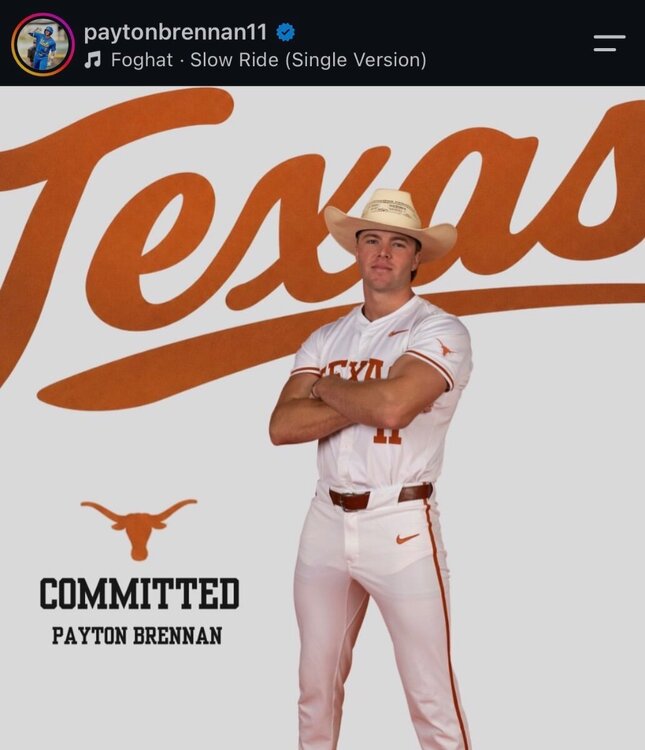
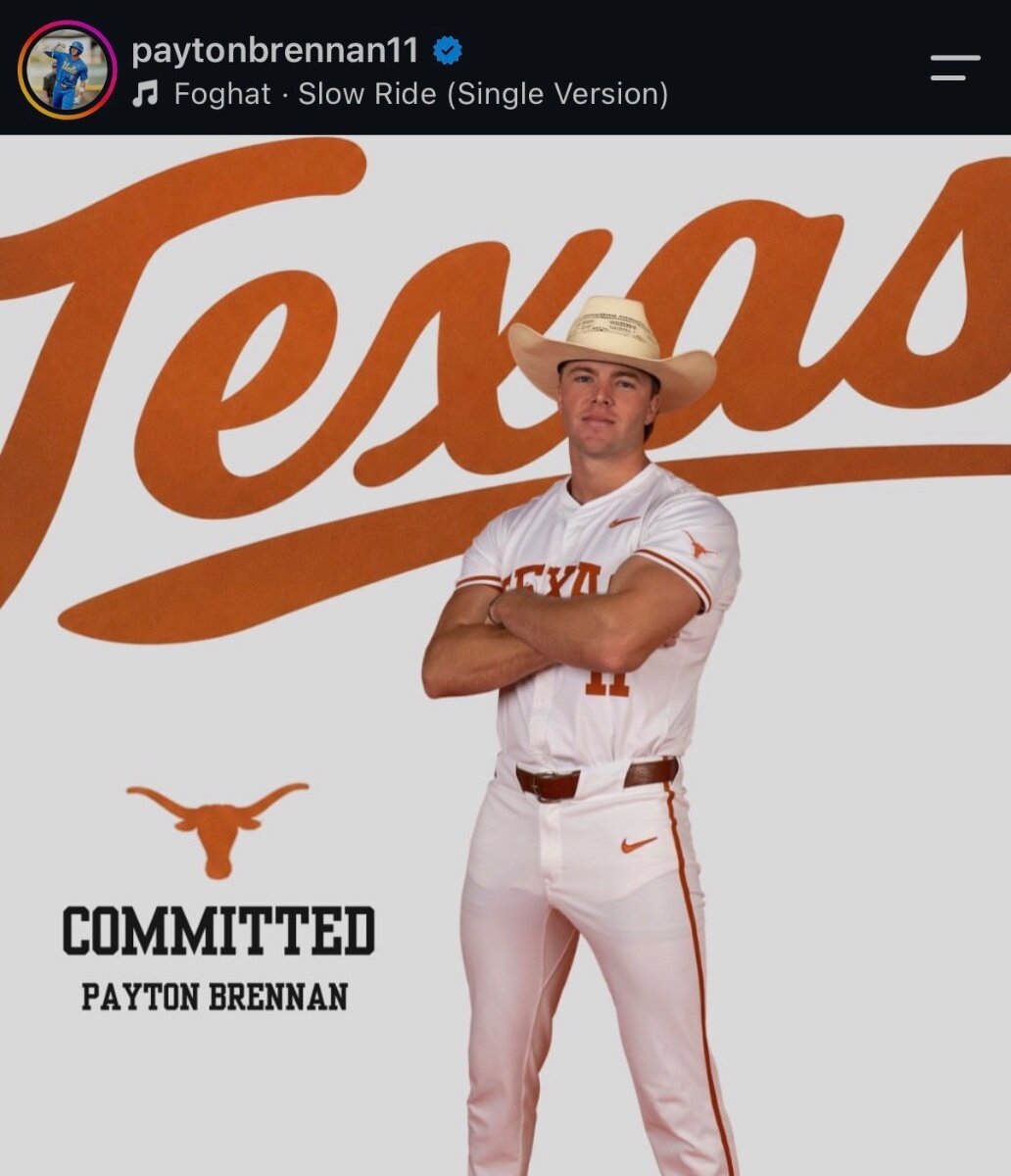
 Taking a Look at Raleek Brown's Fit in the Texas Offense *** I can't help but get excited for what's to come with new Texas running back Raleek Brown. Brown is coming off of a 1st Team All-Big 12 season at Arizona State where he rushed for 1,141 yards on 6.1 yards an attempts and 4 touchdowns. The touchdown numbers should improve in this Texas offense, but beyond anything else, it is the home run ability that intrigues me the most. Brown has a fantastic ability to get small in the hole, then make the first guy miss in space. -- I wanted to share some All 22 clips from the 2025 season showcasing Brown's ability at the running back spot, while also giving an idea of how it may translate to the Steve Sarkisian offense in 2026.This time next week, much of the OTF crew will be in Tampa for the beginning of SEC Football Media Days. We’ll have a set up there where we’ll be interviewing various folks from around the SEC. We’ll attempt to speak to a media member from every 2026 conference opponent to get their viewpoint on their matchup with the Longhorns. It should be wall-to-wall football coverage. Hopefully, y’all like it! ** As of today, Texas baseball is waiting on a decision from infielder Ethan Mendoza. Mendoza went undrafted and could return to Texas for next season (or even the next two seasons with the five-for-five). I’m told Mendoza at one point was dead set on moving on to the minors, but his injury and upcoming surgery, on top of not being drafted have him re-thinking that decision. His choices are pretty clear: Sign an undrafted free agent deal for a max bonus of $150k or return to Texas and try to improve his draft stock. A decision is expected as soon as tomorrow. ** While I have to stop short of guaranteeing anything, there could be some very interesting news this week. I need to leave the topic out of it for now.For this week’s OTF Sideline Debate, we asked the staff: If Texas had to pick a sponsor jersey patch, who would you go with and why? — I spent my first year at Texas in Dobie Dormitory. It was in that same exact dorm where Dell Technologies was born just a couple of years prior. I like and appreciate the university’s relationship with Humann, because it started at UT, for much the same reason. No company is more UT than Dell. Any Texas team should be proud to be associated with it because of what it represents. — Bobby Burton — The sponsor I could see on the Texas Longhorns’ football jersey is a tough one. It would likely be an extremely successful alumnus, and one of those has already been used by an OTF team member. One could be a big grocery store chain, which has also been used by an OTF team member. So, you get down to whether Texas put a Google or similar type patch on a football jersey? Or could it be a SpaceX or Tesla or something similar? I’m not sure I actually have the answer on this one. I feel like the OTF team has come up with a number of the companies that I would have used for this story. I know which one it won’t be: Double Eagle. — Gerry Hamilton — The most fantastical pick for this question would be Tesla. In an attempt to complete Tesla’s move from Silicon Valley to the ATX, Elon Musk (the world’s first trillionaire) is ready to invest heavily to rehabilitate, associate and identify his brand with the most recognizable brand in Austin. Tesla is currently Austin’s second highest-ranking Fortune 500 company, behind Dell Technologies, and this would be a great way to let the world know that Tesla is now undeniably a Texas company. Tesla wants to be more mainstream and expand their demo to the American middle class; this move could help them do both. — Rod Babers — I didn’t want to double up and I also wanted to pick a hypothetical sponsor that was started by Longhorn grads. So, I went with Pluckers, which was unofficially established on the Forty Acres in the early 1990s before the brick-and-mortar store was opened on West Campus in 1995. As someone who grew up in Austin, I never realized how spoiled I was, with dozens of Pluckers locations around me until I moved to DFW and had to make much further drives. Pluckers is already ingrained in the athletic department and supplies fans with handfuls of coupons for five free wings after Texas wins at home. Even though those usually end up in the junk drawer for a few years and are rarely used, it’s a good gesture. Pluckers will often cater junior days and recruiting events. Hank and I have hit the Pluckers on Rio Grande during on-campus events a few times, too. While I don’t think a restaurant will ever be under consideration for a jersey sponsor, a Pluckers one would check two important boxes as an Austin-based restaurant started by Longhorn grads. — Jordan Scruggs — It would have to be a company that, like the Texas football program, is steeped in tradition, is recognizable to the public and synonymous enough with the Longhorns that such a transition to putting the company’s logo on a jersey wouldn’t look too out of place. AT&T is headquartered in Texas and, for starters, is already a major corporate partner with the university and the athletic department. AT&T was previously sponsored the Red River Shootout and the Longhorns have played in the Cotton Bowl 23 times (more than any bowl game in program history), with three of those appearances coming under companies that are now under the AT&T umbrella (two trips with Southwestern Bell as the title sponsor and one under the SBC banner). While seeing a corporate logo on a Texas football jersey would be a shock to the system, a Fortune 500 sponsor would ease the transition. — Jeff Howe — Yeti was born in Austin in 2006, built by two brothers who wanted a cooler that could survive a Texas tailgate. Now it’s a billion-dollar brand and the unofficial equipment of every hunter, fisherman, and Friday night (and Saturday) parking lot in the state. Even better: Yeti’s already on the sideline. Those coolers behind the bench? Yeti. The tumblers in every coach’s hand? Yeti. Rugged, premium, homegrown, and burnt orange looks great on that logo. They don’t need Texas football only for exposure. They’d do it because it fits. That’s the sponsor you want. — Marcus Myers — Lamborghini! Why not? It’s become synonymous with Texas Recruiting already across a couple of sports. Plus, there is something about The University of Texas, the city of Austin and the history of the athletics department that exudes luxury, power and identity. To which Lamborghini does just as well. With one of the most iconic logos in the world, it already looks like a Longhorn if you squint hard enough. The luxury supercar brand would immediately tower over the Lumber Liquidators or Woodside Energy’s of the world and continue Texas’ pursuit of becoming the ultimate ‘it’ school in all of America. — CJ Vogel — For me, it's H-E-B. I think it's one of very few companies that would limit complaints about having a patch on a Texas jersey at all (for the record, I’m anti-patch on jerseys). Everybody loves H-E-B and H-E-B is a good representation of Texas as a whole. I don't know about adding red to burnt orange, though. — Hank SouthEach of the On Texas Football staff members ranked our Top 40 players on the Texas football roster for our inaugural Top 40 on the 40. All of our selections were compiled and averaged out to produce an overall Top 40. Each Thursday in July, we’re releasing the list, 10 players at a time, along with a video breaking down the selections. Last week, we started with Nos. 40-31. This week, we’re breaking down Nos. 30-21. No. 30 — Laurence Seymore Seymore’s addition to the roster filled a glaring hole after Texas failed to solidify one of the two open guard spots with a transfer. The second-team All-American (Football Writers Association of America) from Western Kentucky reportedly hit the ground running in summer conditioning. Still, the offensive line will be better if Seymore wins the job by the Sept. 5 season opener against Texas State, rather than getting the nod by default. No. 29 — Derek Williams Jr. Williams showed flashes in spring practice of being the player he was before he injured his knee in a win over Oklahoma midway through the 2024 season. After flirting with the transfer portal, Williams has the inside track to be a starting safety in Will Muschamp’s defense, which highlights the position if he’s got the versatile pieces to do so. No. 28 — Derrek Cooper Should a true freshman RB3 be this close to a spot among the top 25 players on the roster? That speaks to the impact Cooper made in the spring, when he reportedly showed surprisingly sharp pass-protection skills. Cooper also brought a much-needed physical edge to the running game. No. 27 — Brad Spence One of the Longhorns’ best natural pass rushers, Spence could be a true chess piece for Muschamp around the line of scrimmage. With Anthony Hill Jr. off to the NFL, Spence is one of several players who will be counted on to take some of the pass-rushing burden off Colin Simmons. No. 26 — Nick Townsend Townsend is said to be closing in on 260 pounds while remaining one of the top pound-for-pound athletes in the program. The challenge for Townsend is how soon he can channel his physicality, athleticism and ability to make things happen with the ball in his hands into becoming a consistent playmaker on offense. No. 25 — Justus Terry In a limited role as a true freshman, Terry flashed the potential to be the kind of interior disruptor the defense missed after back-to-back seasons with Byron Murphy and Alfred Collins in that role. After undergoing surgery to address an upper-body injury that kept him out of the Citrus Bowl, Terry has a big preseason ahead as he looks to crack a deep, talented defensive line rotation. No. 24 — Zina Umeozulu The Texas staff fought hard to keep Umeozulu out of the portal. Voted as high as No. 12 on OTF staff members’ ballot, Umeozulu should be in for a heck of a battle with Lance Jackson for the snaps made available with Ethan Burke’s eligibility expiring after the 2025 season. No. 23 — Michael Masunas The Longhorns need guys on offense like Masunas, who don’t need to touch the ball to impact the game? Can the Michigan State transfer be the same kind of blocking presence Geoff Swaim and Andrew Beck were on the Forty Acres? Whether he’s that level of blocker or not, Masunas should allow Steve Sarkisian to get back to a running game that can rely on a tight end getting a consistent push as an in-line blocker or on the move in Sarkisian’s split-zone concepts. No. 22 — Kade Phillips After a tremendous true freshman season, it felt like the coaches challenged Phillips in spring practice (Kobe Black was working ahead of him in the spring game). Phillips has the tools to be everything Muschamp would want in a No. 1 cornerback. The change to more aggressive, man-to-man coverage could be what the doctor ordered to unlock Phillips’ immense talent. No. 21 — Brandon Baker Not only did Baker turn heads with his performance after moving inside to guard ahead of spring practice, but his attitude and his embracing the move set the tone for the spring and summer in Kyle Flood’s room. If Baker has the kind of season he and the coaches believe he’s capable of, he’ll have a stay-or-go decision after the season regarding his NFL future.There’s an argument to be made that the 2000s under Mack Brown, not the 1960s under Darrell Royal, are the best decade in the history of the Texas football program. Only Boise State tallied more wins than the Longhorns’ 110 victories from 2000-09 among FBS clubs. Texas only won two conference championships during the decade. But the Longhorns suffered an upset loss in the Big 12 title game in 2001 and were denied rightful entry to the 2008 game (it’s hard to explain to someone who wasn’t around or didn’t follow college football at the time that a system of computer rankings rendered Texas’ 45-35 win over Oklahoma in arguably the best in the history of the series moot). The Longhorns won at least nine games in each of those 10 seasons, including nine consecutive seasons (2001-09) with at least 10 wins. Texas was a legitimate national championship contender in three of those seasons (2001, 2004 and 2008) and finished no worse than 12th in any final Associated Press Top 25. The 2005 national championship team is one of the best in college football history. The argument for Vince Young as the greatest college football player of his era (or any other, for that matter) is strong. Young, Brown, Derrick Johnson and Michael Huff are in the College Football Hall of Fame. The likes of Cedric Benson, Justin Blalock, Quentin Jammer, Casey Hampton, Colt McCoy, Brian Orakpo, Jordan Shipley and Rod Wright helped the program gain and maintain national relevance for those 10 seasons. If the 2008 squad had its date with destiny against Florida, or if McCoy played the entirety of the title game against Alabama the following season, a second national championship in the decade might be enough for the 2000s to unseat the 1960s as the golden age of Longhorn football. Still, in this discussion, second place isn’t a bad place to be, if that's where one chooses to rank those 10 seasons. *** The No. 60 is chock-full of Longhorn legends, especially with Derrick Johnson wearing it in his last game at DKR (a 26-13 win over Texas A&M, which helped secure a Rose Bowl berth against Michigan at the end of the 2004 season). With that said, the discussion on the greatest No. 60 in school history starts and stops with Tommy Nobis. Recognizing Nobis on Tuesday, which coincides with the 60-day mark until Texas kicks off the 2026 season, puts into perspective how special the No. 60 has been on the Forty Acres and caps off an incredible run of Longhorn legends who wore a jersey number in the 60s. For starters, the 60s are bookended with Nobis and Dan Neil, a College Football Hall of Fame nominee and two-time first-team All-American (1995 and 1996) who wore No. 69 during his four seasons (1992-96), is impressive. What’s even more eye-opening is that if Neil is inducted into the College Football Hall of Fame (he’s been on the ballot three times, most recently in 2025), he’d be the fourth Longhorn offensive linemen in the Hall of Fame who wore a jersey number in the 60s, joining Bud McFadin (No. 61), Bob McKay (No. 62) and Harley Sewell (No. 66). *** If you’re trying to assemble the Mount Rushmore of Texas offensive linemen, you could do it entirely of guys who wore jersey numbers from 60 through 69. Along with the three College Football Hall of Fame inductees and Neil, Blalock was a two-time All-American who started all 51 games in his Longhorn career. Blalock’s primary competition to be considered the best No. 63 in school history is Mike Williams, a consensus All-American in 2001 (like Doug Dawson was in 1983, when he wore No. 66 and was a captain for a team that came painfully close to winning a national championship) who was the fourth overall pick in the 2002 NFL Draft. Jake Majors' (No. 65) school record 57 starts over parts of his five seasons (2020-24) could be in jeopardy with five-for-five eligibility looming. Although Majors and Lyle Sendlein (No. 62) wouldn’t be considered for the Mount Rushmore, their names would be up for discussion when picking a center for an all-time Texas offensive line. *** There was more debate than I anticipated over which all-time No. 64 the OTF community preferred: Casey Hampton (1996-2000) or Kasey Studdard (2002-06)? While I’m a Studdard fan then, now and forever, it’s hard to put Hampton’s dominance into its proper context for those who were too young to remember the two-time first-team All-American’s career or didn’t see one of the best defensive line products the state of Texas has ever produced. Hampton led the Longhorns in total tackles with 101 in 1999 and 78 in 2000 (tied D.D. Lewis for the team lead), making him the first Texas defensive lineman to lead the team in tackles in consecutive seasons. A nose tackle who was constantly facing double- and triple-teams, Hampton recorded 39 of his 54 career tackles for loss over his last seasons and was named Big 12 Defensive Player of the Year in 2000. The best example of what Hampton meant to the Longhorns (and later the Pittsburgh Steelers, the franchise with which Hampton won two Super Bowls, was named to Pro Bowls and was voted to their all-time team in 2007 after he was picked in the first round of the 2001 draft) came in the wake of a 64-13 loss to Oklahoma in 2000. A flustered Brown told Royal that he felt the team quit in the loss to the Sooners, while singling out how hard Hampton played, Royal let Brown know that his assumption wasn’t correct. "Teams don't quit,” Royal said. “Some players may have given up, and it may look like that. But some of your guys may have gone out and played the best games of their careers."Even though a lot has changed since Steve Sarkisian and Kyle Flood got to Alabama in 2019 and started evaluating, recruiting and developing offensive linemen in college football together, Ismael Camra will get them back to their roots. The 6-foot-6-inch, 335-pound Gilmer product’s Fourth of July commitment to Texas is the Longhorns' biggest, most highly-touted member of a five-man offensive line class. Look no further than Sarkisian’s celebratory social media message as confirmation that even though the staff isn’t married to the acquisition philosophy that bigger is always better, they’ll make an exception for a prospect with Camara’s upside. There are a few approaches Texas could take regarding Camara’s developmental track. Which one might depend on the makeup of the offensive line in 2027, specifically whether right guard Brandon Baker and right tackle Melvin Siani return. If Baker has the kind of season in which he’d be wise to strike while the iron is hot regarding the NFL draft, Camara could have a clearer path to the field at guard. Likewise, Siani’s departure (along with the expected exit of probable 2027 first-round pick Trevor Goosby), would likely push Camara to tackle (unless Baker were to come back for his senior season and kick back outside to tackle), where he’d compete with the likes of Andre Cojoe, Jordan Coleman, Jonte Newman, John Turntine III and fellow 2027 signee Brian Swanson (along with a potential plug-and-play transfer portal addition) for two open tackle spots. Regardless, how Sarkisian and Flood brought Evan Neal along under Nick Saban in Tuscaloosa might be the blueprint for how to maximize Camara’s development. With Jedrick Wills and Alex Leatherwood occupying the tackle spots for the Crimson Tide in 2019, Sarkisian and Flood put Neal into the starting lineup as a true freshman at left guard. When Wills left for the NFL, Neal moved to right tackle for Alabama’s 2020 national championship club, which was spearheaded by Sarkisian’s historic offense. Neal, who moved to left tackle when Flood followed Sarkisian to Texas, was the seventh overall pick in the 2022 NFL Draft by the New York Giants. While Neal’s outcome is a best-case scenario for Camara, what matters is that there’s proof of concept if the Longhorns want to let Camara adjust to the speed of the game and the physicality at guard before sliding him out to tackle. There was a time when an offensive lineman choosing Texas meant rolling the dice on their football career. Over 12 recruiting classes (2003-14) and 43 total signees (41 high school prospects and two junior college transfers), the Longhorns failed to develop a single NFL draft pick. Things started to shift ever-so-slightly in the last decade, thanks to Connor Williams (2015) and Samuel Cosmi (2017). Still, the long-awaited developmental boon has come under Sarkisian and Flood, with five recruiting classes (2018-22) in which the signees spent the majority of their time on campus under the current regime have produced five draft picks, including three from the 2022 haul (Kelvin Banks Jr., DJ Campbell and Cameron Williams). Whether it was how they brought along Neal and the other Crimson Tide players they coached, or what they've done with prospects they've inherited or recruited to Texas on their own, Sarkisian and Flood know what to do to get the most out of Camara. A big human with big-time potential, Camara should feel as though his bright football future is in good hands.Darrell Royal, who would’ve celebrated his 102nd birthday on Monday, led Texas through what, to this point, is the golden age of football on the Forty Acres. The 1960s were so good to Texas that the Longhorns, not Alabama, should’ve been CBS Sports' pick for college football’s best program during Royal’s first full decade on the job. The sport was a different animal when Royal led the Longhorns to an 86-19-3 record, winning the Southwest Conference five times and claiming national championships at the conclusion of undefeated seasons in 1963 and 1969 than it was in the 2000s when Mack Brown won 110 games (the second-most FBS wins in the decade) and a national championship. It’s on a different planet today, with Steve Sarkisian (whose squad kicks off the 2026 season in 60 days) looking to break through after guiding Texas to a 35-8 record during a three-season run that included two trips to the College Football Playoff and a conference title. Still, what Royal’s program accomplished during the 1960s goes beyond the record book. That includes a few painfully close calls that would’ve added more hardware to the trophy case had things broken a different way. The 1961 Longhorns were ranked No. 1 and in the midst of an undefeated season when a controversial hit on All-American running back Jimmy Saxton in a 6-0 loss to TCU derailed what could’ve easily been a run to Royal’s first national title. Texas settled for a 10-1 record and a No. 3 ranking in the final Associated Press poll, scoring a 12-7 win over Ole Miss in the Cotton Bowl. It was one of four seasons during the decade in which the Longhorns recorded a top-five finish without claiming a piece of the national title. Bear Bryant’s Crimson Tide benefited from the misfortune of Royal’s Texas teams more than anyone, splitting the 1961 national championship with Ohio State and sharing the crown with Arkansas in 1964. Although the Razorbacks snapped the Longhorns’ 15-game winning streak with a 14-13 win in Austin en route to an undefeated season, the AP and UPI ranked Alabama No. 1 at the end of the regular season, making the Crimson Tide national champions. Texas made its case to be considered the nation’s best on New Year’s Day, when Tommy Nobis led the defensive charge that denied Alabama’s Joe Namath the end zone on fourth-and-goal late in a 21-17 victory in the Orange Bowl, which was college football's first-ever prime-time telecast. Again, the Longhorns settled for a 10-1 record and a No. 5 final ranking from the AP voters. But it’s what Royal and Emory Bellard did in 1968 that makes Texas the team of the decade. Implementing the Wishbone after an underwhelming three-year stretch during the 1965 (6-4), 1966 (7-4) and 1967 (6-4) seasons, the decision to put James Street under center during what would eventually be a 31-22 loss to Texas Tech (and an 0-1-1 start to the 1968 season) kickstarted one of the most memorable runs in college football history. Texas went 9-0 with Street in the driver’s seat of the Wishbone, including a 36-13 rout of Tennessee in the Cotton Bowl to finish with a 9-1-1 record and a No. 5 finish in the final AP rankings, the first year in which the poll conducted a vote after bowl games were played (the UPI followed suit in 1974). Ending the decade with 20 consecutive wins (part of a school-record 30-game winning streak), having President Richard Nixon proclaim the Longhorns as national champions after the historic 15-14 win in Fayetteville over No. 2 Arkansas and handing Notre Dame a loss in a Cotton Bowl game that marked the end of the Fighting Irish’s 45-year self-imposed bowl ban should be more than enough for Texas to secure the “Team of the Decade” label. The way Bellard and Royal changed offensive football forever with the birth of the Wishbone, however, is what puts the Longhorns over the top as the sport’s top dog in the 1960s. Long after Bryant and Oklahoma’s Barry Switzer adopted the offense to revive their respective programs, Mike Leach and Hal Mumme studied the Wishbone while developing what would eventually become the Air Raid offense. "One thing with the Air Raid that's very important is to make sure all the skill positions touch the ball," Leach told ESPN's Jake Trotter in 2018. "In the Wishbone, all the skill positions touch the ball. All the skill positions contribute to the offensive effort. From the Wishbone, we drew the concept of distribution." Almost 60 years after the Wishbone took the game by storm, its influence on modern-day football adds further credence to the idea that from the start of Royal's fourth season through the end of his 13th, Austin, Texas, was home to the best program in college football.Jim Schlossnagle and Texas Baseball secure a commitment from former UCLA outfielder Payton Brennan Monday evening. Brennan hit .290 with 9 home runs and 51 RBI for the Bruins in 2026. He also racked up a .394 on base percentage on the season. per 64Analytics, Brennan was the No. 8 player in the portal rankings, adding to what has been a solid haul for the Horns this summer. With the current roster, the Texas outfield will likely consist of Anthony Pack Jr., Sawyer Solitaria and Payton Brennan as the starting trio. Long Beach State OF addition Trevor Goldenetz is likely your 4th option.




Important Information
We have placed cookies on your device to help make this website better. You can adjust your cookie settings, otherwise we'll assume you're okay to continue.
Account
Navigation
Search
Configure browser push notifications
Chrome (Android)
- Tap the lock icon next to the address bar.
- Tap Permissions → Notifications.
- Adjust your preference.
Chrome (Desktop)
- Click the padlock icon in the address bar.
- Select Site settings.
- Find Notifications and adjust your preference.
Safari (iOS 16.4+)
- Ensure the site is installed via Add to Home Screen.
- Open Settings App → Notifications.
- Find your app name and adjust your preference.
Safari (macOS)
- Go to Safari → Preferences.
- Click the Websites tab.
- Select Notifications in the sidebar.
- Find this website and adjust your preference.
Edge (Android)
- Tap the lock icon next to the address bar.
- Tap Permissions.
- Find Notifications and adjust your preference.
Edge (Desktop)
- Click the padlock icon in the address bar.
- Click Permissions for this site.
- Find Notifications and adjust your preference.
Firefox (Android)
- Go to Settings → Site permissions.
- Tap Notifications.
- Find this site in the list and adjust your preference.
Firefox (Desktop)
- Open Firefox Settings.
- Search for Notifications.
- Find this site in the list and adjust your preference.