
Search the Community
Showing results for tags 'OTF Premium'.
-
 Blake reported this a while back and we’ve been mentioning it when talking about the Texas pitching staff in 2026, but it’s official (per Kendall Rogers) that the Longhorns are welcoming back Max Grubbs, Luke Harrison and Ruger Riojas for the 2026 season. The plan is for Harrison to be back in the Saturday role next season. *** UPDATE: The return of Grubbs, Harrison and Riojas is officially official
- 26 replies
-
- 22
-

-

-

OTF Premium Brayden Rouse announcing July 8
Gerry Hamilton posted a topic in On Texas Football Forum
Texas 4-star++ LB Brayden Rouse will announce his decision July 8. As of Sunday, it’s expected to be Tennessee or Texas. The Vols have the long standing relationship with the family- 59 replies
-
- 26
-
-
-
OnTexasFootball doesn’t believe there is any new movement with 4-star++ WR Jalen Lott ahead of his July 8 announcement. 1. Oregon 2. Texas
- 36 replies
-
- 20
-
-
-

-

-
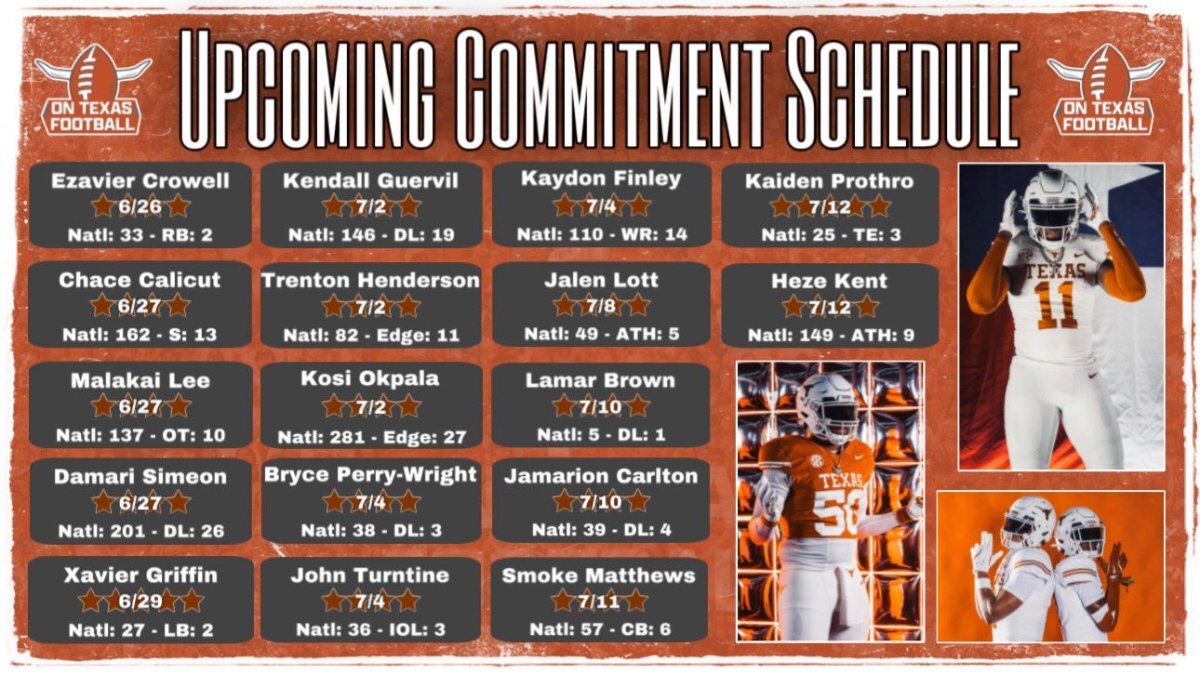
Happy Independence Day! There are three Texas targets expected to make verbal commitments today. After securing a commitment from OTF 4-star+ linebacker Kosi Okpala on Thursday, the Longhorns’ 2026 recruiting class stands at 16 members. Coming into Friday, Steve Sarkisian’s fifth full-cycle class on the Forty Acres was ranked No. 14 nationally by 247Sports and No. 16 by Rivals. We know when each of the three recruits is expected to make the call. The OTF staff will keep you updated on any changes throughout the day. *** Felix Ojo, OT, Mansfield Lake Ridge OTF 4-Star+ Time: 1 p.m. Finalists: Florida, Michigan, Ohio State, TEXAS, Texas Tech Note: Ojo is expected to announce his decision on X (formerly Twitter). *** John Turntine III, OT, North Crowley OTF 5-Star Time: 2:15 p.m. Finalists: Michigan, Stanford, TEXAS, Texas A&M Note: Turntine's ceremony is scheduled to start at noon. He's expected to announce his decision on X (formerly Twitter). *** Kaydon Finley, WR, Aledo OTF 4-Star+ Time: 6:30-7 p.m. Finalists: Arizona State, Notre Dame, TEXAS, Texas A&M View full news story
- 66 replies
-
- 12
-
-
Happy Independence Day! There are three Texas targets expected to make verbal commitments today. After securing a commitment from OTF 4-star+ linebacker Kosi Okpala on Thursday, the Longhorns’ 2026 recruiting class stands at 16 members. Coming into Friday, Steve Sarkisian’s fifth full-cycle class on the Forty Acres was ranked No. 14 nationally by 247Sports and No. 16 by Rivals. We know when each of the three recruits is expected to make the call. The OTF staff will keep you updated on any changes throughout the day. *** Felix Ojo, OT, Mansfield Lake Ridge OTF 4-Star+ Time: 1 p.m. Finalists: Florida, Michigan, Ohio State, TEXAS, Texas Tech Note: Ojo is expected to announce his decision on X (formerly Twitter). *** John Turntine III, OT, North Crowley OTF 5-Star Time: 2:15 p.m. Finalists: Michigan, Stanford, TEXAS, Texas A&M Note: Turntine's ceremony is scheduled to start at noon. He's expected to announce his decision on X (formerly Twitter). *** Kaydon Finley, WR, Aledo OTF 4-Star+ Time: 6:30-7 p.m. Finalists: Arizona State, Notre Dame, TEXAS, Texas A&M
- 66 comments
-
- 11
-
-
-

OTF Premium Update on Jamarion Carlton (9:30 a.m.)
CJ Vogel posted a topic in On Texas Football Forum
There has been scuttlebutt regarding where Temple (Texas) EDGE Jamarion Carlton fits into the picture as of late. Form the last word that I have received, Carlton has a final decision that will see him choose finalists of Texas and the Baylor Bears. LSU hosted Carlton for an OV on May 30, though with their recent surge for Trenton Henderson the Bayou Bengals are a long shot to also win out on Carlton. I will say don't discount Baylor. The Baylor staff has done a fine job this cycle of winning some key recruitments in the CenTex region. Given where things stand in the 2026 cycle, I would be quite surprised to see the Longhorns not come out on top in this one. Carlton decides on July 10.- 27 replies
-
- 32
-
-
4-star++ Jalen Lott update Texas is trying to make up ground in the race for 4-star++ WR Jalen Lott (Frisco, Texas/Panther Creek). Steve Sarkisian and multiple staff members have been in constant contact with the family this week. USC and Oregon had considerably higher NIL offers out to the Texas legacy as of late last weekend. Texas has now stepped up to where it’s a competitive race. Lott is scheduled to make his announcement July 8. If OnTexasFootball were handicapping the race on July 1: 1. Oregon 2. Texas 🔼 3. USC 🔽
- 53 replies
-
- 39
-
-
-
Nobody needs a reason to celebrate the life and football career of Tommy Nobis. Nevertheless, the countdown to the 2025 football season reached 60 days on Tuesday, making it the perfect time to reflect on Nobis’ gridiron legacy. It’s hard to argue against Nobis being the best defensive player to come through the Texas program. The only sophomore starter for Darrell Royal’s 1963 national champions, Nobis remains the standard for what a Longhorn defender should be, even though his last snap on the Forty Acres was almost 65 years ago. One of the most decorated defensive players in college football history, Nobis won the Maxwell Award in 1965, meeting the criteria for the University of Texas to retire his No. 60 (a Longhorn must be named a consensus All-American and win a recognized national player of the year award to get their number retired). Before the Texas defensive charge that led to LenDale White coming up short on fourth-and-2 late in the fourth quarter of the 2006 Rose Bowl, Nobis thwarting Joe Namath’s attempt to convert a fourth down in the 1965 Orange Bowl (a 21-17 win for the Longhorns over the Crimson Tide in college football’s first-ever live prime-time telecast) was arguably the top defensive play in school history (the top competitor might be the fumble Pat Culpepper and Johnny Treadwell combined to force on the goal line in a 7-3 win over Arkansas, helping Texas secure the 1962 Southwest Conference title). *** Tributes for Nobis poured in when he died in 2017. Mike Perrin, who oversaw the Texas athletic department between the end of Steve Patterson’s forgettable tenure and the powers that be hiring Chris Del Conte, was a freshman during Nobis’ final season on the Forty Acres. “Tommy Nobis was an icon not just at The University of Texas,” Perrin said, “but in all of college football.” Bill Little, who was the sports editor of The Daily Texan as a UT student when Nobis played for the Longhorns and, later, the football program’s sports information director, said of Nobis, “There are few players that strike fear in opponents the way Nobis did in his time.” There’s no shortage of scribes, observers, coaches or players willing to back up Little’s opinion. Hall of Fame running back Larry Csonka is one of them, going on the record that he’d "rather play against Dick Butkus than Nobis." *** Inducted into the College Football Hall of Fame in 1981, the one tribute Nobis should’ve received while he was alive was enshrinement alongside Butkus, Csonka and other gridiron legends in the Pro Football Hall of Fame. Rich McKay, the CEO of the Atlanta Falcons, wrote an open letter regarding Nobis’ Hall of Fame candidacy in 2020. “It is time to rightfully acknowledge, appreciate, and celebrate one of the greatest to ever play the game: the late Tommy Nobis,” McKay wrote. We can — we should — do that by immortalizing Nobis with a bronze bust at the Pro Football Hall of Fame in Canton, Ohio.” It’s long been acknowledged that Nobis, who was the Falcons’ first-ever draft pick (No. 1 overall in the 1965 NFL Draft) and wore his “Mr. Falcon” moniker like a badge of honor, played on some dreadful squads. In 11 seasons with the Falcons, Nobis never played in a playoff game, enjoying just two winning seasons in his NFL career. Nobis is one of only four defensive players on the NFL’s 1960s All-Decade Team not currently in the Hall of Fame. Nobis, the 1966 NFL Rookie of the Year, was a two-time All-Pro who was named to the Pro Bowl five times. Longtime Atlanta Journal-Constitution columnist Furman Bisher once wrote the following regarding Nobis' exclusion from the Hall of Fame: “There isn't much more one can say about Tommy Nobis. In the glow of a winning team, where he would have been a star on the isolated camera, he would already have been residing in Canton. It's not a Falcons thing, it's a Nobis thing, and here is a man who lives up to all the ideals I would establish for admission to the Pro Football Hall of Fame." *** The finest two-way player I have ever seen," is a quote often attributed to Royal regarding Nobis' ability on the field. Royal maximized Nobis’ unique skill set by playing him at guard on offense. So, when Kelvin Banks became the first Longhorn offensive lineman to win the Outland Trophy last season, that’s not entirely true. Nobis, lining up as a ferocious lead blocker for Royal’s Wing-T offense, won the Outland Trophy two years after Scott Appleton became the first of the program’s five Outland Trophy winners in 1963 (Appleton, Nobis, Banks, Brad Shearer in 1977 and T’Vondre Sweat in 2023 put Texas behind only Nebraska’s nine and Alabama’s six Outland Trophy winners for the most produced by one school). *** I’m happy that during his Tuesday appearance on “Coffee & Football,” Ramonce Taylor mentioned how Mack Brown’s staff initially recruited him to Texas to be a part of Duane Akina’s secondary. I remember going to watch Taylor’s last high school game (Belton’s bi-district playoff loss to Leander at Killeen’s Leo Buckley Stadium in 2003), believing I was watching a prospect who had a chance to become the next great Longhorn defensive back. Then, I watched Taylor cut through the defense like a hot knife through butter. I left the stadium knowing Texas had to find a way to let Taylor touch the football. Thankfuly, that’s something Taylor said was in the works before his epic senior year started; Taylor rushed for 2,370 yards and 29 touchdowns as an all-state running back, he was an all-district basketball player while sharing the court with current Stephen F. Austin men’s basketball coach Matt Braeuer and won his second consecutive state championship in the long jump. *** Whether it was Taylor, Curtis Brown, Earl Thomas, Quandre Diggs or Ja’Tavion Sanders, the true two-way players who’ve come through the Texas program over the last two decades have, for the most part, ended up on the side of the ball where they were meant to play. Jermaine Bishop Jr. is the one 2026 recruit, currently committed to the Longhorns, who should be the source of a healthy internal debate regarding whether he’ll help Steve Sarkisian’s offense or Pete Kwiatkowski’s defense. Bishop caught 83 passes for 1,565 yards and 18 touchdowns as a junior, ending the season with 2,009 all-purpose yards. Even though Bishop posed for photos with the Jim Thorpe Award during his June official visit and has a bright future as a defensive back, I agree with Gerry Hamilton’s take on this week’s episode of the “Recruiting Breakdown" regarding Bishop's future. Sarkisian could see enough of Xavier Worthy in Bishop’s game to at least experiment with ways to get the ball into the hands of such an electric, game-changing talent. View full news story
-
Nobody needs a reason to celebrate the life and football career of Tommy Nobis. Nevertheless, the countdown to the 2025 football season reached 60 days on Tuesday, making it the perfect time to reflect on Nobis’ gridiron legacy. It’s hard to argue against Nobis being the best defensive player to come through the Texas program. The only sophomore starter for Darrell Royal’s 1963 national champions, Nobis remains the standard for what a Longhorn defender should be, even though his last snap on the Forty Acres was almost 65 years ago. One of the most decorated defensive players in college football history, Nobis won the Maxwell Award in 1965, meeting the criteria for the University of Texas to retire his No. 60 (a Longhorn must be named a consensus All-American and win a recognized national player of the year award to get their number retired). Before the Texas defensive charge that led to LenDale White coming up short on fourth-and-2 late in the fourth quarter of the 2006 Rose Bowl, Nobis thwarting Joe Namath’s attempt to convert a fourth down in the 1965 Orange Bowl (a 21-17 win for the Longhorns over the Crimson Tide in college football’s first-ever live prime-time telecast) was arguably the top defensive play in school history (the top competitor might be the fumble Pat Culpepper and Johnny Treadwell combined to force on the goal line in a 7-3 win over Arkansas, helping Texas secure the 1962 Southwest Conference title). *** Tributes for Nobis poured in when he died in 2017. Mike Perrin, who oversaw the Texas athletic department between the end of Steve Patterson’s forgettable tenure and the powers that be hiring Chris Del Conte, was a freshman during Nobis’ final season on the Forty Acres. “Tommy Nobis was an icon not just at The University of Texas,” Perrin said, “but in all of college football.” Bill Little, who was the sports editor of The Daily Texan as a UT student when Nobis played for the Longhorns and, later, the football program’s sports information director, said of Nobis, “There are few players that strike fear in opponents the way Nobis did in his time.” There’s no shortage of scribes, observers, coaches or players willing to back up Little’s opinion. Hall of Fame running back Larry Csonka is one of them, going on the record that he’d "rather play against Dick Butkus than Nobis." *** Inducted into the College Football Hall of Fame in 1981, the one tribute Nobis should’ve received while he was alive was enshrinement alongside Butkus, Csonka and other gridiron legends in the Pro Football Hall of Fame. Rich McKay, the CEO of the Atlanta Falcons, wrote an open letter regarding Nobis’ Hall of Fame candidacy in 2020. “It is time to rightfully acknowledge, appreciate, and celebrate one of the greatest to ever play the game: the late Tommy Nobis,” McKay wrote. We can — we should — do that by immortalizing Nobis with a bronze bust at the Pro Football Hall of Fame in Canton, Ohio.” It’s long been acknowledged that Nobis, who was the Falcons’ first-ever draft pick (No. 1 overall in the 1965 NFL Draft) and wore his “Mr. Falcon” moniker like a badge of honor, played on some dreadful squads. In 11 seasons with the Falcons, Nobis never played in a playoff game, enjoying just two winning seasons in his NFL career. Nobis is one of only four defensive players on the NFL’s 1960s All-Decade Team not currently in the Hall of Fame. Nobis, the 1966 NFL Rookie of the Year, was a two-time All-Pro who was named to the Pro Bowl five times. Longtime Atlanta Journal-Constitution columnist Furman Bisher once wrote the following regarding Nobis' exclusion from the Hall of Fame: “There isn't much more one can say about Tommy Nobis. In the glow of a winning team, where he would have been a star on the isolated camera, he would already have been residing in Canton. It's not a Falcons thing, it's a Nobis thing, and here is a man who lives up to all the ideals I would establish for admission to the Pro Football Hall of Fame." *** The finest two-way player I have ever seen," is a quote often attributed to Royal regarding Nobis' ability on the field. Royal maximized Nobis’ unique skill set by playing him at guard on offense. So, when Kelvin Banks became the first Longhorn offensive lineman to win the Outland Trophy last season, that’s not entirely true. Nobis, lining up as a ferocious lead blocker for Royal’s Wing-T offense, won the Outland Trophy two years after Scott Appleton became the first of the program’s five Outland Trophy winners in 1963 (Appleton, Nobis, Banks, Brad Shearer in 1977 and T’Vondre Sweat in 2023 put Texas behind only Nebraska’s nine and Alabama’s six Outland Trophy winners for the most produced by one school). *** I’m happy that during his Tuesday appearance on “Coffee & Football,” Ramonce Taylor mentioned how Mack Brown’s staff initially recruited him to Texas to be a part of Duane Akina’s secondary. I remember going to watch Taylor’s last high school game (Belton’s bi-district playoff loss to Leander at Killeen’s Leo Buckley Stadium in 2003), believing I was watching a prospect who had a chance to become the next great Longhorn defensive back. Then, I watched Taylor cut through the defense like a hot knife through butter. I left the stadium knowing Texas had to find a way to let Taylor touch the football. Thankfuly, that’s something Taylor said was in the works before his epic senior year started; Taylor rushed for 2,370 yards and 29 touchdowns as an all-state running back, he was an all-district basketball player while sharing the court with current Stephen F. Austin men’s basketball coach Matt Braeuer and won his second consecutive state championship in the long jump. *** Whether it was Taylor, Curtis Brown, Earl Thomas, Quandre Diggs or Ja’Tavion Sanders, the true two-way players who’ve come through the Texas program over the last two decades have, for the most part, ended up on the side of the ball where they were meant to play. Jermaine Bishop Jr. is the one 2026 recruit, currently committed to the Longhorns, who should be the source of a healthy internal debate regarding whether he’ll help Steve Sarkisian’s offense or Pete Kwiatkowski’s defense. Bishop caught 83 passes for 1,565 yards and 18 touchdowns as a junior, ending the season with 2,009 all-purpose yards. Even though Bishop posed for photos with the Jim Thorpe Award during his June official visit and has a bright future as a defensive back, I agree with Gerry Hamilton’s take on this week’s episode of the “Recruiting Breakdown" regarding Bishop's future. Sarkisian could see enough of Xavier Worthy in Bishop’s game to at least experiment with ways to get the ball into the hands of such an electric, game-changing talent.
- 9 comments
-
- 12
-
-
-
The month of July has arrived, which means we are just one more flip of the calendar away from Texas Football returning for the 2025 season. As we sit today, the countdown to kickoff remains at 60 days to the meeting in Columbus with the defending national champions. On a side note, at times these past few months this offseason has felt like both the longest and shortest in recent memory. But anyways, the light as the end of the tunnel is getting brighter by the day. As we enter July, a quick look at the calendar for what is ahead for the team. *** For the current week of the 4th of July, the team is home and away from Austin. Most will return home, and some others may take a small trip during the off time. Of course, the team itself has been participating in summer conditioning for a month and when they return from the 4th of July, there will be about four weeks remaining of conditioning until fall camp begins. Speaking about fall camp, the Longhorns started true football activities on July 31, 2024 a year ago. A full one month before the meeting with Colorado State kicked off at DKR on August 31, 2024. I have Wednesday, July 30 circled as the day to watch for the beginning of fall camp this year. *** In case you missed my conversation with QB Arch Manning in Thibodaux, Louisiana, there was some solid feedback in regards to standouts on the offensive side of the ball and it matches what we have reported over the offseason as well. TE Jack Endries has clearly caught the attention of Manning since arriving in June. The former Cal tight end has collected more than 1,000 yards through the air over the last two seasons of football on the west coast. He now joins the Longhorns with hopes of continuing the big time numbers put up by Ja'Tavion Sanders and Gunnar Helm over the last three years. On the offensive line, Manning said the vocal leader of the group comes from the center spot, Cole Hutson. Having covered Hutson a good bit in high school, this does not come as much surprise. Hutson possesses the necessary type of passion and feistiness that is coveted on the interior. One name I can say I was not expecting when speaking with Manning about offseason standouts was freshman WR Kaliq Lockett. Don't get me wrong, I think that is a huge sign of approval from the Texas quarterback and perhaps a nod that he should be checked in on more, it just was not a name I was expecting to hear. Still, a great sign for the young Sachse native. *** Some Team Notes A couple of nuggets from the month of June – – RB CJ Baxter continues to inch closer towards the field. His participation in offseason workouts has increased and the intensity of workouts has increased. Still, there remains some ground that needs to be covered before he is deemed 100%, and even then I think there remains some necessary mental work to trust the knee again. Will Baxter be suited up for day one of fall camp? I don't know for certain. If he is, he will certainly be wearing a green, non-contact jersey. – Sticking at running back, redshirt freshman Christian Clark has had a great summer. Clark was able to get live reps in the spring after returning from a torn Achilles tendon and has parlayed that into a successful month of conditioning. Clark has been receiving plenty of run with the second unit in offseason sessions and if I had to handicap the RB room today, Clark would be the first in line right behind Wisner. – Defensively, the name Brad Spence continues to positively pop up in conversations. – In a fun nugget, I have heard there has been a bit of an ongoing competition for offseason drills between Colin Simmons and Anthony Hill Jr. The two are often seen paired with one another in conditioning drills, with jawing going back and forth on who places better in drills or workouts. Both DFW products have been locked in this summer as one would imagine. – The term glue guy gets thrown around a lot in basketball for a guy who doesn't do a whole lot of scoring but will fill up the box score in many other departments, in football it is much tougher to find that and for this guy I don't even think it's fair considering the production a year ago. But I don't know if there is a player on the roster that is admired and respected in the locker room as much as RB Tre Wisner. The ultimate teammate is how he gets described at times.
- 13 replies
-
- 30
-
-
-
Twelve different coaches have led the Texas football program since the launch of the weekly Associated Press poll in 1936. Of the 10 who lasted at least four seasons, none have more wins through their first four than Steve Sarkisian. With a 38-17 record, Sarkisian’s win total matches that of Mack Brown (1998-2001), who had a 38-13 mark heading into the 2002 season. Sarkisian is part of a group of Longhorn coaches in the AP Poll era — with Blair Cherry, Ed Price, Darrell Royal, Fred Akers, David McWilliams and John Mackovic — who won an outright conference championship within their first four seasons. Sarkisian and Cherry are the only coaches from that group to coach Texas to multiple AP top-five finishes by the end of their fourth season, with Sarkisian’s 2023 (No. 3) and 2024 (No. 4) final rankings counting toward the program’s 22 all-time top-five finishes. Although Sarkisian has accomplished a lot while improving the program’s win total from five (2021) to eight (2022) to 12 (2023) to 13 (2024), history suggests the best is yet to come. For the most accomplished coaches in school history (Royal, Akers and Brown), their fifth season is when business started to pick up. Brown achieved the first back-to-back 11-win seasons in school history, going 11-2 in 2002, a season the Longhorns punctuated by thumping LSU in the Cotton Bowl, 35-20 (the Tigers returned most of the 2002 roster for the 2003 season, which ended with Nick Saban’s first national championship). The program enjoyed nine consecutive seasons of 10 or wins under Brown, whose 2005 national championship-winning season came in his eighth as Texas coach; Brown coached Texas through a memorable six-season stretch (2004-09) in which it went 69-9 with two Big 12 titles, a Rose Bowl win over Michigan at the end of the 2004 season, a Fiesta Bowl victory over Ohio State to cap a 12-1 season in 2008 and a trip to the BCS title game during the 2009 season. A forgettable 42-11 loss to Arkansas, after vaulting No. 1 in the AP Poll, and a 14-14 tie against Houston kept Akers’ 1981 club from claiming a share of the national title, but a 14-12 win over Bear Bryant’s third-ranked Crimson Tide in the Cotton Bowl lifted Texas to a No. 2 final ranking. It was the program’s best finish since splitting the 1970 national title with Nebraska (a Cotton Bowl loss to Notre Dame dropped the Longhorns to No. 3 in the final poll, although the UPI declared the Longhorns No. 1 at the end of a 10-0 regular season). Over his fifth, sixth and seventh seasons running the program (1981-83), Akers coached Texas to a 30-5-1 record and an outright Southwest Conference title in the 1983 season, which ended with a brutal 10-9 loss in the Cotton Bowl to Georgia. When it comes to near misses at a national championship, Sarkisian has a lot in common with Akers. Seven years apart, Akers led the Longhorns into a Cotton Bowl played on Jan. 2 with the national championship hanging in the balance, only for his team’s title hopes to be dashed, with titles Texas could’ve claimed going, instead, to Notre Dame (1977) and Miami (1983). Sarkisian has led the Longhorns to the brink of the College Football Playoff National Championship in each of the last two seasons, a pair of opportunities all for naught, with Texas getting painfully close to college football’s top prize before succumbing to Washington and Ohio State, respectively. If the Longhorns went to battle with a healthy Jonathon Brooks in the Sugar Bowl two years ago, or if CJ Baxter’s knee injury didn't end his sophomore season before it started, Sarkisian might’ve already gotten Texas over the hump. The mission to win the school’s fifth national championship begins in 61 days, an appropriate number considering the link between Sarkisian, Royal and a running back injury muddying a title-winning picture. The 1961 season, Royal’s fifth at the helm, saw the Longhorns race out to an 8-0 start, climbing to No. 1 in the AP Poll for the first time since 1946. With Jimmy Saxton leading the offense, Texas won its first eight games by an average margin of 26.6 points; a 28-7 Red River rout of Oklahoma was the closest anybody came to nipping Royal’s bunch. Long before Marcell Dareus simultaneously launched Alabama’s dynasty under Saban and brought an abrupt end to a golden era of Texas football under Brown with an ill-timed blow to Colt McCoy’s shoulder, Saxton was on the receiving end of arguably the most controversial hit in school history. Whether Bobby Plummer’s knee intentionally connected with Saxton’s head at the end of a 45-yard gain is irrelevant; the shot forced Saxton to miss enough of the game to render the offense helpless in a 6-0 loss to the Horned Frogs, a defeat Royal reportedly said was the toughest he endured during his coaching career. The first consensus All-American running back in school history, Saxton was the third-place finisher for the Heisman Trophy and held the school’s single-season record for yards per carry (7.9), which stood for 59 years until Bijan Robinson’s 8.2 yards per rushing attempt in 2020 established a new program standard. A 25-0 win over Texas A&M and a 12-7 victory over Ole Miss in the Cotton Bowl helped the 10-1 Longhorns end the season with a No. 3 ranking from the AP, but Royal wouldn’t claim his first of three national championships until two years later. Texas was arguably the best team in college football for four seasons in the middle of Royal’s 20-season tenure (1961-64), compiling a 40-3-1 record with three SWC titles, a national championship and four consecutive finishes in the top five of the AP Poll. If not for Saxton's injury and a one-point loss to Arkansas in 1964, Royal might've ended the 1960s with four outright national titles to his name. Until the Wishbone revived Royal’s career and led the Longhorns to 30 consecutive victories, the program’s run of success beginning with Royal’s fifth season could count as arguably the most prosperous Austin has ever experienced. Texas is 61 days from kicking off Sarkisian’s fifth season, which has a chance to be another campaign in what’s shaping up to be the next historic run of Longhorn football. View full news story
- 24 replies
-
- 17
-
-
-
OTF Premium Derrick Cooper note (1pm Monday)
Gerry Hamilton posted a topic in On Texas Football Forum
Derrek Cooper note Texas remains in contact with the 5-star RB from Hollywood (Fla) Chaminade-Madonna. The Longhorns simply want Cooper to make an OV during the season for a game weekend. Texas wanted him to make a weekend OV in June, but Cooper’s family didn’t want to cancel a weekend OV to schools that had been recruiting him 1.5-2 years. Cooper announced today on X that he will no longer be announcing a decision July 12. Georgia, Miami, Ohio State and Texas in contention.- 63 replies
-
- 56
-
-
Twelve different coaches have led the Texas football program since the launch of the weekly Associated Press poll in 1936. Of the 10 who lasted at least four seasons, none have more wins through their first four than Steve Sarkisian. With a 38-17 record, Sarkisian’s win total matches that of Mack Brown (1998-2001), who had a 38-13 mark heading into the 2002 season. Sarkisian is part of a group of Longhorn coaches in the AP Poll era — with Blair Cherry, Ed Price, Darrell Royal, Fred Akers, David McWilliams and John Mackovic — who won an outright conference championship within their first four seasons. Sarkisian and Cherry are the only coaches from that group to coach Texas to multiple AP top-five finishes by the end of their fourth season, with Sarkisian’s 2023 (No. 3) and 2024 (No. 4) final rankings counting toward the program’s 22 all-time top-five finishes. Although Sarkisian has accomplished a lot while improving the program’s win total from five (2021) to eight (2022) to 12 (2023) to 13 (2024), history suggests the best is yet to come. For the most accomplished coaches in school history (Royal, Akers and Brown), their fifth season is when business started to pick up. Brown achieved the first back-to-back 11-win seasons in school history, going 11-2 in 2002, a season the Longhorns punctuated by thumping LSU in the Cotton Bowl, 35-20 (the Tigers returned most of the 2002 roster for the 2003 season, which ended with Nick Saban’s first national championship). The program enjoyed nine consecutive seasons of 10 or wins under Brown, whose 2005 national championship-winning season came in his eighth as Texas coach; Brown coached Texas through a memorable six-season stretch (2004-09) in which it went 69-9 with two Big 12 titles, a Rose Bowl win over Michigan at the end of the 2004 season, a Fiesta Bowl victory over Ohio State to cap a 12-1 season in 2008 and a trip to the BCS title game during the 2009 season. A forgettable 42-11 loss to Arkansas, after vaulting No. 1 in the AP Poll, and a 14-14 tie against Houston kept Akers’ 1981 club from claiming a share of the national title, but a 14-12 win over Bear Bryant’s third-ranked Crimson Tide in the Cotton Bowl lifted Texas to a No. 2 final ranking. It was the program’s best finish since splitting the 1970 national title with Nebraska (a Cotton Bowl loss to Notre Dame dropped the Longhorns to No. 3 in the final poll, although the UPI declared the Longhorns No. 1 at the end of a 10-0 regular season). Over his fifth, sixth and seventh seasons running the program (1981-83), Akers coached Texas to a 30-5-1 record and an outright Southwest Conference title in the 1983 season, which ended with a brutal 10-9 loss in the Cotton Bowl to Georgia. When it comes to near misses at a national championship, Sarkisian has a lot in common with Akers. Seven years apart, Akers led the Longhorns into a Cotton Bowl played on Jan. 2 with the national championship hanging in the balance, only for his team’s title hopes to be dashed, with titles Texas could’ve claimed going, instead, to Notre Dame (1977) and Miami (1983). Sarkisian has led the Longhorns to the brink of the College Football Playoff National Championship in each of the last two seasons, a pair of opportunities all for naught, with Texas getting painfully close to college football’s top prize before succumbing to Washington and Ohio State, respectively. If the Longhorns went to battle with a healthy Jonathon Brooks in the Sugar Bowl two years ago, or if CJ Baxter’s knee injury didn't end his sophomore season before it started, Sarkisian might’ve already gotten Texas over the hump. The mission to win the school’s fifth national championship begins in 61 days, an appropriate number considering the link between Sarkisian, Royal and a running back injury muddying a title-winning picture. The 1961 season, Royal’s fifth at the helm, saw the Longhorns race out to an 8-0 start, climbing to No. 1 in the AP Poll for the first time since 1946. With Jimmy Saxton leading the offense, Texas won its first eight games by an average margin of 26.6 points; a 28-7 Red River rout of Oklahoma was the closest anybody came to nipping Royal’s bunch. Long before Marcell Dareus simultaneously launched Alabama’s dynasty under Saban and brought an abrupt end to a golden era of Texas football under Brown with an ill-timed blow to Colt McCoy’s shoulder, Saxton was on the receiving end of arguably the most controversial hit in school history. Whether Bobby Plummer’s knee intentionally connected with Saxton’s head at the end of a 45-yard gain is irrelevant; the shot forced Saxton to miss enough of the game to render the offense helpless in a 6-0 loss to the Horned Frogs, a defeat Royal reportedly said was the toughest he endured during his coaching career. The first consensus All-American running back in school history, Saxton was the third-place finisher for the Heisman Trophy and held the school’s single-season record for yards per carry (7.9), which stood for 59 years until Bijan Robinson’s 8.2 yards per rushing attempt in 2020 established a new program standard. A 25-0 win over Texas A&M and a 12-7 victory over Ole Miss in the Cotton Bowl helped the 10-1 Longhorns end the season with a No. 3 ranking from the AP, but Royal wouldn’t claim his first of three national championships until two years later. Texas was arguably the best team in college football for four seasons in the middle of Royal’s 20-season tenure (1961-64), compiling a 40-3-1 record with three SWC titles, a national championship and four consecutive finishes in the top five of the AP Poll. If not for Saxton's injury and a one-point loss to Arkansas in 1964, Royal might've ended the 1960s with four outright national titles to his name. Until the Wishbone revived Royal’s career and led the Longhorns to 30 consecutive victories, the program’s run of success beginning with Royal’s fifth season could count as arguably the most prosperous Austin has ever experienced. Texas is 61 days from kicking off Sarkisian’s fifth season, which has a chance to be another campaign in what’s shaping up to be the next historic run of Longhorn football.
- 24 comments
-
- 18
-
-
-
Texas RHP Aiden Moffett entered the transfer portal on Friday, OTF has confirmed. Moffett announced his decision to enter the portal on Friday afternoon via X. Sources told OTF on Friday that Moffett's transfer is related to the upcoming MLB Draft. In this summer's MLB Draft League, Moffett is 1-1 with a 4.26 ERA, with one save in five appearances, recording 12 strikeouts in 6.1 innings. An LSU transfer, Moffett made six appearances for Texas in 2025, finishing the season with a 2.25 ERA with one hit, one run and four walks allowed in four innings. Moffett struck out seven batters and allowed six total free passes (two HBPs). With Moffett's departure, here's the updated list of outgoing transfers from the 2025 squad: C Oliver Service C/INF Cole Chamberlain INF Carson Luna INF/OF Sam Richardson INF Jaquae Stewart OF Tommy Farmer IV OF Will Gasparino OF Donovan Jordan OF Matt Scott LHP Chance Covert II LHP Ace Whitehead RHP Aiden Moffett RHP Easton Tumis The following is the updated list of incoming transfers Jim Schlossnagle and the Longhorns have added through the transfer portal: C Andrew Ermis (Temple College) C Carson Tinney (Notre Dame) INF Temo Becarra (Stanford) INF Josh Livingston (Wichita State) UTIL Kaleb Freeman (Georgia State) OF Jack Moroknek (Butler) OF Aidan Robbins (Seton Hall) LHP Luke Dotson (Mississippi State) LHP Cal Higgins (Western Kentucky) LHP Haiden Leffew (Wake Forest)
-
Since Bob McKay wrapped up a Texas career (1968-69) worthy of induction into the College Football Hall of Fame three decades before Lyle Sendlein began his time with the Longhorns (2002-06), the 2005 national championship team’s starting center had an uphill climb to become the top player in program history to wear No. 62. Still, Sendlein started each of the 26 games on the schedule over his last two seasons on campus before starting 133 combined regular-season and playoff games over nine NFL seasons with the Arizona Cardinals. One of those starts Sendlein made came in Super Bowl XLIII, which pitted him against Texas and Pittsburgh Steelers legend Casey Hampton (the Steelers, with former Longhorns Tony Hills and Limas Sweed also on the roster, won, 27-23). Sendlein’s second career start in burnt orange saw him jump from the frying pan into the fire, in the second game of the 2005 season, playing one of the biggest roles on a star-studded offense when No. 2 Texas went into Ohio Stadium, at night. It upended No. 4 Ohio State, 25-22, kickstarting, in earnest, a run to the program's most recent national title. Sendlein’s redshirt junior season saw him replace departed starting center Jason Glynn, who was with the Longhorns for five seasons (2000-04) and started each of the last 38 games of his career. The Longhorn offensive line (left tackle Jonathan Scott, left guard Kasey Studdard, right guard Will Allen and right tackle Justin Blalock) had experience to share, combining for 89 career starts between the four returning starters from a squad that went 11-1 with a thrilling Rose Bowl win over Michigan in 2004. The 2005 Texas offensive line started the season as a group oozing potential and fulfilled it, ending an unforgettable 13-0 campaign as arguably the best unit in school history. Sendlein helped elevate the line, which paved the way for an offense quarterbacked by Vince Young to record the best single-season marks in school history for points (50.2) and total yards per game (512.1). When it comes to the similarities between the Longhorn offensive lines in 2005 and 2025, a new starting center is roughly where they end. Cole Hutson started 13 games as a true freshman right guard in 2022, so he’s not new to the starting lineup. Hutson also logged 389 snaps in a reserve role last season, including a season-high 52 in the team's College Football Playoff first-round win over Clemson and 35 in the loss to Ohio State in the Cotton Bowl. The return bout with the Buckeyes, on Aug. 30 in Columbus, will mark Hutson’s starting debut at center. He’s taking the baton from Jake Majors, who signed with the Tampa Bay Buccaneers as an undrafted free agent after starting a school-record 57 games in his career (2020-24). Unlike Sendlein’s situation, there isn’t a lot of starting experience around Hutson. Major is one of four departed starters, accounting for more than 35 percent of the 161 combined starts Texas lost from last season. DJ Campbell (30 career starts at right guard) and projected starting left tackle Trevor Goosby (two starts as a redshirt freshman last season) have 45 combined career starts between them. Those three account for all of the starting experience among Kyle Flood’s group. What the group lacks in starting experience, it makes up for in raw, high-upside talent. If Neto Umeozulu and Brandon Baker continue to trend in the right direction from where they ended spring practice, the group charged with protecting Arch Manning and creating running lanes for a deep backfield has a tremendous opportunity to grow together en route to a possible third consecutive berth in the CFP. While the 2005 offensive line merely added a new starting center to a mix of talented blockers coming together at the right time, the remaining members of a highly-touted 2022 signing class (Hutson, Campbell, Umeozulu and Connor Robertson are on the 2025 roster, Kelvin Banks and Cam Williams are in the NFL and Malik Agbo will suit up for West Virginia after entering the transfer portal during the spring window) and their 2025 linemates will get a good idea of where they stand and what's possible in Steve Sarkisian's fifth season leading the program after traveling to the Horseshoe in 62 days. View full news story
- 20 replies
-
- 10
-
-
I know there have been some folks wondering which quarterbacks stood out the most during the weekend in Thibodaux for the Manning Passing Academy. Here are some takeaways from the weekend. *** Washington QB Demond Williams Jr. was named the Air It Out Challenge winner at the Friday Nite Lights portion of the camp. The Air It Out Challenge included four targeted throws – one to the flats, one of the middle, one to the corner while rolling out and a deep shot to a net in the end zone about 35 yards downfield. Georgia Tech QB Haynes King actually had a really good showing in this challenge as well. He went 4-4 on his first run of hitting targets. Quarterbacks that threw on Thursday that impressed: Baylor QB Sawyer Robertson UNC QB Gio Lopez Clemson QB Cade Klubnik Texas Tech QB Behren Morton – One of the big takeaways for me was just wide LaNorris Sellers' frame is. He certainly looks like a full back at times in pads, and seeing him in person only confirmed that his frame is unique for a quarterback. Special player. – LSU QB Garrett Nussmeier looked good in the camp setting. Of course, accuracy and putting the ball where it needs to go has never been his issue. Nuss' concerns stem from pressure, where he folded several times a year ago. – I still think there is some Sam Ehlinger to Sam Leavitt's game. He is a fine throwing of the football, nothing extraordinary, but his real value comes from being a gamer. Someone that will lower his head and will his team to victory. Going to be a really interesting year for Leavitt without Cam Skattebo by his side in the backfield. – Duke QB Darian Mensah is going to be a very fun watch in the ACC this year. Big fan of his. It was fun talking with Oklahoma QB John Mateer at the camp. I had not seen him since he was at Little Elm and committed to Central Arkansas at the time. He told me he never envisioned leaving Washington State, though when the Sooners hired Ben Arbuckle from Wazzu, he knew it was a move that made a lot of sense. Throwing wise, there are some concerns about the height in which Mateer releases his passes from. But ultimately, I don't envision it being an issue. Folks like to point out the competition level at Wazzu last year as a knock on Mateer as well, I don't buy it. He's a very talented football player. – My questions on Georgia QB Gunnar Stockton remained unanswered. I actually did not know he was in attendance for the camp until Friday night. The few passes I watched of his were overthrown or errant. – I am a believer in Alabama QB Ty Simpson in the Kalen DeBoer offense. Simpson looked really sharp this weekend when getting to the top of his dropback. *** On Arch Manning Again, Arch didn't throw on Thursday when the camp counselors first arrived for an hour session with Eli and Peyton Manning. But he did throw on Friday under the lights. How much can you really take from ~8 throws or so? Not much. The quarterbacks were split alphabetically into two groups, which slotted Manning and Mateer in consecutive order. It was very interesting to compare the zip and velocity of passes off of the hand from both. There was more loft to Mateer's passes and more zip to Manning's. Again, take that for whatever you want. Technically speaking, the throwing form for Manning is exactly what you would expect. Pristine and without wasted movements. Arch went 2-4 in the Air It Out Challenge that was mentioned above. *** Quarterbacks not in attendance: Florida QB DJ Lagway – was at Texas HS State 7v7 tournament Oregon QB Dante Moore Ohio State QB Julian Sayin Marcel Reed was in attendance, but he did not throw on the weekend.
- 15 replies
-
- 19
-
-
Since Bob McKay wrapped up a Texas career (1968-69) worthy of induction into the College Football Hall of Fame three decades before Lyle Sendlein began his time with the Longhorns (2002-06), the 2005 national championship team’s starting center had an uphill climb to become the top player in program history to wear No. 62. Still, Sendlein started each of the 26 games on the schedule over his last two seasons on campus before starting 133 combined regular-season and playoff games over nine NFL seasons with the Arizona Cardinals. One of those starts Sendlein made came in Super Bowl XLIII, which pitted him against Texas and Pittsburgh Steelers legend Casey Hampton (the Steelers, with former Longhorns Tony Hills and Limas Sweed also on the roster, won, 27-23). Sendlein’s second career start in burnt orange saw him jump from the frying pan into the fire, in the second game of the 2005 season, playing one of the biggest roles on a star-studded offense when No. 2 Texas went into Ohio Stadium, at night. It upended No. 4 Ohio State, 25-22, kickstarting, in earnest, a run to the program's most recent national title. Sendlein’s redshirt junior season saw him replace departed starting center Jason Glynn, who was with the Longhorns for five seasons (2000-04) and started each of the last 38 games of his career. The Longhorn offensive line (left tackle Jonathan Scott, left guard Kasey Studdard, right guard Will Allen and right tackle Justin Blalock) had experience to share, combining for 89 career starts between the four returning starters from a squad that went 11-1 with a thrilling Rose Bowl win over Michigan in 2004. The 2005 Texas offensive line started the season as a group oozing potential and fulfilled it, ending an unforgettable 13-0 campaign as arguably the best unit in school history. Sendlein helped elevate the line, which paved the way for an offense quarterbacked by Vince Young to record the best single-season marks in school history for points (50.2) and total yards per game (512.1). When it comes to the similarities between the Longhorn offensive lines in 2005 and 2025, a new starting center is roughly where they end. Cole Hutson started 13 games as a true freshman right guard in 2022, so he’s not new to the starting lineup. Hutson also logged 389 snaps in a reserve role last season, including a season-high 52 in the team's College Football Playoff first-round win over Clemson and 35 in the loss to Ohio State in the Cotton Bowl. The return bout with the Buckeyes, on Aug. 30 in Columbus, will mark Hutson’s starting debut at center. He’s taking the baton from Jake Majors, who signed with the Tampa Bay Buccaneers as an undrafted free agent after starting a school-record 57 games in his career (2020-24). Unlike Sendlein’s situation, there isn’t a lot of starting experience around Hutson. Major is one of four departed starters, accounting for more than 35 percent of the 161 combined starts Texas lost from last season. DJ Campbell (30 career starts at right guard) and projected starting left tackle Trevor Goosby (two starts as a redshirt freshman last season) have 45 combined career starts between them. Those three account for all of the starting experience among Kyle Flood’s group. What the group lacks in starting experience, it makes up for in raw, high-upside talent. If Neto Umeozulu and Brandon Baker continue to trend in the right direction from where they ended spring practice, the group charged with protecting Arch Manning and creating running lanes for a deep backfield has a tremendous opportunity to grow together en route to a possible third consecutive berth in the CFP. While the 2005 offensive line merely added a new starting center to a mix of talented blockers coming together at the right time, the remaining members of a highly-touted 2022 signing class (Hutson, Campbell, Umeozulu and Connor Robertson are on the 2025 roster, Kelvin Banks and Cam Williams are in the NFL and Malik Agbo will suit up for West Virginia after entering the transfer portal during the spring window) and their 2025 linemates will get a good idea of where they stand and what's possible in Steve Sarkisian's fifth season leading the program after traveling to the Horseshoe in 62 days.
- 20 comments
-
- 13
-
-
-
OTF Premium OTF on the Road | Manning Passing Academy
CJ Vogel posted a topic in On Texas Football Forum
OTF is headed to Louisiana for the 2025 Manning Passing Academy this weekend. Arch Manning will represent Texas and we will have updates throughout the week of his performance and media availabilities. Will have the thread updated during my time in Thibodeaux, Louisiana!- 92 replies
-
- 19
-
-
4-star++ DL James Johnson announcement thread Miami (Fla.) Northwestern 4-star++ defensive lineman James Johnson is scheduled to announce his commitment today with a decision expected to come down to Georgia, Texas and maybe Miami. The 6-foot-2, 275-pound quick disruptor made official visits to Georgia (May 30-June 1), Miami (June 6-8), Florida (June 13-15) and Texas (June 20-22). Headed into the Texas OV, OTF was told it was 55-45 Georgia leading Texas. Johnson, who made his OV to Texas on his birthday weekend, had a tremendous visit with his mom and at that point it was seen as a neck and neck battle. Early in the week, there was more Georgia chatter than Texas with Miami still fighting. On Thursday, there was a little more Texas chatter. As we head into decision day, this is a recruitment that Texas has gone all in for all week. Johnson transferred to Northwestern High in the spring from North Fort Myers High. Johnson has known Texas lean and 4-star++ DL Kendall Guervil (Fort Myers, Fla./High) for years, as well as Texas freshman defensive lineman Myron Charles (Port Charlotte, Fla./High). Johnson sports an 82-inch wingspan and 10 inch hands. His explosivity on the football field translates to track and field with a 58'0" shot put to his credit as a junior.
- 228 replies
-
- 40
-
-
Three decisions today for Longhorn targets (all times are CDT): Damari Simeon, DT, St. Augustine Prep (Egg Harbor Township, N.J.) Time: 4 p.m. Finalists: Michigan, Ohio State, Penn State and Texas Link: St. Augustine Prep will stream Simeon's announcement on Instagram The Pick: Ohio State Chace Calicut, S/LB, Galena Park North Shore Time: 3 p.m. Finalists: Georgia, Michigan and Texas Link: Calicut's decision will be streamed live from the OT7 Showcase and Finals The Pick: Georgia Malakai Lee, OT, Kamehameha (Honolulu, Hawaii) Time: 6:30 p.m. Finalists: Alabama, Georgia, Michigan and Texas Link: Lee is announcing his decision on the 247Sports YouTube channel The Pick: Michigan
- 119 replies
-
- 12
-
-
-
Texas catcher/infielder Cole Chamberlain has entered the transfer portal, OTF has learned. Chamberlain's profile has already been removed from the program's online roster. Zachary Symm of Orangebloods first reported the departure of Chamberlain, who played in 22 games as a freshman for the Longhorns. Chamberlain went 5-for-37 with two doubles, nine RBI, 15 walks and 15 strikeouts. With Chamberlain's departure, here's the updated list of outgoing transfers from the 2025 squad: C Oliver Service C/INF Cole Chamberlain INF Carson Luna INF/OF Sam Richardson INF Jaquae Stewart OF Tommy Farmer IV OF Will Gasparino OF Donovan Jordan OF Matt Scott LHP Chance Covert II LHP Ace Whitehead RHP Easton Tumis The following is the updated list of incoming transfers Jim Schlossnagle and the Longhorns have added through the transfer portal: C Carson Tinney (Notre Dame) INF Temo Becarra (Stanford) INF Josh Livingston (Wichita State) UTIL Kaleb Freeman (Georgia State) OF Jack Moroknek (Butler) OF Aidan Robbins (Seton Hall) LHP Luke Dotson (Mississippi State) LHP Cal Higgins (Western Kentucky)
- 15 replies
-
- 17
-
-
-
2026 New Boston RB Ashton Rowden tells OTF that he has been in contact with Texas running back coach Chad Scott recently. Rowden said he is familiar with Scott, and that there was a conversation about a week ago where Texas was checking in on the New Boston four-star back. The 5-foot-11-inch running back holds 24 offers at the moment, and took four official visits in the month of June: May 30: TCU June 6: Texas Tech June 13: Minnesota June 20: Houston As far as I know, there was no visit conversation, but Rowden certainly becomes a name to monitor on the trail.
- 43 replies
-
- 12
-
-
-
Thursday recruiting update 1. OTF still likes where Texas sits with 4-star++ DL Kendall Guervil 2. OTF likes Georgia more for 4-star+ S/LB Chace Calicut 3. OTF believes 4-star++ DL James Johnson could go either way. 4. OTF likes where Texas sits with 5-star OT John Turntine III 5. Confidence remains for Texas with 5-star LB Xavier Griffin. OTF will continue to check to see if that remains, of course. 6. OTF likes where Texas sits with OT Felix Ojo. Early July decision likely. 7. 4-star++ CB Samari Matthews could go wither way with Texas and South Carolina. A little more Longhorns chatter today. 8. Texas very much in it with 4-star++ DB Davon Benjamin. Oregon is all in, however. This one could play out another month or so.
- 25 replies
-
- 40
-
-
-
-
Texas had been trending for Damari Simeon (Richland, NJ/St. Augustine) since the earlier June OV, and up until last night. That has now changed today. Barring a change, OTF believes the Horns will not likely be the pick June 27.
- 79 replies
-
- 26
-
-
-

-