
Search the Community
Showing results for tags 'OTF Premium'.
-
 Seems like we have good reason to have a thread to chat on all summer and through the season. Team workouts begin June 1, I believe
 -
 Whether Trevor Goosby comes back to Texas for another season in 2027 or enters the NFL draft, the Longhorns know they’ll be without their All-American candidate at left tackle for the rest of the 2026 season. Goosby’s patellar tendon injury means Andre Cojoe, who played 62 snaps at left tackle in Saturday’s 34-27 win over Ole Miss, is the next man up for No. 11 Texas (5-2, 3-2 SEC). Much like Will Muschamp’s conundrum of doing multiple things to make up for Colin Simmons’ absence, the Longhorn offensive line can’t replace Goosby with one player. With that said, there are three things Steve Sarkisian and Kyle Flood can do to help Cojoe hold serve and allow the offense to build on a performance against the Rebels that included season highs in total yards (419), rushing yards (207), yards per carry (4.9) and points against a Power Four opponent. 1. Lean into Cojoe’s ability as a run blocker Cojoe moved people on Saturday and his ability to cave in or seal the backside of Texas’ stretch runs opened cutbacks for Raleek Brown. Cojoe and Dylan Sikorski got a lot of work together in camp while Goosby was dealing with a knee injury (bone bruise). Their familiarity paid off in the win over Ole Miss; according to Pro Football Focus, the Longhorns rushed for 148 yards (9.9 yards per attempt) on A-, B- and C-gap runs to the left. 2. Get Jordan Coleman more snaps Sarkisian shouldn’t hesitate to use the jumbo package with Coleman as the sixth offensive lineman beyond goal-to-go runs inside the 5-yard line. Four of the seven snaps Coleman has logged this season have ended with a rushing touchdown, including two on Saturday (Michael Terry III's 2-yard run in the second quarter and Arch Manning’s 1-yard keeper in the fourth quarter). The win over the Rebels proved again that when the Longhorns get their hats on opposing defenders, they can move people and create creases for the backs. Coleman (356 pounds) and Cojoe (339 pounds) give Texas a large surface to run behind. Plus, the more snaps Coleman gets, the more ready he’ll be if something happens to Cojoe or Melvin Siani (Coleman made strides at left tackle with the first-team offense during spring practice while Goosby was out, recovering from shoulder surgery). 3. Keep prioritizing the quick passing game Sarkisian dialed up screens to get Manning into a rhythm and to get the ball to his playmakers in space early in the game. But the highest percentage of Manning’s pass attempts against Ole Miss were thrown up to nine yards beyond the line of scrimmage (36.7 percent, according to PFF). Although one of Manning’s interceptions came within this depth, he was 7-for-11 for 77 yards. Manning was 5-for-6 for 56 yards on pass attempts to the middle of the field up to nine yards beyond the line of scrimmage, including first-down throws to Emmett Mosley V (23 yards), Cam Coleman (12 yards), Jermaine Bishop Jr. (11 yards) and Michael Masunas (10 yards). The quick game can increase Cojoe’s margin for error as the blindside pass protector, which should lead to fewer plays like the strip-sack that led to a Rebel touchdown. Establishing the quick game can also force the defense to tighten things up in coverage, which should then open up the deep shots Sarkisian likes to take (although leaving a tight end and/or running back in to help will be required, especially when the Longhorns face top-quality edge defenders from Missouri and LSU). To help a struggling or unproven pass protector, an offensive coordinator can do one of three things: lean on calls to force the quarterback to rid of the ball quickly, keep extra blockers in to help with protection or put more receivers out into the route. Expect Sarkisian to look at all of those options to compensate for losing an NFL-caliber prospect at one of the most important positions on the field. View full news story
- 30 replies
-
- 18
-

-

-
Forget the SEC championship, the College Football Playoff or anything besides No. 19 Texas hanging on for a 34-27 win over No. 7 Ole Miss. The Longhorns stopped the bleeding from a two-game losing streak. It wasn’t pretty. Texas (5-2, 2-2 SEC) tied the Steve Sarkisian-era single-game record with 14 penalties and set a new single-game high with 121 penalty yards. A 24-3 halftime lead evaporated in the second half. The Rebels scored 21 points to tie the game while the Longhorns were mired in an all-too-familiar lull, with five consecutive possessions ending in a fumble, three punts and an interception. For the second time in SEC play, the hands team couldn’t recover a late-game onside kick. The botched recovery made this Texas' third conference game decided on the last play. Nevertheless, the Longhorns overcame their second-half struggles to get a much-needed win. The offense ended the game with a pair of scoring drives and the defense, although things got leaky in coverage, forced a punt, blocked a field goal and intercepted Trinidad Chambliss for the third time on three of Ole Miss’ (5-2, 3-2) last four possessions. *** Sarkisian, to his credit, was committed to the run down the stretch and it paid off. Raleek Brown and Michael Terry III carried the ball on the first five plays of a 6-play, 80-yard touchdown drive to regain the lead in the fourth quarter. Other than a short pass to Ryan Wingo on the first play of the Longhorns’ last drive, Arch Manning was involved in two plays: his 1-yard touchdown run (on a bootleg that was wide open, similar to his first touchdown, both of which were good calls by Sarkisian, since Manning hasn't been the ball carrier in those situations) and a 2-yard scramble on the play before Gianni Spetic’s 33-yard field goal. With 207 yards on 42 official rushing attempts, Texas improved to 25-2 under Sarkisian when recording at least 40 official rushing attempts in a game. Although the 40-carry mark includes plays like sacks and kneel-downs, it reflects a dedicated effort to run the football. That’s what Sarkisian did to get the offense in gear in the fourth quarter. *** Brown’s 157 yards (6.8 yards per carry) is the best yardage day by a Longhorn since Tre Wisner went for 186 yards in the 2024 regular-season finale against Texas A&M. Wingo’s 111-yard performance included a 50-yard touchdown catch from Manning. Their efforts made Saturday’s win the first Texas game with a 100-yard rusher and a 100-yard receiver since Jonathon Brooks and Xavier Worthy did it against TCU on Nov. 11, 2023. Even though the offense mustered just 19 net yards in the third quarter, the Longhorns finished the game with 419 total yards (5.8 yards per play). Since joining the SEC, Texas is 9-0 when it records at least 400 total yards. *** Brown’s ability to read zone runs and hit open cutback lanes helped Texas avoid a third consecutive loss. Brown ran with vision and violence, two things he hasn’t shown consistently as a Longhorn. *** When Texas needed some thump in the running game, Terry delivered (41 yards and a touchdown on eight carries). Terry’s two explosive runs (12 yards and 19 yards) on the 80-yard touchdown drive made him the big, physical back between the tackles the Longhorns figured they'd miss with Derrek Cooper not yet back to 100 percent. *** Rasheem Biles was all over the field. It’s hard to believe he was credited with only four tackles (one tackle for loss, two pass breakups, and four quarterback hurries). Biles’ fourth-and-goal interception was one of the game's pivotal plays. He also pressured Chambliss on a critical third down in the first half, forcing a rushed throw that fell incomplete as the Rebels settled for a field goal. On a day when Will Muschamp manufactured pressure with the absence of Colin Simmons, Biles pressured Chambliss and was around the ball on critical downs. *** Along with Biles, Justin Cryer (five tackles, an interception and a pass breakup) came up big for the Longhorns. Chambliss tested the Texas linebackers in coverage and they were up for the challenge. *** Muschamp deserves a lot of credit for Chambliss’ rough start. He dialed up different pressures, but showing blitz and then dropping defenders seemed to throw off Chambliss’ timing in the first half. *** Things are by no means fixed on the Forty Acres. Sarkisian must resolve the team’s third-quarter woes (I still don’t know why he gets away from things that work early). The kicking game is still way too feast-or-famine. Penalties remain a problem. Manning had moments of brilliance mixed with critical mistakes and the offense left points on the field. Ole Miss had 162 of its 364 total yards (44.5 percent) in the fourth quarter. Still, the Longhorns deserve credit for pulling it together and executing well enough, long enough to win. While this team shows no signs of getting off the rollercoaster any time soon, Saturday’s win was one in which their stretches of good play outweighed the bad. View full news story
- 65 replies
-
- 18
-
-
Split 1’s reps today in practice
- 48 replies
-
- 31
-
-
-
 Texas opens up as a 20.5-point favorite over Mississippi State for Halloween at DKR. The Bulldogs are likely to be without Kamario Taylor in that contest after he left the game Saturday vs. Oklahoma. The total for the game is 50.5.
 -
Whether Trevor Goosby comes back to Texas for another season in 2027 or enters the NFL draft, the Longhorns know they’ll be without their All-American candidate at left tackle for the rest of the 2026 season. Goosby’s patellar tendon injury means Andre Cojoe, who played 62 snaps at left tackle in Saturday’s 34-27 win over Ole Miss, is the next man up for No. 11 Texas (5-2, 3-2 SEC). Much like Will Muschamp’s conundrum of doing multiple things to make up for Colin Simmons’ absence, the Longhorn offensive line can’t replace Goosby with one player. With that said, there are three things Steve Sarkisian and Kyle Flood can do to help Cojoe hold serve and allow the offense to build on a performance against the Rebels that included season highs in total yards (419), rushing yards (207), yards per carry (4.9) and points against a Power Four opponent. 1. Lean into Cojoe’s ability as a run blocker Cojoe moved people on Saturday and his ability to cave in or seal the backside of Texas’ stretch runs opened cutbacks for Raleek Brown. Cojoe and Dylan Sikorski got a lot of work together in camp while Goosby was dealing with a knee injury (bone bruise). Their familiarity paid off in the win over Ole Miss; according to Pro Football Focus, the Longhorns rushed for 148 yards (9.9 yards per attempt) on A-, B- and C-gap runs to the left. 2. Get Jordan Coleman more snaps Sarkisian shouldn’t hesitate to use the jumbo package with Coleman as the sixth offensive lineman beyond goal-to-go runs inside the 5-yard line. Four of the seven snaps Coleman has logged this season have ended with a rushing touchdown, including two on Saturday (Michael Terry III's 2-yard run in the second quarter and Arch Manning’s 1-yard keeper in the fourth quarter). The win over the Rebels proved again that when the Longhorns get their hats on opposing defenders, they can move people and create creases for the backs. Coleman (356 pounds) and Cojoe (339 pounds) give Texas a large surface to run behind. Plus, the more snaps Coleman gets, the more ready he’ll be if something happens to Cojoe or Melvin Siani (Coleman made strides at left tackle with the first-team offense during spring practice while Goosby was out, recovering from shoulder surgery). 3. Keep prioritizing the quick passing game Sarkisian dialed up screens to get Manning into a rhythm and to get the ball to his playmakers in space early in the game. But the highest percentage of Manning’s pass attempts against Ole Miss were thrown up to nine yards beyond the line of scrimmage (36.7 percent, according to PFF). Although one of Manning’s interceptions came within this depth, he was 7-for-11 for 77 yards. Manning was 5-for-6 for 56 yards on pass attempts to the middle of the field up to nine yards beyond the line of scrimmage, including first-down throws to Emmett Mosley V (23 yards), Cam Coleman (12 yards), Jermaine Bishop Jr. (11 yards) and Michael Masunas (10 yards). The quick game can increase Cojoe’s margin for error as the blindside pass protector, which should lead to fewer plays like the strip-sack that led to a Rebel touchdown. Establishing the quick game can also force the defense to tighten things up in coverage, which should then open up the deep shots Sarkisian likes to take (although leaving a tight end and/or running back in to help will be required, especially when the Longhorns face top-quality edge defenders from Missouri and LSU). To help a struggling or unproven pass protector, an offensive coordinator can do one of three things: lean on calls to force the quarterback to rid of the ball quickly, keep extra blockers in to help with protection or put more receivers out into the route. Expect Sarkisian to look at all of those options to compensate for losing an NFL-caliber prospect at one of the most important positions on the field.
- 30 comments
-
- 25
-
-
Note on Michigan commit Xavier Muhammad (post visit) Texas hosted Shadow Creek (formerly South Houston) DL Xavier Muhammad yesterday. In talking with a source, Muhammad checked in a 6-4, 305. That is up from around 265-270 junior season. Texas is making a push, and the flip is certainly in play. He got the full court press from Will Muschamp and Kenny Baker yesterday. The Longhorns have been making a push with Texas Tech DL K'Adrian Redmond too, but that one is long shot if not dead at this point. Texas has planned to sign four DL's in the class if they can find the fits. OTF will have more later today.
- 6 replies
-
- 24
-
-
-
Forget the SEC championship, the College Football Playoff or anything besides No. 19 Texas hanging on for a 34-27 win over No. 7 Ole Miss. The Longhorns stopped the bleeding from a two-game losing streak. It wasn’t pretty. Texas (5-2, 2-2 SEC) tied the Steve Sarkisian-era single-game record with 14 penalties and set a new single-game high with 121 penalty yards. A 24-3 halftime lead evaporated in the second half. The Rebels scored 21 points to tie the game while the Longhorns were mired in an all-too-familiar lull, with five consecutive possessions ending in a fumble, three punts and an interception. For the second time in SEC play, the hands team couldn’t recover a late-game onside kick. The botched recovery made this Texas' third conference game decided on the last play. Nevertheless, the Longhorns overcame their second-half struggles to get a much-needed win. The offense ended the game with a pair of scoring drives and the defense, although things got leaky in coverage, forced a punt, blocked a field goal and intercepted Trinidad Chambliss for the third time on three of Ole Miss’ (5-2, 3-2) last four possessions. *** Sarkisian, to his credit, was committed to the run down the stretch and it paid off. Raleek Brown and Michael Terry III carried the ball on the first five plays of a 6-play, 80-yard touchdown drive to regain the lead in the fourth quarter. Other than a short pass to Ryan Wingo on the first play of the Longhorns’ last drive, Arch Manning was involved in two plays: his 1-yard touchdown run (on a bootleg that was wide open, similar to his first touchdown, both of which were good calls by Sarkisian, since Manning hasn't been the ball carrier in those situations) and a 2-yard scramble on the play before Gianni Spetic’s 33-yard field goal. With 207 yards on 42 official rushing attempts, Texas improved to 25-2 under Sarkisian when recording at least 40 official rushing attempts in a game. Although the 40-carry mark includes plays like sacks and kneel-downs, it reflects a dedicated effort to run the football. That’s what Sarkisian did to get the offense in gear in the fourth quarter. *** Brown’s 157 yards (6.8 yards per carry) is the best yardage day by a Longhorn since Tre Wisner went for 186 yards in the 2024 regular-season finale against Texas A&M. Wingo’s 111-yard performance included a 50-yard touchdown catch from Manning. Their efforts made Saturday’s win the first Texas game with a 100-yard rusher and a 100-yard receiver since Jonathon Brooks and Xavier Worthy did it against TCU on Nov. 11, 2023. Even though the offense mustered just 19 net yards in the third quarter, the Longhorns finished the game with 419 total yards (5.8 yards per play). Since joining the SEC, Texas is 9-0 when it records at least 400 total yards. *** Brown’s ability to read zone runs and hit open cutback lanes helped Texas avoid a third consecutive loss. Brown ran with vision and violence, two things he hasn’t shown consistently as a Longhorn. *** When Texas needed some thump in the running game, Terry delivered (41 yards and a touchdown on eight carries). Terry’s two explosive runs (12 yards and 19 yards) on the 80-yard touchdown drive made him the big, physical back between the tackles the Longhorns figured they'd miss with Derrek Cooper not yet back to 100 percent. *** Rasheem Biles was all over the field. It’s hard to believe he was credited with only four tackles (one tackle for loss, two pass breakups, and four quarterback hurries). Biles’ fourth-and-goal interception was one of the game's pivotal plays. He also pressured Chambliss on a critical third down in the first half, forcing a rushed throw that fell incomplete as the Rebels settled for a field goal. On a day when Will Muschamp manufactured pressure with the absence of Colin Simmons, Biles pressured Chambliss and was around the ball on critical downs. *** Along with Biles, Justin Cryer (five tackles, an interception and a pass breakup) came up big for the Longhorns. Chambliss tested the Texas linebackers in coverage and they were up for the challenge. *** Muschamp deserves a lot of credit for Chambliss’ rough start. He dialed up different pressures, but showing blitz and then dropping defenders seemed to throw off Chambliss’ timing in the first half. *** Things are by no means fixed on the Forty Acres. Sarkisian must resolve the team’s third-quarter woes (I still don’t know why he gets away from things that work early). The kicking game is still way too feast-or-famine. Penalties remain a problem. Manning had moments of brilliance mixed with critical mistakes and the offense left points on the field. Ole Miss had 162 of its 364 total yards (44.5 percent) in the fourth quarter. Still, the Longhorns deserve credit for pulling it together and executing well enough, long enough to win. While this team shows no signs of getting off the rollercoaster any time soon, Saturday’s win was one in which their stretches of good play outweighed the bad.
- 65 comments
-
- 12
-
-
It’s time to tackle “One Burning Question,” an On Texas Football in-season feature where we’ll examine a question facing the Texas Longhorns as they enter a game. On Sunday, we’ll revisit the question to see whether Steve Sarkisian’s team answered it successfully. This week, with No. 19 Texas (4-2, 1-2 SEC) welcoming No. 7 Ole Miss (5-1, 3-1) to Royal-Texas Memorial Stadium on Saturday (6:30 p.m., ABC), the question is: With the season on the line, can the offensive line come through? There have been times throughout the first six games of the season when the offensive line has done its job. While the flashes have been few and far between, Kyle Flood’s group makes things happen when they’re on the same page and execute Sarkisian's calls. The fleeting moments of quality trench play aren’t what Texas fans had in mind when Sarkisian and Flood set out to rebuild the offensive line after the 2025 season. Considering how the Longhorns overcame a rough start to the transfer portal cycle and landed two players targeted by other SEC programs (Melvin Siani and Dylan Sikorski) and added depth when Laurence Seymore was granted another season of eligibility, the situation up front is worse than it was last season. Traditional statistics tell an unsavory story. Texas is tied for 121st in FBS in sacks allowed (2.83 per game), is tied for 135th in tackles for loss allowed (7.8 per game) and is on pace for the program’s lowest output in points per game (30.2) and yards per play (5.45) since 2017. The 362.3 yards per game (No. 92 nationally) the Longhorns are averaging is on pace to be the worst season for total offense on the Forty Acres since 2014 (Shawn Watson’s offense averaged 337.3 yards per game). Texas enters Saturday’s game against the Rebels ranked 101st nationally in rushing yards per game (136) and 120th in yards per carry (3.64). The Longhorns haven’t run the football with this little success since the 2002 offense averaged 135.5 yards per game on the ground, an average buoyed by Cedric Benson’s 1,293-yard sophomore season. Advanced statistics don’t put the Texas offense in a flattering light either. Line yards per carry measures an offensive line's effectiveness through weighted yardage. The offensive line is credited with 120 percent of the negative yards on running back carries stopped behind the line of scrimmage and 100 percent on carries that gain 0-4 yards. Texas is 115th out of 138 FBS offensive lines. The Longhorns are 97th nationally in stuff rate, which calculates the percentage of rushing plays stopped at or behind the line of scrimmage. Power success rate is the percentage of third- and fourth-down runs with two or fewer yards to go that result in a first down or a touchdown. Texas is No. 98 in the country, with 69.4 percent of its runs moving the chains or reaching the end zone in those situations, The offensive line isn’t solely to blame for the offense’s struggles. Still, things won’t improve if an ailing backfield that could be without Hollywood Smothers (shoulder) on Saturday doesn’t have room to operate and the quarterback (whether it’s Arch Manning or KJ Lacey) is under constant duress. The group can’t fade in the second half as they did in last Saturday’s 27-24 loss to Florida. After racking up 114 yards on 18 non-sack rushing attempts in the first half, Texas netted just 14 yards on seven non-sack rushing attempts after halftime. Those seven carries included Smothers losing three yards on third-and-1 on the offense’s first possession of the third quarter, Raleek Brown getting dropped for a 2-yard loss on the first play of the next series and Manning losing three yards while trying to run for a first down on a fourth-and-2 at the 8:30 mark of the fourth quarter. There’s a chance Sarkisian and Flood will make personnel changes for the Ole Miss game. They could stand pat and hope Saturday is the day when everything comes together. Regardless, if the Longhorns can’t move the chains and limit the time that Trinidad Chambliss and the Rebels’ potent offense are on the field, things could get out of hand. The offensive line is out of time to figure things out. It’s now or never for a unit that’s fallen woefully short of the most measured preseason expectations through six games. View full news story
-
If No. 19 Texas is going to avoid losing a third consecutive game when No. 7 Ole Miss rolls into DKR on Saturday (6:30 p.m., ABC), these five matchups must go the Longhorns' way. 1. Texas’ Third-Down Offense vs. Ole Miss’ Third-Down Defense With the Longhorns going three-and-out on 46.2 percent of their offensive possessions against Tennessee (six of 12 drives), Oklahoma (seven of 15 drives) and Florida (five of 12 drives), it shouldn't come as a shock that Texas has the worst third-down offense in SEC play. The Longhorns moved the chains at an 8-for-36 clip in their first three conference games, including a 2-for-10 showing in their loss to the Gators last Saturday. The Rebels, however, have struggled to get off the field on third down. Pete Golding’s defense allowed its first four SEC opponents to go 30-for-61 (49.2 percent conversion rate) on third down, with Florida posting a 6-for-10 effort in its 52-28 rout of Ole Miss at the Swamp on Sept. 26. Unlike when it failed to take advantage of the Gators’ porous pass defense last week, Texas must take advantage of a perceived weakness and be at its best on third down to keep the Rebels’ potent offense off the field and to regain some much-needed confidence on offense. 2. Texas’ Defensive Line vs. Ole Miss’ Offensive Line We’ll see how the availability report looks closer to kickoff, but Wednesday’s report included three starting offensive linemen for the Rebels: left tackle Terez Davis (questionable), right guard Patrick Kutas (probable) and center Brycen Sanders (questionable). Kutas, who was named SEC Co-Offensive Lineman of the Week for his performance in Ole Miss’ 31-3 win over Missouri last Saturday, slid from guard to center in place of Sanders. Even though the Rebels had to move pieces around and didn’t have a 100-percent healthy Kewan Lacy in the backfield, they still rushed for a season-high 257 yards (6.8 yards per attempt) against the Tigers, led by Lacy’s season-high 122 yards on 16 carries. If Colin Simmons is out, it’ll be up to the interior of the Longhorn defensive line (Ian Geffrard, Alex January, Hero Kanu and Maraad Watson) to set the tone, while an EDGE group that’ll be without Richard Wesley adjusts to life without Simmons. According to Pro Football Focus, 448 of the 990 rushing yards Ole Miss has gained this season have come on A- and B-gap runs. Another 293 yards have come on D-gap runs, making setting the edge and keeping contain the top priorities for Lance Jackson, Zina Umelozulu and the Texas edge defenders. Additionally, the Rebels are No. 2 nationally in pass blocking efficiency according to PFF, allowing just 22 total pressures on 235 pass attempts. When opponents pressure Chambliss, it’s hard to get home and get him on the ground, with Chambliss’ 12.2 percent pressure-to-sack rate ranking third among SEC quarterbacks who’ve been pressured on at least 15 dropbacks this season. While the Ole Miss front might be banged up, it’ll take the best effort of the season from Kenny Baker and LaAllan Clark’s groups to keep the Longhorns in the game. Texas will have to earn its opportunities to rush the passer on Saturday. 3. Texas Wide Receivers vs. Ole Miss Defensive Backs Whether Arch Manning or KJ Lacey is behind center for the Longhorns, the game plan is likely to call for a lot of screen passes and quick throws to the perimeter. Against a secondary missing nickelback Edwin Joseph (the Florida State transfer suffered an ankle injury in Ole Miss’ 52-17 road win over Vanderbilt on Oct. 10), the Texas wideouts can control the game if they can maximize their opportunities in space. Based on PFF’s missed tackle data, 47.2 percent (34 of 72) of the Rebels’ missed tackles have come when defending the pass, the second-highest percentage of any defense in the SEC (Kentucky has missed 53.5 percent of its tackles in the passing game). Even though Jermaine Bishop Jr. only has 10 receptions on the season, no Longhorn has forced more missed tackles on receptions (four) than the true freshman, according to PFF. Forcing Ole Miss players to make plays in space is one of the few things Steve Sarkisian should feel his offense does well enough to make it a significant part of how he attacks Golding's defense. 4. Texas Linebackers vs. Trinidad Chambliss No SEC quarterback is better in the intermediate passing game than Chambliss. According to Pro Football Focus, which has Chambliss graded at an SEC-leading 91.2 on throws 10-19 yards downfield, he's completing 60.9 percent of his intermediate throws for 647 yards, with six touchdowns against three interceptions. Intermediate throws are Chambliss’ second-favorite passing depth, according to PFF, with 30.5 percent of his attempts attacking the area 10-19 yards beyond the line of scrimmage. Furthermore, 19.5 percent of his attempts have been intermediate throws in the middle of the field, where he’s 25-for-41 on the season, with 464 yards and five touchdowns (two interceptions). It’s a big week for the Longhorn defense against one of the nation’s top quarterbacks. On top of handling their responsibilities of containing Chambliss’ playmaking ability when things break down, Rasheem Biles, Justin Cryer and any other Texas linebacker on the field need to be especially ready to answer the challenge when Chambliss targets them in coverage. 5. Ryan Niblett vs. Oscar Bird Bird, who came to Oxford in 2025 by way of Australia, is already Ole Miss’ all-time leader in career punting average (46.5 yards per punt). Bird is averaging 48.6 yards per punt this season; six of his 18 punts have been downed inside the opponent’s 20-yard line (only one touchback) and seven of his punts have traveled 50 or more yards, including a season-best 60-yarder against Florida. The Longhorns can’t afford to give up field position. Niblett proved last week that he can still make things happen when he makes the first would-be tackler miss, but catching the football cleanly and helping the offense avoid situations where it has to start a possession near its goal line are of the utmost importance against the Rebels. View full news story
-
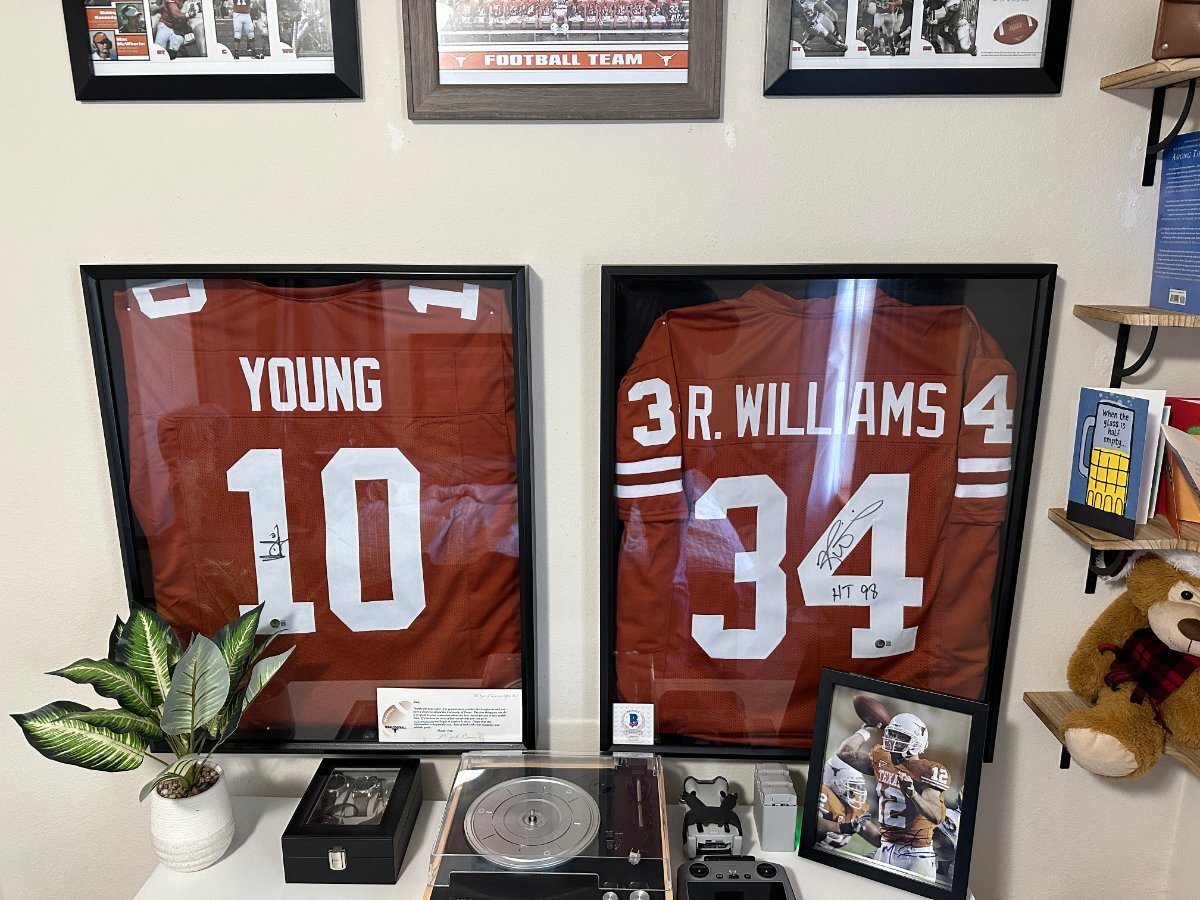
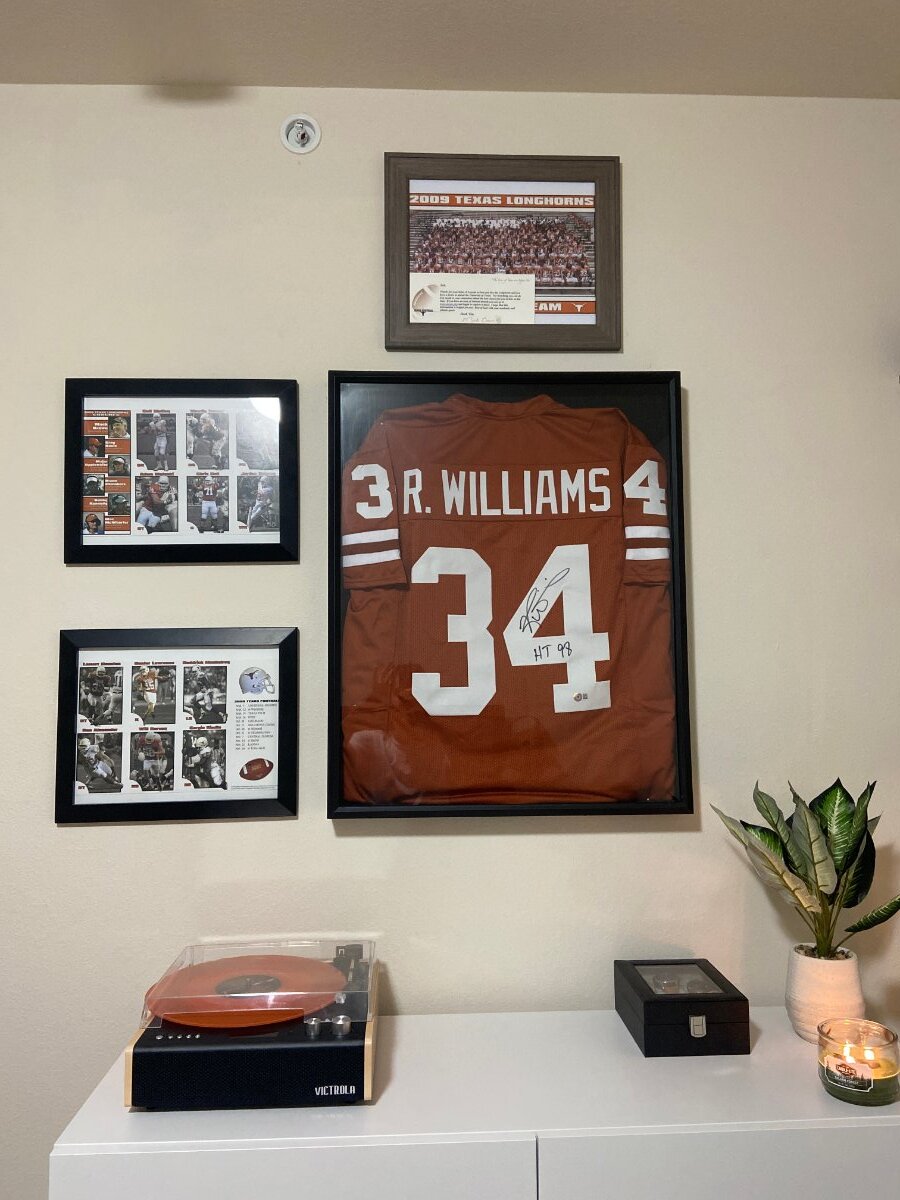
 Hi Longhorn nation! Drop your Longhorn memorabilia in the thread here. I'm 27 so just getting started, but I'll start. Acquired some new ones between the two images but, A Ricky signed jersey with "HT 98" and a VY signed jersey. I've got the Colt Mccoy signed picture as well. The 3 frames on the wall were sent by the University after I wrote them a letter in grade school for a school project! 2 of them are trading cards maybe? that I just kept together and framed and the other is a picture with the entire 2009 team, signed by all the players. Feel grateful and lucky to acquire these, thank you for sharing below!
-
It’s time to tackle “One Burning Question,” an On Texas Football in-season feature where we’ll examine a question facing the Texas Longhorns as they enter a game. On Sunday, we’ll revisit the question to see whether Steve Sarkisian’s team answered it successfully. This week, with No. 19 Texas (4-2, 1-2 SEC) welcoming No. 7 Ole Miss (5-1, 3-1) to Royal-Texas Memorial Stadium on Saturday (6:30 p.m., ABC), the question is: With the season on the line, can the offensive line come through? There have been times throughout the first six games of the season when the offensive line has done its job. While the flashes have been few and far between, Kyle Flood’s group makes things happen when they’re on the same page and execute Sarkisian's calls. The fleeting moments of quality trench play aren’t what Texas fans had in mind when Sarkisian and Flood set out to rebuild the offensive line after the 2025 season. Considering how the Longhorns overcame a rough start to the transfer portal cycle and landed two players targeted by other SEC programs (Melvin Siani and Dylan Sikorski) and added depth when Laurence Seymore was granted another season of eligibility, the situation up front is worse than it was last season. Traditional statistics tell an unsavory story. Texas is tied for 121st in FBS in sacks allowed (2.83 per game), is tied for 135th in tackles for loss allowed (7.8 per game) and is on pace for the program’s lowest output in points per game (30.2) and yards per play (5.45) since 2017. The 362.3 yards per game (No. 92 nationally) the Longhorns are averaging is on pace to be the worst season for total offense on the Forty Acres since 2014 (Shawn Watson’s offense averaged 337.3 yards per game). Texas enters Saturday’s game against the Rebels ranked 101st nationally in rushing yards per game (136) and 120th in yards per carry (3.64). The Longhorns haven’t run the football with this little success since the 2002 offense averaged 135.5 yards per game on the ground, an average buoyed by Cedric Benson’s 1,293-yard sophomore season. Advanced statistics don’t put the Texas offense in a flattering light either. Line yards per carry measures an offensive line's effectiveness through weighted yardage. The offensive line is credited with 120 percent of the negative yards on running back carries stopped behind the line of scrimmage and 100 percent on carries that gain 0-4 yards. Texas is 115th out of 138 FBS offensive lines. The Longhorns are 97th nationally in stuff rate, which calculates the percentage of rushing plays stopped at or behind the line of scrimmage. Power success rate is the percentage of third- and fourth-down runs with two or fewer yards to go that result in a first down or a touchdown. Texas is No. 98 in the country, with 69.4 percent of its runs moving the chains or reaching the end zone in those situations, The offensive line isn’t solely to blame for the offense’s struggles. Still, things won’t improve if an ailing backfield that could be without Hollywood Smothers (shoulder) on Saturday doesn’t have room to operate and the quarterback (whether it’s Arch Manning or KJ Lacey) is under constant duress. The group can’t fade in the second half as they did in last Saturday’s 27-24 loss to Florida. After racking up 114 yards on 18 non-sack rushing attempts in the first half, Texas netted just 14 yards on seven non-sack rushing attempts after halftime. Those seven carries included Smothers losing three yards on third-and-1 on the offense’s first possession of the third quarter, Raleek Brown getting dropped for a 2-yard loss on the first play of the next series and Manning losing three yards while trying to run for a first down on a fourth-and-2 at the 8:30 mark of the fourth quarter. There’s a chance Sarkisian and Flood will make personnel changes for the Ole Miss game. They could stand pat and hope Saturday is the day when everything comes together. Regardless, if the Longhorns can’t move the chains and limit the time that Trinidad Chambliss and the Rebels’ potent offense are on the field, things could get out of hand. The offensive line is out of time to figure things out. It’s now or never for a unit that’s fallen woefully short of the most measured preseason expectations through six games.
- 37 comments
-
- 11
-
-
If No. 19 Texas is going to avoid losing a third consecutive game when No. 7 Ole Miss rolls into DKR on Saturday (6:30 p.m., ABC), these five matchups must go the Longhorns' way. 1. Texas’ Third-Down Offense vs. Ole Miss’ Third-Down Defense With the Longhorns going three-and-out on 46.2 percent of their offensive possessions against Tennessee (six of 12 drives), Oklahoma (seven of 15 drives) and Florida (five of 12 drives), it shouldn't come as a shock that Texas has the worst third-down offense in SEC play. The Longhorns moved the chains at an 8-for-36 clip in their first three conference games, including a 2-for-10 showing in their loss to the Gators last Saturday. The Rebels, however, have struggled to get off the field on third down. Pete Golding’s defense allowed its first four SEC opponents to go 30-for-61 (49.2 percent conversion rate) on third down, with Florida posting a 6-for-10 effort in its 52-28 rout of Ole Miss at the Swamp on Sept. 26. Unlike when it failed to take advantage of the Gators’ porous pass defense last week, Texas must take advantage of a perceived weakness and be at its best on third down to keep the Rebels’ potent offense off the field and to regain some much-needed confidence on offense. 2. Texas’ Defensive Line vs. Ole Miss’ Offensive Line We’ll see how the availability report looks closer to kickoff, but Wednesday’s report included three starting offensive linemen for the Rebels: left tackle Terez Davis (questionable), right guard Patrick Kutas (probable) and center Brycen Sanders (questionable). Kutas, who was named SEC Co-Offensive Lineman of the Week for his performance in Ole Miss’ 31-3 win over Missouri last Saturday, slid from guard to center in place of Sanders. Even though the Rebels had to move pieces around and didn’t have a 100-percent healthy Kewan Lacy in the backfield, they still rushed for a season-high 257 yards (6.8 yards per attempt) against the Tigers, led by Lacy’s season-high 122 yards on 16 carries. If Colin Simmons is out, it’ll be up to the interior of the Longhorn defensive line (Ian Geffrard, Alex January, Hero Kanu and Maraad Watson) to set the tone, while an EDGE group that’ll be without Richard Wesley adjusts to life without Simmons. According to Pro Football Focus, 448 of the 990 rushing yards Ole Miss has gained this season have come on A- and B-gap runs. Another 293 yards have come on D-gap runs, making setting the edge and keeping contain the top priorities for Lance Jackson, Zina Umelozulu and the Texas edge defenders. Additionally, the Rebels are No. 2 nationally in pass blocking efficiency according to PFF, allowing just 22 total pressures on 235 pass attempts. When opponents pressure Chambliss, it’s hard to get home and get him on the ground, with Chambliss’ 12.2 percent pressure-to-sack rate ranking third among SEC quarterbacks who’ve been pressured on at least 15 dropbacks this season. While the Ole Miss front might be banged up, it’ll take the best effort of the season from Kenny Baker and LaAllan Clark’s groups to keep the Longhorns in the game. Texas will have to earn its opportunities to rush the passer on Saturday. 3. Texas Wide Receivers vs. Ole Miss Defensive Backs Whether Arch Manning or KJ Lacey is behind center for the Longhorns, the game plan is likely to call for a lot of screen passes and quick throws to the perimeter. Against a secondary missing nickelback Edwin Joseph (the Florida State transfer suffered an ankle injury in Ole Miss’ 52-17 road win over Vanderbilt on Oct. 10), the Texas wideouts can control the game if they can maximize their opportunities in space. Based on PFF’s missed tackle data, 47.2 percent (34 of 72) of the Rebels’ missed tackles have come when defending the pass, the second-highest percentage of any defense in the SEC (Kentucky has missed 53.5 percent of its tackles in the passing game). Even though Jermaine Bishop Jr. only has 10 receptions on the season, no Longhorn has forced more missed tackles on receptions (four) than the true freshman, according to PFF. Forcing Ole Miss players to make plays in space is one of the few things Steve Sarkisian should feel his offense does well enough to make it a significant part of how he attacks Golding's defense. 4. Texas Linebackers vs. Trinidad Chambliss No SEC quarterback is better in the intermediate passing game than Chambliss. According to Pro Football Focus, which has Chambliss graded at an SEC-leading 91.2 on throws 10-19 yards downfield, he's completing 60.9 percent of his intermediate throws for 647 yards, with six touchdowns against three interceptions. Intermediate throws are Chambliss’ second-favorite passing depth, according to PFF, with 30.5 percent of his attempts attacking the area 10-19 yards beyond the line of scrimmage. Furthermore, 19.5 percent of his attempts have been intermediate throws in the middle of the field, where he’s 25-for-41 on the season, with 464 yards and five touchdowns (two interceptions). It’s a big week for the Longhorn defense against one of the nation’s top quarterbacks. On top of handling their responsibilities of containing Chambliss’ playmaking ability when things break down, Rasheem Biles, Justin Cryer and any other Texas linebacker on the field need to be especially ready to answer the challenge when Chambliss targets them in coverage. 5. Ryan Niblett vs. Oscar Bird Bird, who came to Oxford in 2025 by way of Australia, is already Ole Miss’ all-time leader in career punting average (46.5 yards per punt). Bird is averaging 48.6 yards per punt this season; six of his 18 punts have been downed inside the opponent’s 20-yard line (only one touchback) and seven of his punts have traveled 50 or more yards, including a season-best 60-yarder against Florida. The Longhorns can’t afford to give up field position. Niblett proved last week that he can still make things happen when he makes the first would-be tackler miss, but catching the football cleanly and helping the offense avoid situations where it has to start a possession near its goal line are of the utmost importance against the Rebels.
- 10 comments
-
- 11
-
-
-
Wednesday's Injury Report *** EDGE Colin Simmons is listed as DOUBTFUL. RB Hollywood Simmons is QUESTIONABLE. EDGE Richard Wesley is OUT. View full news story
-
Wednesday's Injury Report *** EDGE Colin Simmons is listed as DOUBTFUL. RB Hollywood Simmons is QUESTIONABLE. EDGE Richard Wesley is OUT.
-
Steve Sarkisian faces the toughest on-field decision of his six-season tenure as No. 19 Texas welcomes No. 7 Ole Miss to DKR on Saturday (6:30 p.m., ABC). Will he continue to ride with Arch Manning as the Longhorns’ starting quarterback, hoping Manning can reverse course and stop his precipitous slide? Or will Sarkisian pull the plug and give KJ Lacey an opportunity to spark the offense? Other than resolving the quarterback conundrum, there are things Sarkisian and the Texas (4-2, 1-2 SEC) coaches can do to avoid the program’s first three-game losing streak since the Longhorns dropped five in a row late in Sarkisian’s 2021 debut. Here’s the checklist Texas must complete to stop the bleeding and get a much-needed win over the Rebels. — Pick an offensive identity and ride with it Sarkisian wants to be creative while being true to who the Longhorns are as an offense. That sounds good, in theory, but the offense needs consistency to be consistent. Between the quarterback situation, the offensive line coming off a forgettable performance in last Saturday’s 27-24 loss to Florida and Hollywood Smothers dealing with an apparent shoulder injury, Sarkisian’s hand could be forced when deciding how to attack Pete Golding’s defense. While there are times when the running game clicks, specifically when Sarkisian relies on duo and inside zone calls to get the job done, it’s not consistent enough to count on it when it matters. If Smothers and/or Derrek Cooper can’t go against Ole Miss (5-1, 3-1), Sarkisian might not have a choice but to lean into being an offense that operates almost exclusively out of 10 and 11 personnel. Especially if Raleek Brown is the only reliable runner available, getting the ball to Jermaine Bishop Jr. and Ryan Wingo in space with schemed-up deep shots for Cam Coleman and Emmett Mosley V sprinkled in might be the most effective means of moving the chains and setting up scoring opportunities. Whether it’s that or something else, Sarkisian can’t afford to waste possessions trying to figure out what might work. Be aggressive by focusing on the few things the offense has shown it can execute and, if the results are good, don’t pivot until Golding adjusts. — Have a plan to deal with Will Echoles According to Pro Football Focus, the 6-foot-3-inch, 315-pound future NFL draft pick has logged 199 of his 275 snaps in the B gap. That means Brandon Baker and Dylan Sikorski will have their hands full. Echoles’ 14 total pressures (according to PFF) are tied for the fourth-most among SEC interior defensive linemen. He leads the Ole Miss defensive line with eight stops (a solo tackle that constitutes a failure for the offense) and his 81.6 season-long PFF grade against the run is the 11th-best among SEC defensive linemen. Echoles is a game-wrecker. Considering the damage David Stone and Jayden Jackson did two weeks ago in Texas’ loss to Oklahoma in the Red River Shootout, the offense’s fate could hinge on how the interior of the Longhorn offensive line handles Echoles. — Prioritize communication and execution in coverage If Colin Simmons can’t go, Will Muschamp will have to take risks to put pressure on Trinidad Chambliss. When he turns up the heat, the Texas secondary will be vulnerable, meaning one-on-one battles must be won on the back end to give the Longhorns a chance. Only three of Chambliss’ 11 scrambles this season (according to PFF) have come from a clean pocket. Instead of bailing early and trying to make something happen when he feels the rush, Chambliss is executing at a high level against pressure, especially when he’s been blitzed. According to PFF, Chambliss has been blitzed on 36.4 percent of his dropbacks this season. Against the blitz, Chambliss is completing 62.7 percent of his passes (47-for-75) for 608 yards with six touchdowns and one interception. Chambliss has only been sacked twice on blitzes this season, resulting in an exceptional 8.7 percent pressure-to-sack rate (Manning, by contrast, has a 29.7 percent pressure-to-sack rate against the blitz this season, according to PFF). This week, coverage busts will lead to catastrophic mistakes. Whether Muschamp has his secondary playing man or zone coverage, communication and execution must be the best they’ve been all season to avoid getting burned by one of the nation’s top playmaking quarterbacks. — Prepare to maximize the “Middle 8” Losing the last four minutes of the first half and the first four minutes of the second half cost the Longhorns dearly against Oklahoma and Florida. Settling for a field goal on their last drive of the first half against the Sooners was bad enough, but the offense went three-and-out to open the third quarter and Oklahoma used a 42-yard run by Lloyd Avant to set up a 53-yard field goal by Tate Sandell, making it a one-score game. Sarkisian’s fourth-and-1 gamble backfired against the Gators, putting the Texas defense on a short field with 2:44 remaining until halftime. Florida converted a fourth-and-12 on its ensuing 9-play, 49-yard drive, cutting the Longhorns’ lead to a touchdown (17-10) with 18 seconds remaining in the half. The Gators got the ball to start the third quarter and went 3-for-3 on third down, covering 69 yards in 15 plays and milking more than eight minutes off the clock to tie the game. Texas has been outscored 37-14 in the second half of each of its last two games. The momentum in both losses started mounting for the opponent when the Longhorns failed to end the first half or start the second half on the right foot, a trend that must be reversed to give themselves a shot at knocking off the Rebels. View full news story
-
Ask OTF Anything Tuesday It’s that time again. Almost anything goes … ask away!
-
Steve Sarkisian faces the toughest on-field decision of his six-season tenure as No. 19 Texas welcomes No. 7 Ole Miss to DKR on Saturday (6:30 p.m., ABC). Will he continue to ride with Arch Manning as the Longhorns’ starting quarterback, hoping Manning can reverse course and stop his precipitous slide? Or will Sarkisian pull the plug and give KJ Lacey an opportunity to spark the offense? Other than resolving the quarterback conundrum, there are things Sarkisian and the Texas (4-2, 1-2 SEC) coaches can do to avoid the program’s first three-game losing streak since the Longhorns dropped five in a row late in Sarkisian’s 2021 debut. Here’s the checklist Texas must complete to stop the bleeding and get a much-needed win over the Rebels. — Pick an offensive identity and ride with it Sarkisian wants to be creative while being true to who the Longhorns are as an offense. That sounds good, in theory, but the offense needs consistency to be consistent. Between the quarterback situation, the offensive line coming off a forgettable performance in last Saturday’s 27-24 loss to Florida and Hollywood Smothers dealing with an apparent shoulder injury, Sarkisian’s hand could be forced when deciding how to attack Pete Golding’s defense. While there are times when the running game clicks, specifically when Sarkisian relies on duo and inside zone calls to get the job done, it’s not consistent enough to count on it when it matters. If Smothers and/or Derrek Cooper can’t go against Ole Miss (5-1, 3-1), Sarkisian might not have a choice but to lean into being an offense that operates almost exclusively out of 10 and 11 personnel. Especially if Raleek Brown is the only reliable runner available, getting the ball to Jermaine Bishop Jr. and Ryan Wingo in space with schemed-up deep shots for Cam Coleman and Emmett Mosley V sprinkled in might be the most effective means of moving the chains and setting up scoring opportunities. Whether it’s that or something else, Sarkisian can’t afford to waste possessions trying to figure out what might work. Be aggressive by focusing on the few things the offense has shown it can execute and, if the results are good, don’t pivot until Golding adjusts. — Have a plan to deal with Will Echoles According to Pro Football Focus, the 6-foot-3-inch, 315-pound future NFL draft pick has logged 199 of his 275 snaps in the B gap. That means Brandon Baker and Dylan Sikorski will have their hands full. Echoles’ 14 total pressures (according to PFF) are tied for the fourth-most among SEC interior defensive linemen. He leads the Ole Miss defensive line with eight stops (a solo tackle that constitutes a failure for the offense) and his 81.6 season-long PFF grade against the run is the 11th-best among SEC defensive linemen. Echoles is a game-wrecker. Considering the damage David Stone and Jayden Jackson did two weeks ago in Texas’ loss to Oklahoma in the Red River Shootout, the offense’s fate could hinge on how the interior of the Longhorn offensive line handles Echoles. — Prioritize communication and execution in coverage If Colin Simmons can’t go, Will Muschamp will have to take risks to put pressure on Trinidad Chambliss. When he turns up the heat, the Texas secondary will be vulnerable, meaning one-on-one battles must be won on the back end to give the Longhorns a chance. Only three of Chambliss’ 11 scrambles this season (according to PFF) have come from a clean pocket. Instead of bailing early and trying to make something happen when he feels the rush, Chambliss is executing at a high level against pressure, especially when he’s been blitzed. According to PFF, Chambliss has been blitzed on 36.4 percent of his dropbacks this season. Against the blitz, Chambliss is completing 62.7 percent of his passes (47-for-75) for 608 yards with six touchdowns and one interception. Chambliss has only been sacked twice on blitzes this season, resulting in an exceptional 8.7 percent pressure-to-sack rate (Manning, by contrast, has a 29.7 percent pressure-to-sack rate against the blitz this season, according to PFF). This week, coverage busts will lead to catastrophic mistakes. Whether Muschamp has his secondary playing man or zone coverage, communication and execution must be the best they’ve been all season to avoid getting burned by one of the nation’s top playmaking quarterbacks. — Prepare to maximize the “Middle 8” Losing the last four minutes of the first half and the first four minutes of the second half cost the Longhorns dearly against Oklahoma and Florida. Settling for a field goal on their last drive of the first half against the Sooners was bad enough, but the offense went three-and-out to open the third quarter and Oklahoma used a 42-yard run by Lloyd Avant to set up a 53-yard field goal by Tate Sandell, making it a one-score game. Sarkisian’s fourth-and-1 gamble backfired against the Gators, putting the Texas defense on a short field with 2:44 remaining until halftime. Florida converted a fourth-and-12 on its ensuing 9-play, 49-yard drive, cutting the Longhorns’ lead to a touchdown (17-10) with 18 seconds remaining in the half. The Gators got the ball to start the third quarter and went 3-for-3 on third down, covering 69 yards in 15 plays and milking more than eight minutes off the clock to tie the game. Texas has been outscored 37-14 in the second half of each of its last two games. The momentum in both losses started mounting for the opponent when the Longhorns failed to end the first half or start the second half on the right foot, a trend that must be reversed to give themselves a shot at knocking off the Rebels.
- 19 comments
-
- 11
-
-
OTF Premium What I believe about KJ Lacey ...
Gerry Hamilton posted a topic in On Texas Football Forum
I believe it will be closer to 50-50 first team reps than thought/reported.- 85 replies
-
- 30
-
-

-
It’s time to revisit On Texas Football's “One Burning Question,” where we ask a question about the Texas Longhorns heading into a game. Entering Saturday’s 27-24 loss to Florida, the burning question was: Can Steve Sarkisian and Arch Manning get on the same page? They didn’t. It was bad enough that Sarkisian must at least entertain a quarterback change. Sarkisian is ultimately to blame for the Texas (4-2, 1-2 SEC) offense woefully underperforming. He assembled a roster he believed could execute his offense at a championship level. After Saturday’s loss to the Gators, the Longhorns rank among the worst offenses in the country in total offense (93rd), yards per play (tied for 104th), rushing offense (102nd), 10-yard plays from scrimmage (tied for 81st) and 20-yard plays from scrimmage (tied for 126th). Nevertheless, things came to a head in Sarkisian’s 19th consecutive game with Manning as his starting quarterback. Another week of blown opportunities, missed assignments, poor decision-making and Manning’s catastrophic mistakes overshadowing his positive plays might force Sarkisian to make a move that seemed unfathomable a few weeks ago. Sarkisian had hot routes to help Manning handle blitzes. He simplified his quarterback’s reads. There were run-pass options where Manning could've used his legs to jumpstart the offense. Manning, however, didn’t execute enough of those things to keep the offense from another feast-or-famine outing. Whether Manning isn’t confident enough to pull the trigger, can’t process what’s unfolding in front of him or is locked onto a predetermined read at all times, Sarkisian can no longer field an offense in which the starting quarterback needs training wheels. Manning’s inability to get rid of the football on time cost the offense time and again against Florida, most notably on Myles Graham’s strip-sack that ended Texas’ comeback bid. Manning appeared to have Emmett Mosley V open on an out route, but he held the ball too long and succumbed to pressure, for the fifth and final time (the Longhorns have allowed 17 sacks in three games and are tied for 117th in FBS by allowing 2.83 sacks per game), resulting in a game-clinching turnover. On second-and-3 from the Gators’ 16-yard line in the second quarter, Manning appeared to miss a pull read on a run-pass option. Had he pulled the ball instead of handing it off to Hollywood Smothers for a 4-yard loss, Manning could’ve either run for the first down or flipped the ball to Nick Townsend, who was open after leaking into the flat and had a chance to score. Instead of taking a two-touchdown lead, Texas settled for a field goal. Manning doesn’t appear capable of getting the offense out of a bad play (multiple rushing attempts into an outnumbered box and waves of unblocked defenders coming free on blitzes) or changing protection with a pre-snap check at the line of scrimmage. He’s incapable of making those decisions or doesn’t have Sarkisian’s trust to do so, either of which would be a serious indictment of Manning’s development (or lack thereof). There’s no question now that Manning has regressed. Attributes that were his strengths (pocket awareness chief among them) have become weaknesses that are holding the offense back. Whether Manning’s confidence has eroded to the point that he can’t regain or rebuild it is a legitimate concern. Is he broken? Can he fix what’s ailing him? If he does, will it happen before the house of cards collapses? The Sarkisian-Manning era was on a championship trajectory after last month’s comeback win over Ohio State. Five weeks later, Sarkisian might be closer to pulling the plug and starting anew than he is to riding it out, waiting for Manning to get back on track. View full news story
- 56 replies
-
- 10
-
-
-
It’s time to revisit On Texas Football's “One Burning Question,” where we ask a question about the Texas Longhorns heading into a game. Entering Saturday’s 27-24 loss to Florida, the burning question was: Can Steve Sarkisian and Arch Manning get on the same page? They didn’t. It was bad enough that Sarkisian must at least entertain a quarterback change. Sarkisian is ultimately to blame for the Texas (4-2, 1-2 SEC) offense woefully underperforming. He assembled a roster he believed could execute his offense at a championship level. After Saturday’s loss to the Gators, the Longhorns rank among the worst offenses in the country in total offense (93rd), yards per play (tied for 104th), rushing offense (102nd), 10-yard plays from scrimmage (tied for 81st) and 20-yard plays from scrimmage (tied for 126th). Nevertheless, things came to a head in Sarkisian’s 19th consecutive game with Manning as his starting quarterback. Another week of blown opportunities, missed assignments, poor decision-making and Manning’s catastrophic mistakes overshadowing his positive plays might force Sarkisian to make a move that seemed unfathomable a few weeks ago. Sarkisian had hot routes to help Manning handle blitzes. He simplified his quarterback’s reads. There were run-pass options where Manning could've used his legs to jumpstart the offense. Manning, however, didn’t execute enough of those things to keep the offense from another feast-or-famine outing. Whether Manning isn’t confident enough to pull the trigger, can’t process what’s unfolding in front of him or is locked onto a predetermined read at all times, Sarkisian can no longer field an offense in which the starting quarterback needs training wheels. Manning’s inability to get rid of the football on time cost the offense time and again against Florida, most notably on Myles Graham’s strip-sack that ended Texas’ comeback bid. Manning appeared to have Emmett Mosley V open on an out route, but he held the ball too long and succumbed to pressure, for the fifth and final time (the Longhorns have allowed 17 sacks in three games and are tied for 117th in FBS by allowing 2.83 sacks per game), resulting in a game-clinching turnover. On second-and-3 from the Gators’ 16-yard line in the second quarter, Manning appeared to miss a pull read on a run-pass option. Had he pulled the ball instead of handing it off to Hollywood Smothers for a 4-yard loss, Manning could’ve either run for the first down or flipped the ball to Nick Townsend, who was open after leaking into the flat and had a chance to score. Instead of taking a two-touchdown lead, Texas settled for a field goal. Manning doesn’t appear capable of getting the offense out of a bad play (multiple rushing attempts into an outnumbered box and waves of unblocked defenders coming free on blitzes) or changing protection with a pre-snap check at the line of scrimmage. He’s incapable of making those decisions or doesn’t have Sarkisian’s trust to do so, either of which would be a serious indictment of Manning’s development (or lack thereof). There’s no question now that Manning has regressed. Attributes that were his strengths (pocket awareness chief among them) have become weaknesses that are holding the offense back. Whether Manning’s confidence has eroded to the point that he can’t regain or rebuild it is a legitimate concern. Is he broken? Can he fix what’s ailing him? If he does, will it happen before the house of cards collapses? The Sarkisian-Manning era was on a championship trajectory after last month’s comeback win over Ohio State. Five weeks later, Sarkisian might be closer to pulling the plug and starting anew than he is to riding it out, waiting for Manning to get back on track.
- 56 comments
-
- 15
-
-

-
I heard they smoked SMU today … by 30+
- 54 replies
-
- 23
-
-
-
We've been doing this each week following CFB Saturday. Put topical tweets from the game, or Texas football in general, in here. No profanity please.
-
If you can’t win your get-right game, then you’re the get-right game. That’s what No. 7 Texas was for Florida in Saturday’s 27-24 loss, a defeat that drove home a few realities about where the Longhorns are halfway through the 2026 season: — The offense is broken and I don’t think Steve Sarkisian can fix it. It’s beyond sticking with the running game or dialing up high-percentage throws to get Arch Manning into a rhythm. Outside of the opening script and a late touchdown drive highlighted by Manning’s desperation fourth-and-7 heave to Emmett Mosley V, Texas (4-2, 1-2 SEC) was abysmal offensively against one of the worst defenses in the SEC. There’s no identity. There’s no flow or rhythm. The only thing the Longhorns do consistently is fail to execute in critical situations and put the defense in bad spots. The whole operation is a disaster and was every bit of one on Saturday. Almost half of the 272 yards the offense gained were on the first two drives. After that, nothing went right. When Sarkisian made calls that could've worked, Manning either missed open receivers, missed reads, misdiagnosed blitzes or put the offense behind the chains. — Sarkisian’s game management has regressed. Saturday’s loss looked a lot like the losses the Longhorns suffered in 2021 (which, by the way, is the last time Texas lost back-to-back regular-season games). According to Chris Hummer of CBS Sports, the Longhorns are the top-10 team in the Associated Press Top 25 since 2003 to blow a double-digit lead in back-to-back games. When Texas got up 17-3, the Longhorns put it in neutral. The offense lacked urgency until the Gators took a 10-point lead in the fourth quarter and the defense (a unit that's not without blame) was gassed The game flipped when Sarkisian went for it on fourth-and-1 from midfield with 3:23 left in the first half. A defense that had held its own finally cracked when asked to defend a short field (two of Florida’s three touchdown drives started in Longhorn territory). Florida (5-2, 2-2) ran 81 plays against Will Muschamp’s defense. Buster Faulkner followed the same plan that worked for Oklahoma, with Tramell Jones Jr. making his first career start: short, high-percentage passes to set up manageable third downs, which activated the play-action passing game thanks to Jadan Baugh being a threat in short-yardage situations (all eight of the Gators’ third-down conversions came with a to-go distance of seven or less). Jon Sumrall’s team kept chopping wood, just like Sooners did in the Red River Shootout last Saturday. The tougher team found a way to win, and for the second week in a row, it wasn't Sarkisian's squad. — It’s seriously time to look at moving on from Manning. I’ve been hesitant to buy into the Longhorns changing quarterbacks. But Manning isn’t making enough plays to offset catastrophic mistakes. Either Manning doesn’t have a feel for when to make a pull read on RPOs or read options or Sarkisian doesn’t trust him to make the read and the pull read isn’t a part of the play. Beyond that, Manning looked gun-shy, held onto the ball too long and for the second week in a row, turned the ball over on the offense’s last possession of regulation. The main question regarding Manning isn’t whether he’s regressed. It’s whether Manning can get to a point where he can be trusted to manage the game. If that can’t happen, Sarkisian has to look long and hard about what's best for the Longhorns. — The defense will have issues if Colin Simmons, who was carted back to the locker room in the fourth quarter with an apparent lower leg injury, is out for an extended period of time. Right now, Muschamp doesn’t have another defender who can take over a game like Simmons can. Whether Simmons was on the field or not, it’s hard to know how much of the defense’s issues are because of the lopsided play differential or Faulkner out-scheming Muschamp with an inexperienced quarterback and an offense that won the line-of-scrimmage battle. — We can stop talking about the College Football Playoff. We need to start talking about whether this team can pull the nose up offensively to qualify for a bowl game. Yes, it’s that bad right now. Saturday was a chance to get right. Instead, the loss reinforced everything that’s wrong with Texas. That there are too many questions and concerns to count at the halfway point is disturbing, especially since Sarkisian doesn’t have any obvious answers. View full news story
- 122 replies
-
- 14
-
-
-
-
 Happy game day! We'll post all things game related here. This thread will then turn into live updates at kickoff. PREGAME -- Florida will start Tramell Jones at QB in place of Aaron Philo. -- OL Jordan Coleman & DL Justus Terry are not listed on Texas' final injury report. FIRST QUARTER -- 11:42 -- 32-yard TD run by Raleek Brown ... Texas 7, Florida 0 -- 6:42 -- 38-yard FG by Gianni Spetic ... Texas 10, Florida 0 SECOND QUARTER -- 13:48 -- 45-yard FG by Patrick Durkin ... Texas 10, Florida 3 -- 11:27 -- 63-yard Ryan Niblett punt return TD ... Texas 17, Florida 3 -- 0:18 -- 7-yard TD reception from Tramell Jones to Lacota Dippre ... Texas 17, Florida 10 HALFTIME THIRD QUARTER -- 6:50 -- 8-yard TD reception from Tramell Jones to Lacota Dippre ... Texas 17, Florida 17 FOURTH QUARTER -- 10:40 -- 28-yard FG by Patrick Durkin ... Florida 20, Texas 17 -- 6:22 -- 11-yard Jadan Baugh TD run ... Florida 27, Texas 17 -- 4:21 -- 9-yard touchdown pass from Arch Manning to Cam Coleman ... Florida 27, Texas 24 FINAL
- 1741 replies
-
- 14
-
-