




Search the Community
Showing results for tags 'OTF Premium'.
Found 748 results
-
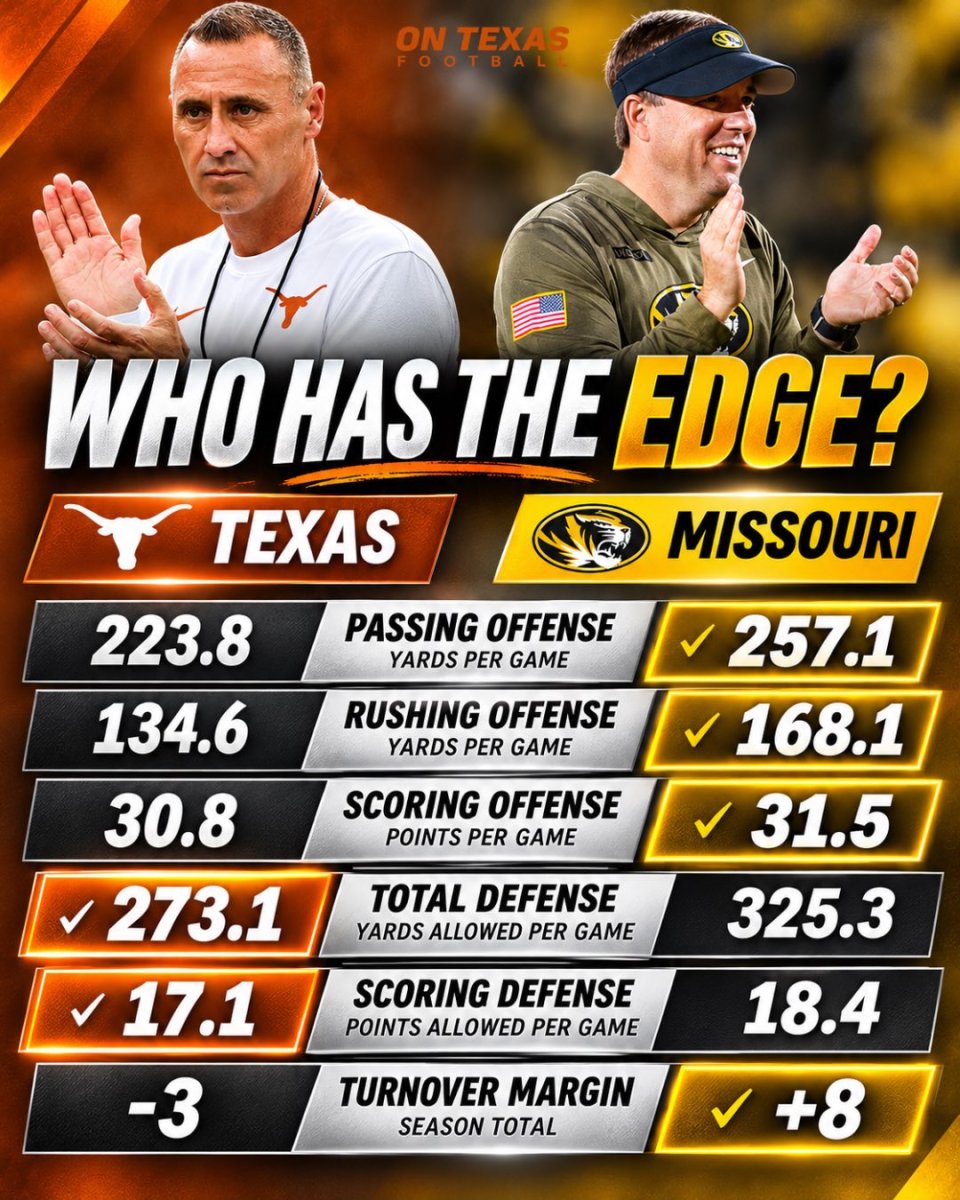
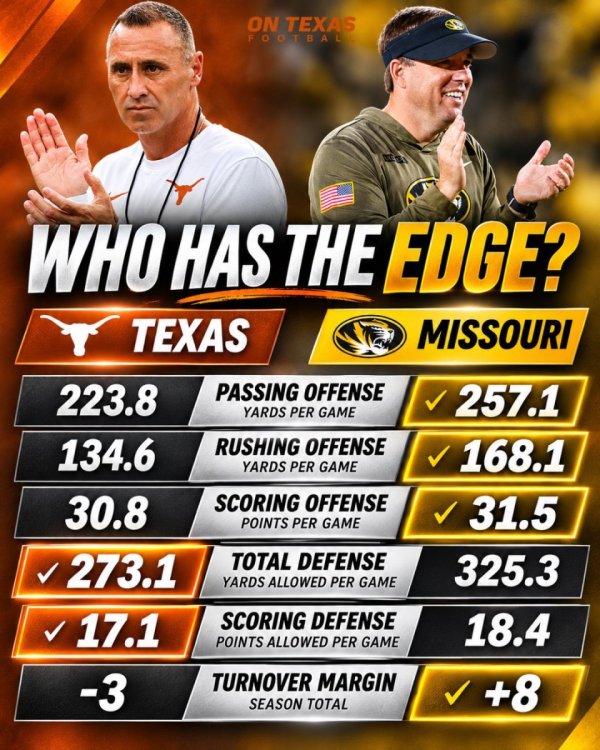
Some numbers to chew on with about 20 minutes to go until kick.
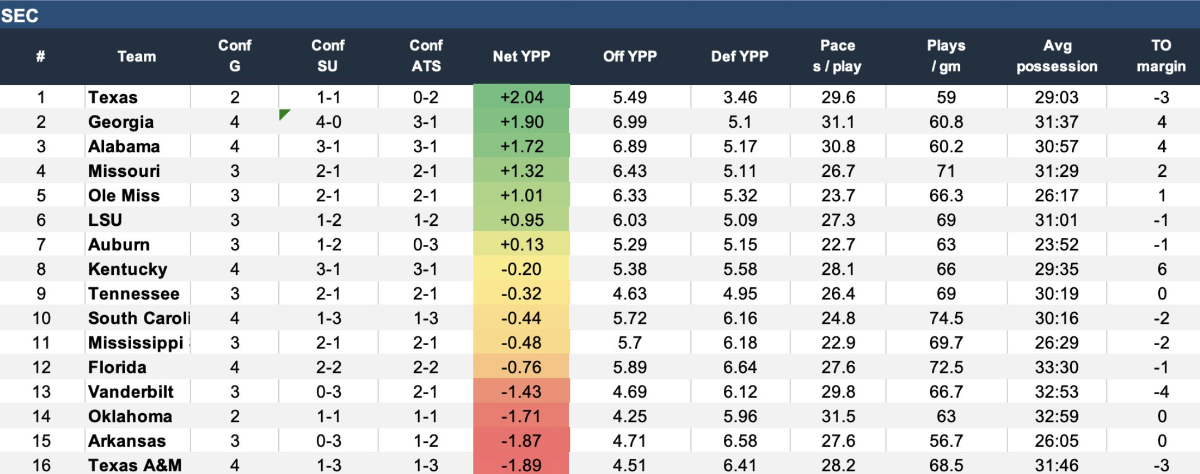
-
AUSTIN, Texas — More than two weeks ago, after a forgettable offensive showing in a 27-24 loss to Florida, Steve Sarkisian sat down with Arch Manning to discuss whether Texas would turn to KJ Lacey if QB1 couldn’t right the ship. On Monday, two days after Manning's three touchdown passes highlighted a 16-for-20, 220-yard performance in a 31-3 rout of Mississippi State, Sarkisian gave Manning a ringing endorsement. While answering a question about the offensive line during his weekly news conference, Sarkisian expressed the utmost confidence in Manning ahead of the 10th-ranked Longhorns’ trip to No. 19 Missouri on Saturday (11 a.m., ABC). “Honestly, I've never felt better about Arch Manning than I do this week,” Sarkisian said. “This guy is ready. He's a warrior. He's tough. His competitive spirit is extremely high. I thought he willed us to play football on the offensive side last week. That's what a quarterback does. “What a difference a few weeks make.” Whether Manning’s arrow is pointing upward after Texas (6-2, 3-2 SEC) faces a Tiger defense that ranks 16th nationally against the run (98.3 yards per game and 2.94 yards per carry allowed), 23rd in scoring defense (18.4 points per game allowed) and 37th in total defense (325.1 yards per game and 4.82 yards per play allowed) remains to be seen. Nevertheless, along with Missouri (6-2, 3-2) entering the game with a pass defense that’s tied for 92nd in FBS (226.9 yards per game allowed), the chances are favorable for Manning to build two winning performances because Sarkisian’s confidence could be rooted in the fact that he’s found a formula for success behind center that the Longhorns can replicate. The formula involves three things: — Making the quick game and screens the focal point of the passing attack After the win over the Bulldogs, 35 of Manning’s 48 pass attempts in his last two games were behind the line of scrimmage or short (0-9 yards downfield) based on Pro Football Focus’ four charted passing depths. Manning completed 28 attempts (72.9 percent of his charted-depth attempts) from those depths for 257 yards, one touchdown and one interception. Manning is 13-for-13 for 66 yards during the two-game winning streak. Short throws are more than just screens; hitches, slants, stop routes and underneath targets to running backs and tight ends force Manning to get the ball out quickly. A lot has been made about Manning holding onto the ball too long and rightfully so. According to PFF, Manning’s average time to throw this season is 2.99 seconds. Among 187 FBS quarterbacks who’ve recorded at least 50 dropbacks this season, Manning’s time is tied for the 34th-longest in the country. Holding onto the ball too long compounds Texas’ pass protection issues. Manning’s pressure-to-sack rate of 27.8 percent is pacing well ahead of his 2025 ratio (13.3 percent) and is on track to be the highest pressure-to-sack rate for a Longhorn starting quarterback since Shane Buechele in 2016 (31.3 percent). It should come as no surprise then that Manning is effective and efficient when he gets rid of the ball in under 2.5 seconds. According to PFF, Manning gets the job done at a high level when the ball is out of his hands in less than 2.5 seconds (it only happens on 39.4 percent of his dropbacks, which is tied for 150th among the 187 qualifying FBS quarterbacks); he’s completing 72.8 percent of his passes (75-for-103) for 681 yards, with nine touchdowns (tied for 18th in FBS) and one interception. The quick game works. If Sarkisian continues to lean into it, it could morph into an offensive fulcrum. — Limiting throws beyond 10 yards downfield to schemed-up deep shots According to PFF, Manning has only attempted four intermediate (10-19 yards) throws in the last two games (3-for-4, 46 yards and a touchdown), accounting for 8.3 percent of his attempts to a charted depth. That pales in comparison to the first six games of the season, when 23.8 percent of his charted-depth throws were in the intermediate game. Given the offense’s pass protection struggles and Manning’s sack avoidance (or lack thereof), Sarkisian might've decided the juice isn’t worth the squeeze. When Manning holds the ball for 2.5 seconds or longer, which has happened on 60.6 percent of his dropbacks, the results have been disastrous. According to PFF, Manning's completion percentage plummets to 57.5 percent in those situations; his six interceptions are tied for the fourth-most in FBS and he's been sacked 22 times (only four FBS quarterbacks have been sacked more times when holding onto the ball that long). Still, the Texas offense needs explosive plays. Sarkisian has settled on crafting carefully dialed-up deep shots to get the job done. Manning has thrown nine deep balls (20 yards or more downfield) in the last two weeks, accounting for 18.8 percent of his total attempts to specific depths. Two of Manning’s three completions on deep balls against Ole Miss and Mississippi State went for touchdowns (a 50-yarder to Ryan Wingo against the Rebels and a 42-yarder to Emmett Mosley V against the Bulldogs); overall, he’s 3-for-9 on deep shots for 129 yards, with only one of his deep throws getting intercepted (three interceptions on deep throws through the first six games). — Leaning on Manning’s legs as a weapon in the running game Sarkisian has been hesitant to rely on designed runs for Manning. Nevertheless, the numbers suggest he’s accepted that those plays are one of the most effective ways the Longhorns can move the ball. After Manning recorded six rushing attempts on designed runs through the first six games (according to PFF), he’s carried the ball nine times on such plays in the last two weeks. Those nine carries have netted Texas 31 yards and resulted in four first downs, with two of them going for touchdowns (both against Ole Miss). Manning also seems more sure of himself when scrambling. While his 24 scrambles through the first six games saw him gain yards that were effectively empty calories (positive yards well short of the line to gain on third down, for instance), Manning’s four scrambles in the last two games have helped the offense move the chains. Manning’s lone scramble for 19 yards in the win over Ole Miss came on third-and-17, two plays before his second-quarter touchdown pass to Wingo. Two of Manning’s three scrambles in the win over Mississippi State moved the chains, including a 10-yard scramble on third-and-9 en route to a second-quarter field goal by Gianni Spetic. Manning's 2026 season hasn't played out the way anybody hoped. Still, if the current formula can be replicated and Manning continues to grow, the Longhorns have a realistic path to reach the College Football Playoff.
-
AUSTIN, Texas — Matas Vokietaitis’ game-high 22 points led five players in double figures as No. 7 Texas 109-59 cruised to a season-opening win over Chicago State at Moody Center on Monday. There were signs of the Longhorns fulfilling Sean Miller’s desire to play a better brand of defense in his second season on the Forty Acres. Texas (1-0) forced 15 turnovers, recorded eight steals and blocked six shots, four of which came from Marcus Spears Jr. The highly-touted freshman scored 11 points and grabbed five rebounds off the bench in his collegiate debut. Spears headlined a productive opening night for the Longhorn freshmen. Austin Goosby (seven points, seven rebounds and eight assists) got the start alongside Vokietaitis, Isaiah Johnson (18 points, five assists, three rebounds and two steals), Elyjah Freeman (five points and four rebounds) and David Punch (nine points, three rebounds and three assists). Joe Sterling scored 14 points (4-for-6 3-pointers) off the bench and Bo Ogden (eight points, two rebounds and two steals) played well in 14 minutes.
-
Trend to Watch for Saturday *** Back with another statistic that isn't too favorable for the Texas offense. I know, I know. It's not very fun to talk about, and I am sure this is a point that is getting tiresome. But it quite literally could not have a larger discrepancy in conference rankings. We are back talking about three-and-out rates on offense. For a few weeks now, I have been tracking SEC offenses and their likeliness to punt after failing to gain ten yards and move the chains on their first three plays of a drive. It has been a true Achilles heel for the Texas offense so far this season, and the number has continued to rise over the last couple of weeks – How? Well, I don't want to get into that. But, here is the key statistic. *** Texas has the highest 3-and-out rate in the SEC so far this season. In eight games, the Longhorns have a 31.25% rate of going 3-and-out on offensive drives. On 96 drives, the Longhorns have punted after three plays on 30 so far this season. A sobering statistic. *** On the flipside, Missouri is the very best in the country at moving the chains on a given drive. Missouri has the lowest 3-and-out rate in the SEC so far at 12.12%. Only 12 of the Tigers' 99 offensive drives have gone 3-and-out. *** So when it comes to game flow, and when it comes to finding a way to play complementary football, there is no statistic that I have found so far in my early game prep that leads me to think the flow of the game will be more heavily dictated than one way or the other. How can Texas help itself out? No false starts, five men in the backfield penalties, or illegal shifts. The Longhorns had one of each against Mississippi State on Saturday in the 31–3 victory. Playing on the road is difficult in the SEC, Texas doesn't need to make it tougher than it already is.
-
Maraad Watson’s 61-yard scoop-and-score was the play of the game in No. 11 Texas’ 31-3 rout of Mississippi State on Saturday. But what Rasheem Biles did on that play encapsulated one of the most impressive individual defensive performances of the Steve Sarkisian era. Inside the last 90 seconds of the first half, Biles sacked AJ Swann on second-and-10. The hit knocked the Bulldogs’ starting quarterback out of the game. The loose ball bounced sharply off the DKR turf into Watson’s hands, adding insult to injury. Biles wasn’t done. He led the convoy that guided Watson down the visiting sideline and into the end zone, delivering a block that helped the Longhorns swing the momentum for good. Biles finished with eight tackles, three sacks, four tackles for loss and two forced fumbles. Will Muschamp deserves credit for weaponizing Biles in the defense’s two full games without Colin Simmons, but Biles executed the plan well enough to top his performance in last Saturday’s win over Ole Miss. *** Biles also helped Texas (6-2, 3-2 SEC) hold Mississippi State (4-4, 2-4 SEC) to a field goal after Arch Manning’s third-quarter fumble gave the Bulldogs the ball at the 28-yard line. Biles sniffed out an end-around to Anthony Evans III, stopping Mississippi State’s outstanding wide receiver for a 15-yard loss after Evans threw the ball out of bounds. *** The Longhorns sacked Swann and Billy Puckett a combined seven times. With its second game in SEC play with seven or more sacks (Texas had 10 in the conference opener against Tennessee), 21 of the defense’s 26 sacks this season have come in league play. *** Muschamp seemed to adjust after Swann got into a rhythm early with an 8-for-8 start, playing tighter coverage and dialing up the pressure on the quarterback. The threat of the vertical passing game went away when Puckett entered the game, allowing the Longhorns to tee off on the Bulldogs. The lost yardage on sacks contributed to Mississippi State finishing the game with 68 yards rushing, its second-lowest total of the season. Saturday’s effort against the run was the best of the season by the Texas defense, while the 1.7 yards per carry the Longhorns held the Bulldogs to was topped only by the 1.6 yards per attempt Texas held the Volunteers to on Sept. 26. *** We’ll see what (if anything) Sarkisian says about injuries after the game. Texas saw Cam Coleman, Hollywood Smothers, Kade Phillips and Graceson Littleton leave the field throughout the night. *** Mississippi State’s five sacks and eight tackles for loss established new season highs. Zach Arnett followed the plan that a lot of defensive coordinators have successfully deployed against the Longhorns, using late movement to cross up Texas’ blocking schemes and protections and throwing multiple pressures at Manning. Until the Longhorns can do a better job of picking up games, pressures and stunts, Manning can do a better job of determining where the ball needs to go and Sarkisian can make sure he’s got built-in hot routes and safety valves to help Manning get rid of the ball, Texas will continue to see pre-snap movement and face pressure from all directions. *** The Longhorns couldn’t get the traditional running game going. Even when taking out the lost yardage on sacks, Texas ended the game with 93 rushing yards (3.4 yards per attempt). *** Along with the offensive line’s forgettable performance, I thought Sarkisian got away from the things that worked against Ole Miss, namely the quick game and working the perimeter with screens. Clunky might be the best way to describe the offense on Saturday. Manning lost a fumble on the first drive of the third quarter for the second consecutive game and the Longhorns had five three-and-outs after finishing last week’s win over the Rebels with three. The whole operation wasn't right for large chunks of the game. *** Mac Chiumento’s average of 38.2 yards per punt won’t cut it in closer games against better competition. The punt team has left a lot to be desired, a problem that becomes more glaring when the offense sputters. *** Texas controlled the game from the jump. Saturday’s performance wasn’t good enough to beat Missouri or LSU, but at least the Longhorns took care of business. They can look forward to the first of three season-defining road games in November with a win in tow.
-
AUSTIN, Texas — It's fair to call Steve Sarkisian’s matchup against the opposing defensive coordinator the top in-game battle to watch in every Texas game. However, it's crucial that Sarkisian wins his battle against Mississippi State on Saturday (6:30 p.m., ESPN). Not just to help the 11th-ranked Longhorns build on what went right in last Saturday’s 34-27 win over Ole Miss, but to set the tone for November. “Zach Arnett is a guy who I have a ton of respect for as a defensive coordinator,” said Sarkisian, whose historic Alabama offense averaged 6.8 yards per play and racked up 499 yards in a 41-0 rout of the Bulldogs in 2020, Arnett’s first season as Mike Leach’s defensive coordinator. “They pose a ton of threats with the multitude of defenses that they throw at you and the athleticism that they play with.” No. 11 Texas (5-2, 2-2 SEC) will be on the road for three of its final four regular-season games, including back-to-back trips to No. 23 Missouri and No. 15 LSU. While the Bulldogs appear to be dead in the water with injured quarterback Kamario Taylor ruled out for the rest of the season, the Longhorns haven’t played well enough to overlook anyone left on their schedule. That’s especially true on offense. It’s good that the win over the Rebels saw Texas set season highs against a Power Four opponent in points, total offense (419 yards), rushing yards (207) and yards per carry (4.9). Now the Longhorns need to at least match their most recent performance to establish some much-needed consistency. Specifically, the Texas will attempt to establish the run and stick with it against a Mississippi State (4-3, 2-3 SEC) run defense that’s been solid through seven games. Even with Raleek Brown coming off a 157-yard performance against Ole Miss, including three of Texas’ eight rushing plays of 20 yards or more this season, the Longhorns can’t expect to plow through a Bulldog defense that’s the nation’s No. 46 unit against the run (124.8 yards per game allowed). Mississippi State is also a top-50 defense in yards per carry allowed (3.66, tied for No. 44 in FBS); rushing attempts of 10 or more yards allowed (20, tied for 14th); rushing attempts of 20 or more yards allowed (four, tied for No. 19 in the country) and rushing touchdowns allowed (five, tied for 13th). The challenge for a Texas offensive line coming off its most noteworthy performance of the season is keeping the offense on schedule and limiting negative plays against a defense that’s had trouble creating them. The Bulldogs are tied for 83rd in the country in tackles for loss (35 total and five per game), 91st in line yards per carry allowed (rushing yards attributed to the opposing offensive line using weighted yardage) and 124th in stuff rate (the percentage of an opponent’s rushing attempts stopped at or behind the line of scrimmage). With 42 carries against the Rebels (including sacks and kneel-downs), the Longhorns improved to 25-2 under Sarkisian when recording 40 or more official rushing attempts, including 14 consecutive wins in 40-carry games. It’s not a coincidence that Texas controlled the late stages of the game on the ground in its two wins over top-10 opponents (Ole Miss and a 24-23 win over then-No. 1 Ohio State on Sept. 12). The Longhorns ran the ball on 13 of their last 14 plays from scrimmage against the Rebels, ending a 6-play, 80-yard drive with a touchdown and an 8-play, 44-yard drive with a field goal. The best way Sarkisian can help Andre Cojoe settle in during his first career start, get Arch Manning into a rhythm, maximize the play-action deep shots he wants to dial up and keep the offense on schedule is to be patient with the running game. The Longhorns don’t need to match their production on the ground from the Ole Miss game against Mississippi State, but the rushing attack must be effective enough for Sarkisian to trust it for four quarters. TEXAS WIDE RECEIVERS vs. MISSISSIPPI STATE CORNERBACKS According to Pro Football Focus, Manning has been pressured on 80 dropbacks this season (tied for No. 35 in FBS and tied for the sixth-most in the SEC). He’s been blitzed 109 times through seven games, including 18 times on 33 dropbacks against the Rebels. After Florida blitzed Manning 18 times in 28 dropbacks two weeks ago, he’s been blitzed at a 59-percent rate in the last two games. Arnett has blitzed three of the seven Power Four quarterbacks the Bulldogs have faced on more than 30 percent of their dropbacks: Minnesota’s Drake Lindsey (48 percent), Missouri’s Austin Simmons (31.7 percent) and Alabama’s Keelon Russell (55.6 percent). Although Mississippi State’s pass defense is putrid (No. 129 in FBS, allowing 267.4 yards per game; 69 completions of 10-plus yards allowed is tied for 106th; 27 completions of 20-plus yards allowed is tied for 117th), the Bulldogs have one of the SEC’s top cornerback tandems in Jett Jefferson and Kelley Jones, who rank first and fifth in the conference in passes defended, with nine and seven, respectively. If Arnett feels Mississippi State’s only chance to survive is to do what the Gators did and get to Manning before he can get rid of the football, the Texas wide receivers must win one-on-one battles, especially when the Bulldogs are in man coverage. According to PFF, Jefferson and Jones only play a quarter of their snaps in man coverage. While nine targets against Jones in man coverage have resulted in only four completions and 47 yards, four of the seven catches Jefferson has allowed in man coverage have been touchdowns. JELANI McDONALD vs. FLUFF BOTHWELL After injury limited him to one carry in Mississippi State’s 56-23 loss to Alabama on Oct. 3 and forced him to miss the team’s 31-0 road loss to LSU on Oct. 17, Bothwell returned to action and recorded his fourth 100-yard game of the season (111 yards on 17 carries) in a 23-15 loss to Oklahoma last Saturday. Jeff Lebby’s Veer-and-Shoot offense naturally creates vertical seams in the running game and a lot of one-on-one opportunities for running backs to win against opposing safeties. That puts the spotlight on McDonald to keep Bothwell from getting loose, which he can do if he builds on last week’s 12-tackle performance, with an interception and a pass breakup. McDonald had a career-high 14 tackles in last season’s win in Starkville. He should be in line for another double-digit tackle game, especially if Will Muschamp continues to line him up as the middle safety in a three-high shell. The Longhorns utilized their three-safety look on roughly one-third of their snaps against Ole Miss, a defensive structure that only works if McDonald properly diagnoses what the offense is doing, primarily when it comes to fitting the run properly. Since the Bulldogs love to crank up the tempo offensively, McDonald getting lined up quickly and dissecting what’s happening in front of him at a breakneck pace will be a battle in and of itself. Then, McDonald will try his hand at wrapping up Bothwell, who ranks seventh in the SEC in yards after contact (382 total yards and 4.2 yards per attempt) and eighth in missed tackles forced (25).
-
Depth on Display for the Texas Defense this Weekend? *** Texas is set to host Mississippi State on Saturday without their starting quarterback Kamario Taylor. The Bulldog offense was quite literally limping into the game this week to begin with, but now with Taylor officially sidelined, it feels like a significantly tall task to find a way to put points on the board against this Texas defense. Las Vegas tends to agree with me as well. The line at the moment sits with the Longhorns favored by 21-points, the largest point spread of the season vs. a P4 team for Texas. If – and I understand this is a big if – Texas is able to take care of business offensively, it is likely the need to play the core group of starters the entire game won't be there for 60 full minutes. On Thursday morning, Texas head coach Steve Sarkisian was asked about the depth of a few positions, with the underlying question of are the second and third stringers closer to the field this deep into the season? Starting in the secondary, Sarkisian says he there are some guys to watch. "I think naturally, you know, getting Kobe (Black) back healthy, 100 healthy is going to be big for us," Sarkisian said. "I think Jonah (Williams) has been making strides. I think Toray Davis has been making strides for us there. All those guys kind of in that in that circle. I think Smoke Matthews is a guy that's continuing to grow, and he's found a more of a niche on special teams. Sarkisian added that Texas is getting a healthier version of Xavier Filsaime each week in practice as well. Filsaime has not logged a snap in 2026 despite playing in ten games a year ago with two starts At linebacker, Texas is coming off of a game against Ole Miss where Rasheem Biles and Justin Cryer played 100% of snaps. All 85 defensive snaps for the Longhorns had Biles and Cryer on the field. "Naturally in most defenses really good linebackers stay on the field. If we get to a point to where we can rotate some of those guy. we will do so," Sarkisian said. "Obviously, the temperatures have dropped. We're not playing at 105 degrees out there anymore. It's a little more you know 70–75º degrees and that should allow us to play 10 to 12 more snaps and feel confident in doing so." Additonally, Sarkisian mentioned Brad Spence was getting more time at edge this week alongside Lance Jackson, Zina Umeozulu, Colton Vasek and the rest of LaAllen Clark's room. I think that speaks to Texas planning for life without Colin Simmons for another week at the very least. Additionally, Sarkisian said Thursday that he expects to get freshman edge Richard Wesley back on the field in "the next couple of weeks." But when it comes to the depth and some of those twos and threes that have yet to see a ton of time this year, this is a great opportunity on Saturday to keep the workload light for the starting defense and stack much needed depth for the remainder of the 2026 season, plus whatever postseason comes as a result. "Sometimes the games dictate when we can roll guys in there more," Sarkisian said. "We haven't had that luxury. We've been in so many tight games this year, but we're going to have to find a way and a time to get some of these guys in there."
-
Whether Trevor Goosby comes back to Texas for another season in 2027 or enters the NFL draft, the Longhorns know they’ll be without their All-American candidate at left tackle for the rest of the 2026 season. Goosby’s patellar tendon injury means Andre Cojoe, who played 62 snaps at left tackle in Saturday’s 34-27 win over Ole Miss, is the next man up for No. 11 Texas (5-2, 3-2 SEC). Much like Will Muschamp’s conundrum of doing multiple things to make up for Colin Simmons’ absence, the Longhorn offensive line can’t replace Goosby with one player. With that said, there are three things Steve Sarkisian and Kyle Flood can do to help Cojoe hold serve and allow the offense to build on a performance against the Rebels that included season highs in total yards (419), rushing yards (207), yards per carry (4.9) and points against a Power Four opponent. 1. Lean into Cojoe’s ability as a run blocker Cojoe moved people on Saturday and his ability to cave in or seal the backside of Texas’ stretch runs opened cutbacks for Raleek Brown. Cojoe and Dylan Sikorski got a lot of work together in camp while Goosby was dealing with a knee injury (bone bruise). Their familiarity paid off in the win over Ole Miss; according to Pro Football Focus, the Longhorns rushed for 148 yards (9.9 yards per attempt) on A-, B- and C-gap runs to the left. 2. Get Jordan Coleman more snaps Sarkisian shouldn’t hesitate to use the jumbo package with Coleman as the sixth offensive lineman beyond goal-to-go runs inside the 5-yard line. Four of the seven snaps Coleman has logged this season have ended with a rushing touchdown, including two on Saturday (Michael Terry III's 2-yard run in the second quarter and Arch Manning’s 1-yard keeper in the fourth quarter). The win over the Rebels proved again that when the Longhorns get their hats on opposing defenders, they can move people and create creases for the backs. Coleman (356 pounds) and Cojoe (339 pounds) give Texas a large surface to run behind. Plus, the more snaps Coleman gets, the more ready he’ll be if something happens to Cojoe or Melvin Siani (Coleman made strides at left tackle with the first-team offense during spring practice while Goosby was out, recovering from shoulder surgery). 3. Keep prioritizing the quick passing game Sarkisian dialed up screens to get Manning into a rhythm and to get the ball to his playmakers in space early in the game. But the highest percentage of Manning’s pass attempts against Ole Miss were thrown up to nine yards beyond the line of scrimmage (36.7 percent, according to PFF). Although one of Manning’s interceptions came within this depth, he was 7-for-11 for 77 yards. Manning was 5-for-6 for 56 yards on pass attempts to the middle of the field up to nine yards beyond the line of scrimmage, including first-down throws to Emmett Mosley V (23 yards), Cam Coleman (12 yards), Jermaine Bishop Jr. (11 yards) and Michael Masunas (10 yards). The quick game can increase Cojoe’s margin for error as the blindside pass protector, which should lead to fewer plays like the strip-sack that led to a Rebel touchdown. Establishing the quick game can also force the defense to tighten things up in coverage, which should then open up the deep shots Sarkisian likes to take (although leaving a tight end and/or running back in to help will be required, especially when the Longhorns face top-quality edge defenders from Missouri and LSU). To help a struggling or unproven pass protector, an offensive coordinator can do one of three things: lean on calls to force the quarterback to rid of the ball quickly, keep extra blockers in to help with protection or put more receivers out into the route. Expect Sarkisian to look at all of those options to compensate for losing an NFL-caliber prospect at one of the most important positions on the field.
-
Forget the SEC championship, the College Football Playoff or anything besides No. 19 Texas hanging on for a 34-27 win over No. 7 Ole Miss. The Longhorns stopped the bleeding from a two-game losing streak. It wasn’t pretty. Texas (5-2, 2-2 SEC) tied the Steve Sarkisian-era single-game record with 14 penalties and set a new single-game high with 121 penalty yards. A 24-3 halftime lead evaporated in the second half. The Rebels scored 21 points to tie the game while the Longhorns were mired in an all-too-familiar lull, with five consecutive possessions ending in a fumble, three punts and an interception. For the second time in SEC play, the hands team couldn’t recover a late-game onside kick. The botched recovery made this Texas' third conference game decided on the last play. Nevertheless, the Longhorns overcame their second-half struggles to get a much-needed win. The offense ended the game with a pair of scoring drives and the defense, although things got leaky in coverage, forced a punt, blocked a field goal and intercepted Trinidad Chambliss for the third time on three of Ole Miss’ (5-2, 3-2) last four possessions. *** Sarkisian, to his credit, was committed to the run down the stretch and it paid off. Raleek Brown and Michael Terry III carried the ball on the first five plays of a 6-play, 80-yard touchdown drive to regain the lead in the fourth quarter. Other than a short pass to Ryan Wingo on the first play of the Longhorns’ last drive, Arch Manning was involved in two plays: his 1-yard touchdown run (on a bootleg that was wide open, similar to his first touchdown, both of which were good calls by Sarkisian, since Manning hasn't been the ball carrier in those situations) and a 2-yard scramble on the play before Gianni Spetic’s 33-yard field goal. With 207 yards on 42 official rushing attempts, Texas improved to 25-2 under Sarkisian when recording at least 40 official rushing attempts in a game. Although the 40-carry mark includes plays like sacks and kneel-downs, it reflects a dedicated effort to run the football. That’s what Sarkisian did to get the offense in gear in the fourth quarter. *** Brown’s 157 yards (6.8 yards per carry) is the best yardage day by a Longhorn since Tre Wisner went for 186 yards in the 2024 regular-season finale against Texas A&M. Wingo’s 111-yard performance included a 50-yard touchdown catch from Manning. Their efforts made Saturday’s win the first Texas game with a 100-yard rusher and a 100-yard receiver since Jonathon Brooks and Xavier Worthy did it against TCU on Nov. 11, 2023. Even though the offense mustered just 19 net yards in the third quarter, the Longhorns finished the game with 419 total yards (5.8 yards per play). Since joining the SEC, Texas is 9-0 when it records at least 400 total yards. *** Brown’s ability to read zone runs and hit open cutback lanes helped Texas avoid a third consecutive loss. Brown ran with vision and violence, two things he hasn’t shown consistently as a Longhorn. *** When Texas needed some thump in the running game, Terry delivered (41 yards and a touchdown on eight carries). Terry’s two explosive runs (12 yards and 19 yards) on the 80-yard touchdown drive made him the big, physical back between the tackles the Longhorns figured they'd miss with Derrek Cooper not yet back to 100 percent. *** Rasheem Biles was all over the field. It’s hard to believe he was credited with only four tackles (one tackle for loss, two pass breakups, and four quarterback hurries). Biles’ fourth-and-goal interception was one of the game's pivotal plays. He also pressured Chambliss on a critical third down in the first half, forcing a rushed throw that fell incomplete as the Rebels settled for a field goal. On a day when Will Muschamp manufactured pressure with the absence of Colin Simmons, Biles pressured Chambliss and was around the ball on critical downs. *** Along with Biles, Justin Cryer (five tackles, an interception and a pass breakup) came up big for the Longhorns. Chambliss tested the Texas linebackers in coverage and they were up for the challenge. *** Muschamp deserves a lot of credit for Chambliss’ rough start. He dialed up different pressures, but showing blitz and then dropping defenders seemed to throw off Chambliss’ timing in the first half. *** Things are by no means fixed on the Forty Acres. Sarkisian must resolve the team’s third-quarter woes (I still don’t know why he gets away from things that work early). The kicking game is still way too feast-or-famine. Penalties remain a problem. Manning had moments of brilliance mixed with critical mistakes and the offense left points on the field. Ole Miss had 162 of its 364 total yards (44.5 percent) in the fourth quarter. Still, the Longhorns deserve credit for pulling it together and executing well enough, long enough to win. While this team shows no signs of getting off the rollercoaster any time soon, Saturday’s win was one in which their stretches of good play outweighed the bad.
-
Note on Michigan commit Xavier Muhammad (post visit) Texas hosted Shadow Creek (formerly South Houston) DL Xavier Muhammad yesterday. In talking with a source, Muhammad checked in a 6-4, 305. That is up from around 265-270 junior season. Texas is making a push, and the flip is certainly in play. He got the full court press from Will Muschamp and Kenny Baker yesterday. The Longhorns have been making a push with Texas Tech DL K'Adrian Redmond too, but that one is long shot if not dead at this point. Texas has planned to sign four DL's in the class if they can find the fits. OTF will have more later today.
-
It’s time to tackle “One Burning Question,” an On Texas Football in-season feature where we’ll examine a question facing the Texas Longhorns as they enter a game. On Sunday, we’ll revisit the question to see whether Steve Sarkisian’s team answered it successfully. This week, with No. 19 Texas (4-2, 1-2 SEC) welcoming No. 7 Ole Miss (5-1, 3-1) to Royal-Texas Memorial Stadium on Saturday (6:30 p.m., ABC), the question is: With the season on the line, can the offensive line come through? There have been times throughout the first six games of the season when the offensive line has done its job. While the flashes have been few and far between, Kyle Flood’s group makes things happen when they’re on the same page and execute Sarkisian's calls. The fleeting moments of quality trench play aren’t what Texas fans had in mind when Sarkisian and Flood set out to rebuild the offensive line after the 2025 season. Considering how the Longhorns overcame a rough start to the transfer portal cycle and landed two players targeted by other SEC programs (Melvin Siani and Dylan Sikorski) and added depth when Laurence Seymore was granted another season of eligibility, the situation up front is worse than it was last season. Traditional statistics tell an unsavory story. Texas is tied for 121st in FBS in sacks allowed (2.83 per game), is tied for 135th in tackles for loss allowed (7.8 per game) and is on pace for the program’s lowest output in points per game (30.2) and yards per play (5.45) since 2017. The 362.3 yards per game (No. 92 nationally) the Longhorns are averaging is on pace to be the worst season for total offense on the Forty Acres since 2014 (Shawn Watson’s offense averaged 337.3 yards per game). Texas enters Saturday’s game against the Rebels ranked 101st nationally in rushing yards per game (136) and 120th in yards per carry (3.64). The Longhorns haven’t run the football with this little success since the 2002 offense averaged 135.5 yards per game on the ground, an average buoyed by Cedric Benson’s 1,293-yard sophomore season. Advanced statistics don’t put the Texas offense in a flattering light either. Line yards per carry measures an offensive line's effectiveness through weighted yardage. The offensive line is credited with 120 percent of the negative yards on running back carries stopped behind the line of scrimmage and 100 percent on carries that gain 0-4 yards. Texas is 115th out of 138 FBS offensive lines. The Longhorns are 97th nationally in stuff rate, which calculates the percentage of rushing plays stopped at or behind the line of scrimmage. Power success rate is the percentage of third- and fourth-down runs with two or fewer yards to go that result in a first down or a touchdown. Texas is No. 98 in the country, with 69.4 percent of its runs moving the chains or reaching the end zone in those situations, The offensive line isn’t solely to blame for the offense’s struggles. Still, things won’t improve if an ailing backfield that could be without Hollywood Smothers (shoulder) on Saturday doesn’t have room to operate and the quarterback (whether it’s Arch Manning or KJ Lacey) is under constant duress. The group can’t fade in the second half as they did in last Saturday’s 27-24 loss to Florida. After racking up 114 yards on 18 non-sack rushing attempts in the first half, Texas netted just 14 yards on seven non-sack rushing attempts after halftime. Those seven carries included Smothers losing three yards on third-and-1 on the offense’s first possession of the third quarter, Raleek Brown getting dropped for a 2-yard loss on the first play of the next series and Manning losing three yards while trying to run for a first down on a fourth-and-2 at the 8:30 mark of the fourth quarter. There’s a chance Sarkisian and Flood will make personnel changes for the Ole Miss game. They could stand pat and hope Saturday is the day when everything comes together. Regardless, if the Longhorns can’t move the chains and limit the time that Trinidad Chambliss and the Rebels’ potent offense are on the field, things could get out of hand. The offensive line is out of time to figure things out. It’s now or never for a unit that’s fallen woefully short of the most measured preseason expectations through six games.
-
If No. 19 Texas is going to avoid losing a third consecutive game when No. 7 Ole Miss rolls into DKR on Saturday (6:30 p.m., ABC), these five matchups must go the Longhorns' way. 1. Texas’ Third-Down Offense vs. Ole Miss’ Third-Down Defense With the Longhorns going three-and-out on 46.2 percent of their offensive possessions against Tennessee (six of 12 drives), Oklahoma (seven of 15 drives) and Florida (five of 12 drives), it shouldn't come as a shock that Texas has the worst third-down offense in SEC play. The Longhorns moved the chains at an 8-for-36 clip in their first three conference games, including a 2-for-10 showing in their loss to the Gators last Saturday. The Rebels, however, have struggled to get off the field on third down. Pete Golding’s defense allowed its first four SEC opponents to go 30-for-61 (49.2 percent conversion rate) on third down, with Florida posting a 6-for-10 effort in its 52-28 rout of Ole Miss at the Swamp on Sept. 26. Unlike when it failed to take advantage of the Gators’ porous pass defense last week, Texas must take advantage of a perceived weakness and be at its best on third down to keep the Rebels’ potent offense off the field and to regain some much-needed confidence on offense. 2. Texas’ Defensive Line vs. Ole Miss’ Offensive Line We’ll see how the availability report looks closer to kickoff, but Wednesday’s report included three starting offensive linemen for the Rebels: left tackle Terez Davis (questionable), right guard Patrick Kutas (probable) and center Brycen Sanders (questionable). Kutas, who was named SEC Co-Offensive Lineman of the Week for his performance in Ole Miss’ 31-3 win over Missouri last Saturday, slid from guard to center in place of Sanders. Even though the Rebels had to move pieces around and didn’t have a 100-percent healthy Kewan Lacy in the backfield, they still rushed for a season-high 257 yards (6.8 yards per attempt) against the Tigers, led by Lacy’s season-high 122 yards on 16 carries. If Colin Simmons is out, it’ll be up to the interior of the Longhorn defensive line (Ian Geffrard, Alex January, Hero Kanu and Maraad Watson) to set the tone, while an EDGE group that’ll be without Richard Wesley adjusts to life without Simmons. According to Pro Football Focus, 448 of the 990 rushing yards Ole Miss has gained this season have come on A- and B-gap runs. Another 293 yards have come on D-gap runs, making setting the edge and keeping contain the top priorities for Lance Jackson, Zina Umelozulu and the Texas edge defenders. Additionally, the Rebels are No. 2 nationally in pass blocking efficiency according to PFF, allowing just 22 total pressures on 235 pass attempts. When opponents pressure Chambliss, it’s hard to get home and get him on the ground, with Chambliss’ 12.2 percent pressure-to-sack rate ranking third among SEC quarterbacks who’ve been pressured on at least 15 dropbacks this season. While the Ole Miss front might be banged up, it’ll take the best effort of the season from Kenny Baker and LaAllan Clark’s groups to keep the Longhorns in the game. Texas will have to earn its opportunities to rush the passer on Saturday. 3. Texas Wide Receivers vs. Ole Miss Defensive Backs Whether Arch Manning or KJ Lacey is behind center for the Longhorns, the game plan is likely to call for a lot of screen passes and quick throws to the perimeter. Against a secondary missing nickelback Edwin Joseph (the Florida State transfer suffered an ankle injury in Ole Miss’ 52-17 road win over Vanderbilt on Oct. 10), the Texas wideouts can control the game if they can maximize their opportunities in space. Based on PFF’s missed tackle data, 47.2 percent (34 of 72) of the Rebels’ missed tackles have come when defending the pass, the second-highest percentage of any defense in the SEC (Kentucky has missed 53.5 percent of its tackles in the passing game). Even though Jermaine Bishop Jr. only has 10 receptions on the season, no Longhorn has forced more missed tackles on receptions (four) than the true freshman, according to PFF. Forcing Ole Miss players to make plays in space is one of the few things Steve Sarkisian should feel his offense does well enough to make it a significant part of how he attacks Golding's defense. 4. Texas Linebackers vs. Trinidad Chambliss No SEC quarterback is better in the intermediate passing game than Chambliss. According to Pro Football Focus, which has Chambliss graded at an SEC-leading 91.2 on throws 10-19 yards downfield, he's completing 60.9 percent of his intermediate throws for 647 yards, with six touchdowns against three interceptions. Intermediate throws are Chambliss’ second-favorite passing depth, according to PFF, with 30.5 percent of his attempts attacking the area 10-19 yards beyond the line of scrimmage. Furthermore, 19.5 percent of his attempts have been intermediate throws in the middle of the field, where he’s 25-for-41 on the season, with 464 yards and five touchdowns (two interceptions). It’s a big week for the Longhorn defense against one of the nation’s top quarterbacks. On top of handling their responsibilities of containing Chambliss’ playmaking ability when things break down, Rasheem Biles, Justin Cryer and any other Texas linebacker on the field need to be especially ready to answer the challenge when Chambliss targets them in coverage. 5. Ryan Niblett vs. Oscar Bird Bird, who came to Oxford in 2025 by way of Australia, is already Ole Miss’ all-time leader in career punting average (46.5 yards per punt). Bird is averaging 48.6 yards per punt this season; six of his 18 punts have been downed inside the opponent’s 20-yard line (only one touchback) and seven of his punts have traveled 50 or more yards, including a season-best 60-yarder against Florida. The Longhorns can’t afford to give up field position. Niblett proved last week that he can still make things happen when he makes the first would-be tackler miss, but catching the football cleanly and helping the offense avoid situations where it has to start a possession near its goal line are of the utmost importance against the Rebels.
-
Wednesday's Injury Report *** EDGE Colin Simmons is listed as DOUBTFUL. RB Hollywood Simmons is QUESTIONABLE. EDGE Richard Wesley is OUT.
-
Steve Sarkisian faces the toughest on-field decision of his six-season tenure as No. 19 Texas welcomes No. 7 Ole Miss to DKR on Saturday (6:30 p.m., ABC). Will he continue to ride with Arch Manning as the Longhorns’ starting quarterback, hoping Manning can reverse course and stop his precipitous slide? Or will Sarkisian pull the plug and give KJ Lacey an opportunity to spark the offense? Other than resolving the quarterback conundrum, there are things Sarkisian and the Texas (4-2, 1-2 SEC) coaches can do to avoid the program’s first three-game losing streak since the Longhorns dropped five in a row late in Sarkisian’s 2021 debut. Here’s the checklist Texas must complete to stop the bleeding and get a much-needed win over the Rebels. — Pick an offensive identity and ride with it Sarkisian wants to be creative while being true to who the Longhorns are as an offense. That sounds good, in theory, but the offense needs consistency to be consistent. Between the quarterback situation, the offensive line coming off a forgettable performance in last Saturday’s 27-24 loss to Florida and Hollywood Smothers dealing with an apparent shoulder injury, Sarkisian’s hand could be forced when deciding how to attack Pete Golding’s defense. While there are times when the running game clicks, specifically when Sarkisian relies on duo and inside zone calls to get the job done, it’s not consistent enough to count on it when it matters. If Smothers and/or Derrek Cooper can’t go against Ole Miss (5-1, 3-1), Sarkisian might not have a choice but to lean into being an offense that operates almost exclusively out of 10 and 11 personnel. Especially if Raleek Brown is the only reliable runner available, getting the ball to Jermaine Bishop Jr. and Ryan Wingo in space with schemed-up deep shots for Cam Coleman and Emmett Mosley V sprinkled in might be the most effective means of moving the chains and setting up scoring opportunities. Whether it’s that or something else, Sarkisian can’t afford to waste possessions trying to figure out what might work. Be aggressive by focusing on the few things the offense has shown it can execute and, if the results are good, don’t pivot until Golding adjusts. — Have a plan to deal with Will Echoles According to Pro Football Focus, the 6-foot-3-inch, 315-pound future NFL draft pick has logged 199 of his 275 snaps in the B gap. That means Brandon Baker and Dylan Sikorski will have their hands full. Echoles’ 14 total pressures (according to PFF) are tied for the fourth-most among SEC interior defensive linemen. He leads the Ole Miss defensive line with eight stops (a solo tackle that constitutes a failure for the offense) and his 81.6 season-long PFF grade against the run is the 11th-best among SEC defensive linemen. Echoles is a game-wrecker. Considering the damage David Stone and Jayden Jackson did two weeks ago in Texas’ loss to Oklahoma in the Red River Shootout, the offense’s fate could hinge on how the interior of the Longhorn offensive line handles Echoles. — Prioritize communication and execution in coverage If Colin Simmons can’t go, Will Muschamp will have to take risks to put pressure on Trinidad Chambliss. When he turns up the heat, the Texas secondary will be vulnerable, meaning one-on-one battles must be won on the back end to give the Longhorns a chance. Only three of Chambliss’ 11 scrambles this season (according to PFF) have come from a clean pocket. Instead of bailing early and trying to make something happen when he feels the rush, Chambliss is executing at a high level against pressure, especially when he’s been blitzed. According to PFF, Chambliss has been blitzed on 36.4 percent of his dropbacks this season. Against the blitz, Chambliss is completing 62.7 percent of his passes (47-for-75) for 608 yards with six touchdowns and one interception. Chambliss has only been sacked twice on blitzes this season, resulting in an exceptional 8.7 percent pressure-to-sack rate (Manning, by contrast, has a 29.7 percent pressure-to-sack rate against the blitz this season, according to PFF). This week, coverage busts will lead to catastrophic mistakes. Whether Muschamp has his secondary playing man or zone coverage, communication and execution must be the best they’ve been all season to avoid getting burned by one of the nation’s top playmaking quarterbacks. — Prepare to maximize the “Middle 8” Losing the last four minutes of the first half and the first four minutes of the second half cost the Longhorns dearly against Oklahoma and Florida. Settling for a field goal on their last drive of the first half against the Sooners was bad enough, but the offense went three-and-out to open the third quarter and Oklahoma used a 42-yard run by Lloyd Avant to set up a 53-yard field goal by Tate Sandell, making it a one-score game. Sarkisian’s fourth-and-1 gamble backfired against the Gators, putting the Texas defense on a short field with 2:44 remaining until halftime. Florida converted a fourth-and-12 on its ensuing 9-play, 49-yard drive, cutting the Longhorns’ lead to a touchdown (17-10) with 18 seconds remaining in the half. The Gators got the ball to start the third quarter and went 3-for-3 on third down, covering 69 yards in 15 plays and milking more than eight minutes off the clock to tie the game. Texas has been outscored 37-14 in the second half of each of its last two games. The momentum in both losses started mounting for the opponent when the Longhorns failed to end the first half or start the second half on the right foot, a trend that must be reversed to give themselves a shot at knocking off the Rebels.
-
I believe it will be closer to 50-50 first team reps than thought/reported.
-
It’s time to revisit On Texas Football's “One Burning Question,” where we ask a question about the Texas Longhorns heading into a game. Entering Saturday’s 27-24 loss to Florida, the burning question was: Can Steve Sarkisian and Arch Manning get on the same page? They didn’t. It was bad enough that Sarkisian must at least entertain a quarterback change. Sarkisian is ultimately to blame for the Texas (4-2, 1-2 SEC) offense woefully underperforming. He assembled a roster he believed could execute his offense at a championship level. After Saturday’s loss to the Gators, the Longhorns rank among the worst offenses in the country in total offense (93rd), yards per play (tied for 104th), rushing offense (102nd), 10-yard plays from scrimmage (tied for 81st) and 20-yard plays from scrimmage (tied for 126th). Nevertheless, things came to a head in Sarkisian’s 19th consecutive game with Manning as his starting quarterback. Another week of blown opportunities, missed assignments, poor decision-making and Manning’s catastrophic mistakes overshadowing his positive plays might force Sarkisian to make a move that seemed unfathomable a few weeks ago. Sarkisian had hot routes to help Manning handle blitzes. He simplified his quarterback’s reads. There were run-pass options where Manning could've used his legs to jumpstart the offense. Manning, however, didn’t execute enough of those things to keep the offense from another feast-or-famine outing. Whether Manning isn’t confident enough to pull the trigger, can’t process what’s unfolding in front of him or is locked onto a predetermined read at all times, Sarkisian can no longer field an offense in which the starting quarterback needs training wheels. Manning’s inability to get rid of the football on time cost the offense time and again against Florida, most notably on Myles Graham’s strip-sack that ended Texas’ comeback bid. Manning appeared to have Emmett Mosley V open on an out route, but he held the ball too long and succumbed to pressure, for the fifth and final time (the Longhorns have allowed 17 sacks in three games and are tied for 117th in FBS by allowing 2.83 sacks per game), resulting in a game-clinching turnover. On second-and-3 from the Gators’ 16-yard line in the second quarter, Manning appeared to miss a pull read on a run-pass option. Had he pulled the ball instead of handing it off to Hollywood Smothers for a 4-yard loss, Manning could’ve either run for the first down or flipped the ball to Nick Townsend, who was open after leaking into the flat and had a chance to score. Instead of taking a two-touchdown lead, Texas settled for a field goal. Manning doesn’t appear capable of getting the offense out of a bad play (multiple rushing attempts into an outnumbered box and waves of unblocked defenders coming free on blitzes) or changing protection with a pre-snap check at the line of scrimmage. He’s incapable of making those decisions or doesn’t have Sarkisian’s trust to do so, either of which would be a serious indictment of Manning’s development (or lack thereof). There’s no question now that Manning has regressed. Attributes that were his strengths (pocket awareness chief among them) have become weaknesses that are holding the offense back. Whether Manning’s confidence has eroded to the point that he can’t regain or rebuild it is a legitimate concern. Is he broken? Can he fix what’s ailing him? If he does, will it happen before the house of cards collapses? The Sarkisian-Manning era was on a championship trajectory after last month’s comeback win over Ohio State. Five weeks later, Sarkisian might be closer to pulling the plug and starting anew than he is to riding it out, waiting for Manning to get back on track.
-
I heard they smoked SMU today … by 30+
-
If you can’t win your get-right game, then you’re the get-right game. That’s what No. 7 Texas was for Florida in Saturday’s 27-24 loss, a defeat that drove home a few realities about where the Longhorns are halfway through the 2026 season: — The offense is broken and I don’t think Steve Sarkisian can fix it. It’s beyond sticking with the running game or dialing up high-percentage throws to get Arch Manning into a rhythm. Outside of the opening script and a late touchdown drive highlighted by Manning’s desperation fourth-and-7 heave to Emmett Mosley V, Texas (4-2, 1-2 SEC) was abysmal offensively against one of the worst defenses in the SEC. There’s no identity. There’s no flow or rhythm. The only thing the Longhorns do consistently is fail to execute in critical situations and put the defense in bad spots. The whole operation is a disaster and was every bit of one on Saturday. Almost half of the 272 yards the offense gained were on the first two drives. After that, nothing went right. When Sarkisian made calls that could've worked, Manning either missed open receivers, missed reads, misdiagnosed blitzes or put the offense behind the chains. — Sarkisian’s game management has regressed. Saturday’s loss looked a lot like the losses the Longhorns suffered in 2021 (which, by the way, is the last time Texas lost back-to-back regular-season games). According to Chris Hummer of CBS Sports, the Longhorns are the top-10 team in the Associated Press Top 25 since 2003 to blow a double-digit lead in back-to-back games. When Texas got up 17-3, the Longhorns put it in neutral. The offense lacked urgency until the Gators took a 10-point lead in the fourth quarter and the defense (a unit that's not without blame) was gassed The game flipped when Sarkisian went for it on fourth-and-1 from midfield with 3:23 left in the first half. A defense that had held its own finally cracked when asked to defend a short field (two of Florida’s three touchdown drives started in Longhorn territory). Florida (5-2, 2-2) ran 81 plays against Will Muschamp’s defense. Buster Faulkner followed the same plan that worked for Oklahoma, with Tramell Jones Jr. making his first career start: short, high-percentage passes to set up manageable third downs, which activated the play-action passing game thanks to Jadan Baugh being a threat in short-yardage situations (all eight of the Gators’ third-down conversions came with a to-go distance of seven or less). Jon Sumrall’s team kept chopping wood, just like Sooners did in the Red River Shootout last Saturday. The tougher team found a way to win, and for the second week in a row, it wasn't Sarkisian's squad. — It’s seriously time to look at moving on from Manning. I’ve been hesitant to buy into the Longhorns changing quarterbacks. But Manning isn’t making enough plays to offset catastrophic mistakes. Either Manning doesn’t have a feel for when to make a pull read on RPOs or read options or Sarkisian doesn’t trust him to make the read and the pull read isn’t a part of the play. Beyond that, Manning looked gun-shy, held onto the ball too long and for the second week in a row, turned the ball over on the offense’s last possession of regulation. The main question regarding Manning isn’t whether he’s regressed. It’s whether Manning can get to a point where he can be trusted to manage the game. If that can’t happen, Sarkisian has to look long and hard about what's best for the Longhorns. — The defense will have issues if Colin Simmons, who was carted back to the locker room in the fourth quarter with an apparent lower leg injury, is out for an extended period of time. Right now, Muschamp doesn’t have another defender who can take over a game like Simmons can. Whether Simmons was on the field or not, it’s hard to know how much of the defense’s issues are because of the lopsided play differential or Faulkner out-scheming Muschamp with an inexperienced quarterback and an offense that won the line-of-scrimmage battle. — We can stop talking about the College Football Playoff. We need to start talking about whether this team can pull the nose up offensively to qualify for a bowl game. Yes, it’s that bad right now. Saturday was a chance to get right. Instead, the loss reinforced everything that’s wrong with Texas. That there are too many questions and concerns to count at the halfway point is disturbing, especially since Sarkisian doesn’t have any obvious answers.
-
Happy game day! We'll post all things game related here. This thread will then turn into live updates at kickoff. PREGAME -- Florida will start Tramell Jones at QB in place of Aaron Philo. -- OL Jordan Coleman & DL Justus Terry are not listed on Texas' final injury report. FIRST QUARTER -- 11:42 -- 32-yard TD run by Raleek Brown ... Texas 7, Florida 0 -- 6:42 -- 38-yard FG by Gianni Spetic ... Texas 10, Florida 0 SECOND QUARTER -- 13:48 -- 45-yard FG by Patrick Durkin ... Texas 10, Florida 3 -- 11:27 -- 63-yard Ryan Niblett punt return TD ... Texas 17, Florida 3 -- 0:18 -- 7-yard TD reception from Tramell Jones to Lacota Dippre ... Texas 17, Florida 10 HALFTIME THIRD QUARTER -- 6:50 -- 8-yard TD reception from Tramell Jones to Lacota Dippre ... Texas 17, Florida 17 FOURTH QUARTER -- 10:40 -- 28-yard FG by Patrick Durkin ... Florida 20, Texas 17 -- 6:22 -- 11-yard Jadan Baugh TD run ... Florida 27, Texas 17 -- 4:21 -- 9-yard touchdown pass from Arch Manning to Cam Coleman ... Florida 27, Texas 24 FINAL
-
AUSTIN, Texas — The elixir for what’s ailed the Texas passing game through the first five games of the 2026 season could be facing Florida’s secondary. The Gators will roll into Royal-Texas Memorial Stadium to take on the seventh-ranked Longhorns on Saturday (11 a.m., ABC), with the nation’s 131st-ranked pass defense in tow. In addition to allowing 268.7 yards per game through the air, opponents have torched Jon Sumrall’s defense for 10 touchdowns and 22 completions of 20 yards more, tied for 118th in FBS. If Texas (4-1, 1-1 SEC) is going to turn a corner offensively after Steve Sarkisian’s unit wilted in the second half of a 27-24 loss to Oklahoma in the Red River Shootout, it must produce against Florida (4-2, 2-2). A critical stretch of three October home games for the Longhorns begins with their third game in as many seasons against the Gators, who are 90th nationally in yards per play allowed (5.64), are ranked 121st in third-down defense (46.7 percent conversion rate allowed) and are tied for 87th in FBS in red-zone touchdown rate allowed (63.6 percent, with 14 red-zone touchdowns tied for 109th in the country). Sarkisian said during his Thursday pregame Zoom meeting with the media that the running game is closer to becoming something Texas can count on, “than maybe we're getting credit for.” Even though the offense started clicking late in the loss to the Sooners when the Longhorns operated out of 10 personnel (four wide receivers, one running back and no tight ends) with Jermaine Bishop Jr. on the field, Sarkisian wants a balanced offense. “Don't get me wrong, our 10 personnel is really good to us. It's grown as the season's gone on and it's been effective, but you have layers to that,” Sarkisian said. “Your run game can get limited, your pass protections can get limited, so you have to have other things to offset that if people are trying to attack that aspect of your game.” No matter which personnel packages Texas utilizes against Florida, Arch Manning will look to pick up where Austin Simmons and LaNorris Sellers left off against the Gators. Simmons completed a season-high 76.7 percent of his passes (23-for-30) and threw for 340 yards (one yard shy of tying his career high) in Missouri’s 45-17 rout of Florida on Oct. 3. Sellers threw 279 yards and a season-high four touchdowns last Saturday, helping South Carolina deliver a 38-19 smackdown at the Swamp. To shine against the Gators, who picked Manning off twice and sacked him six times in last season’s 29-21 win over Texas in Gainesville, Manning must reverse a couple of unsavory trends. Manning, who has an 11-0 record as a starter at DKR, has thrown five interceptions in five games, including two critical misfires against Oklahoma. According to Pro Football Focus, 56 of Manning's pressured dropbacks have resulted in 12 sacks, a 21.4-percent pressure-to-sack rate that’s pacing well ahead of his 13.3-percent mark in 2025 (22 sacks on 165 pressured dropbacks). If Manning gets rid of the football quickly and protects it, the Longhorns can build on what went right against the Sooners. The list includes a season-high four completions of 20 or more yards, Cam Coleman’s first 100-yard game as a Longhorn (110 yards and a touchdown on five receptions) and Bishop’s first-career touchdown catch (a 15-yard strike from Manning in the fourth quarter). Beyond whatever numbers the passing game produces on Saturday, Sarkisian wants to see the offense start to look like a unit that’s making strides “to a point to where we can beat the elite teams, knowing that that's who you have to beat if you want to have a really good record at the end of the year.” “I look more at our execution, our level of consistency, knowing the quality of players and the quality of coaches and the environments that we play in,” he said. OTHER STATS AND MATCHUPS TO WATCH WHEN THE LONGHORNS FACE THE GATORS — According to PFF, Manning has been blitzed on 40.3 percent of his dropbacks this season (73 of 181). Florida enters the game with a season-long blitz rate of 30.6 percent, according to PFF. Expect the Gators to dial up pressure with extra pass rushers against Manning like UTSA (blitzed Manning on 22 of 42 dropbacks) and Tennessee (blitzed on 13 of 30 dropbacks) did in recent weeks. The matchup between Manning and Brad White, however, extends beyond the six- and seven-man pressures the Florida defensive coordinator is expected to throw at the Texas quarterback. While Sarkisian wants Manning's legs to be a weapon, Manning has to pick his spots wisely. Manning has scrambled out of a clean pocket 15 times among 22 total scrambles this season, according to PFF. That helps explain why Manning's average of 7.5 yards per scramble is down from last season (10.9 yards per scramble) and why he hasn't been as effective on the move as he was in 2025. — Whether Aaron Philo plays or Tramell Jones Jr. makes his first career start at quarterback for the Gators, Vernell Brown III’s return will test the secondary in the deep part of the field. Brown, who missed Florida’s losses to Missouri and South Carolina with a knee injury and is considered a game-time decision, has been targeted 11 times this season, six of them on attempts of 20 yards or more downfield, according to PFF. Brown has caught three of the six deep shots, which have accounted for 97 of his 133 receiving yards. If Brown and Eric Singleton Jr., who has been working his way back from an ankle injury he suffered in the Gators’ 66-21 season-opening win over Florida Atlantic, are in the lineup alongside Dallas Wilson and Bailey Stockton, the Florida wideouts might be the most talented group of wide receivers the Longhorn secondary will face in 2026, other than Ohio State. — A healthy Florida team on the perimeter means Will Muschamp can’t devote all of his resources to slowing down Jadan Baugh, who ran for 107 yards and a touchdown on 27 carries against Texas last season. The lack of viable threats in the passing game helped Missouri and South Carolina focus most of their attention on stopping Baugh. Both defenses kept him from getting loose and taking over the game, which will be one of Muschamp's primary objectives. The Tigers held Baugh to 13 yards on 12 carries, while the SEC’s third-leading rusher (112 yards per game and 6.1 yards per carry) finished with 59 yards on 15 carries against the Gamecocks. Muschamp’s defense hasn’t allowed a 100-yard rusher this season. Currently, Bo Jackson’s 74-yard outing in the Longhorns’ 24-23 comeback win over Ohio State on Sept. 12 is the best performance an opposing running back has had against Texas in 2026. Georgia and South Carolina are the only two SEC defenses to allow fewer 10-plus-yard runs than the Longhorns (15) this season, with only Mississippi State allowing fewer 20-plus-yard runs than Texas (three). After the Gators ran for 159 yards (4.3 yards per carry) against the Longhorns at the Swamp last season, Saturday’s game is an opportunity for the Texas defense to send a message that it isn’t the same unit that lost the line-of-scrimmage battle in a landslide when the two clubs met more than a year ago.
-
It’s time to tackle “One Burning Question,” an On Texas Football in-season feature where we’ll examine a question facing the Texas Longhorns as they enter a game. On Sunday, we’ll revisit the question to see whether Steve Sarkisian’s team answered it successfully. This week, with No. 7 Texas welcoming Florida to Royal-Texas Memorial Stadium on Saturday (11 a.m., ABC), the question is: Can Steve Sarkisian and Arch Manning get on the same page? For all of the talk about personnel packages, the lack of an identity, play-calling concerns, offensive line issues and whether the Longhorns can count on the running game in 2026, the Texas offense won’t go anywhere until there’s synergy between the play-caller and the quarterback. When the Longhorns turned over a new leaf offensively in the second half of the 2025 season, it felt like Sarkisian understood what he had in Manning, whose playmaking ability became the identity of the offense. By the end of the season, Manning looked primed to take the next step, which led to grandiose expectations for the Texas offense this season, Manning’s fourth in the program and his second full season as QB1. Unfortunately, the ascent hasn’t happened through five games. Whether Manning has regressed is subjective. What’s clear is that he hasn’t taken off as expected, eroding Longhorn fans' patience and turning questions about Manning’s development and potential into legitimate concerns. Late last season, Sarkisian tailored the offense to maximize Manning's skill set. He doesn't fit the mold of the quarterbacks who’ve succeeded in Sarkisian's system, but things were trending upward by the time Manning accounted for 376 yards and four touchdowns in a Citrus Bowl win over Michigan. Sarkisian’s offense works best when rhythm and timing are keeping things on schedule. Considering the links Sarkisian has to Don Coryell (through Norv Turner), Bill Walsh (through Norm Chow and Pete Carroll) and Kyle Shanahan (who he succeeded as the Atlanta Falcons’ offensive coordinator), Sarkisian’s offense blends the discipline and precision of the West Coast offense with Air Coryell’s vertical passing game, topping it off with the running game, RPO and pre-snap elements he picked up from his time in the NFL and when he ran Nick Saban’s Alabama offense. Manning can do some of those things, but he’s at his best when he can use his athleticism and instincts to thrive in chaos. Down the stretch last season, Sarkisian called more quarterback runs and gave Manning the green light to scramble when opportunities presented themselves, which helped bring balance to an offense that couldn’t rely on a traditional running game. Coming into 2026, Manning had to improve within a structured offense. Manning's mastery of the offense would make him an extension of Sarkisian on the field. He'd be trusted to get the offense out of bad plays and articulate what he likes and what doesn't in certain situations. Manning's legs and ability to ad-lib when things break down around him would further elevate the offense, with impossible-to-defend aces up Sarkisian’s sleeve, capable of making college football’s best defensive minds wrong on any given snap. Needless to say, that hasn’t been the case through five games. After last Saturday’s 27-24 loss to Oklahoma in the Red River Shootout, the program is at an offensive crossroads. Will Sarkisian scheme up easy completions to get Manning into a rhythm early against the Gators? Simpler, quick-developing reads, including deep shots that don’t take as long to develop, could help Manning get his feet underneath him. Does Sarkisian need to trust Manning to make good decisions before the snap? Or does the quarterback need to do more to show the play-caller he can handle more responsibility than what he appears to have now? That extends to Manning running the ball. Yes, Manning’s legs are a weapon Sarkisian must incorporate into the offensive play more often, but Manning has to be smart when he takes off and protect himself when he’s vulnerable in the open field. It also means that when Sarkisian does scheme things open with advantage throws for Manning, he must make his layups. At some point, Sarkisian and Manning need each other at their best to become the kind of offensive team Sarkisian believes the Longhorns can be. But doing what they’ve done will result in more of what they've produced. Something has to change. We’ll see what those changes are in a few hours. When the dust settles, we’ll have a better idea of whether the offense can truly turn the corner in the second half of the regular season.
-
AUSTIN, Texas — As is the case with virtually every aspect of the Texas offense, Steve Sarkisian’s running game is at a crossroads. In last Saturday’s Red River Shootout loss to Oklahoma, the Longhorns final numbers were pedestrian: 122 yards on 13 carries, with the longest coming on a 16-yard run by Derrek Cooper in the second quarter. When considering Texas (4-1, 1-1 SEC) faced a stout Sooner front, however, the running game was more effective than the raw numbers indicate. Texas finished the game with 132 yards on 30 non-sack rushing attempts, matching Georgia’s non-sack rushing yards (132 yards on 25 carries) in its 41-13 dismantling of Oklahoma on Sept. 26. Only the Bulldogs averaged more sack-adjusted rushing yards per carry (5.3) against the Sooners than the Longhorns (4.4) this season, with Oklahoma’s season-high in 10-plus-yard rushing attempts against a Power Four foe coming against Texas (four). Immediately after the loss, Sarkisian described the running game as “a little hit and miss for us today.” The Longhorns have “been OK” running the football through five games, Sarkisian said, openly questioning whether his current schemes can generate the consistency he wants on the ground. But after Sarkisian reviewed the rushing attack on film ahead of Monday's meetings and practice to start the week of preparations for Florida coming to town on Saturday (11 a.m., ABC), he felt Texas “ran it pretty good” against the Sooners. “What you're hoping for is that you can find consistency and then, ultimately, pop one,” Sarkisian said. “I think historically, when we've ran the ball well against OU, we've popped a couple runs that have created a 40, 50, 60-yarder. All of a sudden, your number goes from 125 yards rushing to 175 or 200. We just didn't pop that big one Saturday, but I actually thought, from an efficiency standpoint, we were pretty good against a defense that thrives on negative plays in the run game.” The Longhorns had success against Tennessee utilizing duo, insert and zone concepts. Jim Knowles’ defense created a lot of penetration up front, which blew up Texas’ counter and power schemes, but Sarkisian eventually got the running game untracked. Against Oklahoma, the Longhorns found success through their zone running game. Ultimately, the result might've been different if Sarkisian had stuck with it, which could've kept the offense from spiraling in the second half (the Longhorns’ first five second-half possessions included three three-and-outs, a four-play drive that ended with a punt and a two-play drive that ended with an interception). After analyzing 28 of Texas’ 30 non-sack rushing attempts against the Sooners (two Arch Manning scrambles were omitted), here’s what worked and (maybe more importantly) what didn’t: — The Longhorns ran the ball well out of 11 personnel. Using Emmett Mosley V as the motion man (either as an escort blocker or to get the defense flowing away from the play) helped open things up. Texas ran the ball for 93 yards (5.2 yards per attempt) out of 11 personnel. Three of the Longhorns’ explosive runs (the aforementioned 16-yard run and an 11-yard run by Cooper and a 14-yard run by Hollywood Smothers) came with 11 personnel on the field. — Texas didn’t get the bang for its buck running the ball out of 12 personnel. Two-tight end sets generated 25 rushing yards on eight attempts, none longer than five yards. Right now, Nick Townsend is the only tight end who can be considered a two-way threat as a blocker and a receiver. Any tight end combination that doesn't include Townsend makes the offense more predictable (even though Michael Masunas and Spencer Shannon were effective in their roles). — Sarkisian’s counterpunch to defense wanting to take away the wide zone is one of two things: either the Longhorns are running more mid zone, which means the running back’s aiming point is the B gap between the guard and tackle, or Cooper’s feel for where the crease will develop and ability to hit it hard is just that good. The running back’s tighter aiming point forced Brent Venables to adjust. That's when Cooper creased a couple of off-tackle runs late in the first half. Regardless, Cooper needs more carries. Cooper’s violent twitch with the ball in his hands is something the running game hasn't had since CJ Baxter showed flashes of it late in the 2023 season. — Texas had four mid-zone runs for 21 yards (5.3 yards per attempt) on Saturday without split flow from the tight end. Three basic inside zone runs netted one yard and two outside zone runs (without split flow) went for 17 yards (including Cooper’s 16-yarder). Sarkisian still calls a lot of split-zone runs (the tight end blocks back across the formation to seal the backside), with 11 of those going for 46 yards. The Longhorns ran split zone out of 11 personnel with mixed results (gains of five, nine and seven yards and negative plays that lost three and five yards, respectively), but split-zone runs out of 12 personnel didn’t set the world on fire (five for 22 yards) — Sarkisian called one counter run on Saturday and it was one of the offense's best plays of the game. It was on the fourth-quarter drive that ended with Gianni Spetic’s missed field goal. Still, Brandon Baker’s kickout block and Masunas' block to get a piece of Owen Heinecke, who shot a gap while hunting a negative play, got Smothers free for a 14-yard gain. It was a well-executed, tendency-breaking play the offense needed while trying to mount a game-winning drive. — Sarkisian might want to look at running the ball more often out of the pistol. The Longhorns averaged 5.4 yards per attempt out of the pistol; it was 6.8 yards before Cooper was stuffed on an ill-fated crack-toss. The pistol might make the running game less predictable than the running back set to one side of the quarterback in the shotgun (especially since Manning rarely pulls the ball at the mesh point to run it, eliminating a threat for the defense). — There’s a tendency to put the blame entirely on the offensive line when the running game isn’t clicking on all cylinders. Kyle Flood’s group had its issues, especially on a third-and-1 in the third quarter, when Cooper got stuffed after the Sooners caved in the right side of the line. Still, a few of the runs Sarkisian wanted to see pop might've popped if the wide receivers had collectively blocked better. There were numerous instances when a minimal gain could've turned into the 20-plus-yard run Sarkisian likely needed to stay dedicated to the running game if a block had been held a little longer or if the wideouts and won more battles against Oklahoma's defensive backs. — Texas is 24-2 under Sarkisian when recording 40 or more official rushing attempts in a game, including wins this season over Ohio State and UTSA. When Sarkisian makes it a point to run the football, the Longhorns can do it effectively enough to stick with it. For an offense that currently has the highest rate of three-and-out drives in the SEC, a running game that can set up manageable third downs and move the chains (according to CFBStats.com, the Longhorns have the sixth-best rushing offense in the SEC on third-and-3 or less, with 86 yards, 14 first downs and three 10-plus-yard runs on 16 attempts) would be a godsend.
-
Elite of the Elite *** Scoring Drives Surrendered Talking about only points given up by the Texas defense, not special teams or offense. Drive length of opponents that resulted in points on the board. 5 plays, 75 yards: Texas State TD ... aided by plays of 31 and 42. 6 plays, 11 yards: Ohio State FG ... fumble deep in Texas' own end 10 plays, 81 yards: Ohio State TD ... INT downfield gave tOSU the ball, good drive put points on the board 9 plays, 63 yards: Ohio State FG ... Colin Simmons sack forced 3rd & 18, got the stop 4 plays, 49 yards: Ohio State TD ... failed 4th down attempt gave Buckeyes ball at midfield 7 plays, 43 yards: Ohio State FG ... all 43 yards on one play to Jeremiah Smith 13 plays, 59 yards: UTSA FG ... got to the outside a couple of times for big gains 5 plays, 10 yards: UTSA FG ... poor offensive drive + punt gives UTSA great field position 9 plays, 60 yards: Tennessee FG ... 30 yards in penalties surrendered 10 plays, 80 yards: Tennessee TD ... Late game situation, Tennessee connects on 30-yard pass for score 7 plays, 52 yards: Oklahoma FG ... 42-yard run allowed 6 plays, 47 yards: Oklahoma TD ... poor offensive drive + punt gives OU great field position 4 plays, 31 yards: Oklahoma FG ... pretty crazy throws and catches on this drive All in all, the Longhorns have surrendered two scoring drives of 65+ yards. On the season, the Texas defense has allowed five touchdowns and eight field goals in five games so far this season. Two of the five touchdown drives surrendered did not half of the football field (less than 50 yards). That's as good as it gets. *** Yards Per Play This graphic was tweeted out by Todd Fuhrman on Wednesday, highlighting the difference in offense and defensive yards per play so far by SEC teams. First, Texas A&M, Arkansas and Oklahoma are the bottom three. Crazy. But, the point to focus on is the Texas defensive yards per play allowed. 1.49 yards better than Tennessee, who is second in the conference. That is so unbelievably good, even if the opposing quarterback situation has not been good. Texas offense ranks 9th in yards per play. *** Random Defensive Stats – Texas is tied-2nd in the country in opposing red zone trips converting to touchdowns (4 touchdowns in 12 trips). – Texas 4th in the country in sacks per game despite combining for just three sacks vs. Texas State and UTSA. – Texas is 6th in the country allowing just 1.11 points per possession. Additionally, the Longhorns allow 0.81 points per possession in drives that begin between opponents' own 20–40 yard line. They are 4th in the country in those drives. – Texas is 9th in the country in tackles for loss per game (8.00). – Texas is 22nd in the country in 3rd down conversion percentage allowed (30.88%). – Texas defense has surrendered 23 points in two SEC games, the Texas special teams/offense has allowed 21. ***
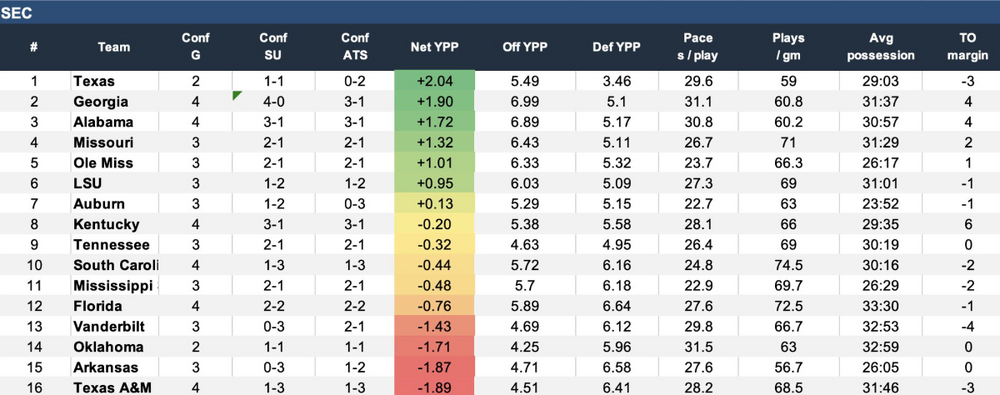
-
Going to call a spade a spade This is a post I didn't want to have to make. I'm a big fan of Arch Manning. Have been since seeing him for the first time in high school. He's a very hard worker. He carries himself the correct way. He cares. He's a very "good guy," just like he says he wants to be. That's what has been drilled into him by his family, and the family is great. I love his sense of humor, and he carries himself really well in a true fishbowl of life he will forever live in. I'm happy he's a Texas Longhorn. His commitment to Texas was and remains massive for the University of Texas. I've said before many times on the YouTube channel he's the first high school athlete that I've seen built up and broken down, as that is normally saved for pro athletes and a select few in college. Being Arch Manning comes with a lot of good to great, and some the exact opposite. He's certainly not going to be treated by the media in a click bait world like the normal athlete. It is what it is, and it's not easy for an 18-22-year-old figuring out life just wanting to be a college "kid" while developing his craft. It was going to be that way for Arch at any blue blood he signed with. With that said, I feel strongly that 20 starts and five games into the season with the fourth quarter vs. Oklahoma less than 24 hours removed is the time to address what has to happen moving forward for Manning. I thought back during the fourth quarter and after the game to the season opener vs. Texas State with 16 seconds remaining in the first half with Texas up 28-7. Texas was coming out of a timeout with the ball on the Texas State 10-yard line. I remember thinking (maybe saying on the Watch With Us) do not force a throw here. Even though the game wasn't in doubt, make the smart or correct quarterback play to end the half. Value points, value momentum, value the football. It all matters later in a season when games are on the line. Every play when a decision has to be made at the QB position is key part of development. Every single one. After an incompletion, Arch forced a throw over the middle into triple coverage that ended in a really bad interception. Did it hurt Texas in terms of winning or losing the game vs an inferior opponent? Of course not. Was it a really bad QB decision? Absolutely. Arch said it after the game and on Monday. I remember saying on the Watch With Us that needs to be the worst pass/decision Arch makes all season. Because anything close to that recurring would likely be a lot more meaningful in SEC play. Arch had some bad QB luck vs. Ohio State in the first half. He made two tremendous throws that were dropped - Cam Coleman and Ryan Wingo. Two should have been TDs (or eventual TD with Coleman). He had a wonderful QB moment in the fourth quarter rally and victory over a very good Ohio State team. In order to be real, it's also very important to be fair. The first drive vs UTSA was solid. He got off to a quality start. There was seemingly progression in decision making vs Ohio State and UTSA. After taking the self inflicted big hit, that game changed. Around a number of errant throws in that game (and before the hit) was the illegal forward pass with 13:56 remaining in the third quarter. It happens for all quarterbacks, and has throughout the history of the game. Fast forward to the Tennessee game. I've never seen two illegal forward passes by the same quarterback in a game. Never. I'm sure it has happened, but my eyes weren't on the TV or in person for a game in history it happened. And I've certainly never seen three in two games, or an illegal forward pass by the same QB in back-to-back games. Again, it's probably happened somewhere in the history of the game, but my 51-year-old eyes have never seen it. To do that three times in two games, and back-to-back games, is truly head scratching plays at the QB position. Around all that there were plays in each game where Arch was outside the tackle box and ate the ball taking an unneeded sack vs throwing the ball away. Similar to the end of the half vs. Texas State, those decisions don't hurt a team when you are winning, but one should clearly put those away in the memory bank if the decision-making returns in game deciding situations or games. Well, the fourth quarter of the Oklahoma game happened less than 24 hours ago. The pick-six pass can't be made, period. Under duress, Arch did a good job keeping the play alive, but what happened next just can't happen at the QB position. At some point in a quarterback's development, one has to register in the moment when the play calls for innate feel, instincts or extremely quick processing to throw the damn ball away. Not taking a sack in a meaningless game and throwing the ball away reps mattered earlier in the season. Sadly, the INT into triple coverage to the end the half vs. Texas State did not remain the worst pass thrown all season. I'm not going to break down the entire why the decision/throw was horrible, because it doesn't even need to be broken down. The ball wasn't valued. The moment wasn't valued. The situation wasn't valued. It wasn't processed in real time by a QB. Then there was the second INT. The reaction to the blitz was a forced throw again. It was a tough spot, but Manning had time to throw an uncatchable ball to the Texas coaches standing along the sideline. And this isn't a nitpick, as one can look at many scenarios in which a QB makes the correct throw away under duress with the game on the line. So where is Arch Manning at through five games this season, and 20 starts into his college career? In my opinion, he's now at the most important part of his career and development to date. Some really bad quarterback decisions in meaningless games early in the season became major in a rivalry game against a struggling team. A game that was given away by the Texas special teams, offense and quarterback. The head scratcher plays have to begin to cease. If we are still talking about them continuing to happen in November, there is a bigger problem that will have to be addressed. The plays in which one is forced to question innate feel and instincts for the position need to be in the rearview mirror, starting Saturday vs. Florida. The growth in game in split second decision making has to happen October 17. Period. The reality is Texas is going to score more points, make more explosive plays in the passing game and "look" better on offense the next three games in October. Texas isn't facing Matt Patricia, Jim Knowles and Brent Venables defenses and overall personnel level the next three games. But that doesn't mean Texas has suddenly improved or "found it" offensively. That doesn't mean Arch Manning has figured it out. This isn't about stats. This is about in-game decision making, and seeing the correct growth. Time is no longer on Arch Manning's side, and on Texas' side. Growth has to be easily seen. The time is now. I'm rooting for Arch, as I always have been. The fishbowl and pressure of being a Manning following in massive footsteps is real. That will always be acknowledged when I speak about Arch. At the same time, he's in a position in which major and career arc changing growth at the position has to begin today. There is no other option after five games this season. I'm not expecting perfection, as that is not the real world. I am expecting key growth to begin now. It simply has to for Arch, and the Texas Longhorns 2026 season.
-
They aren’t confident.