

Blake Munroe
-
Posts
6186 -
Joined
-
Last visited
Content Type
Profiles
Texas Longhorns News
2025 Recruits
2024 Schedule
2026 Recruits
2025 Schedule
2027 Recruits
2026 Schedule
2028 Recruits
Gallery
Downloads
Forums
Blogs
Store
Everything posted by Blake Munroe
-
21 Days Until Kickoff: Who Was The Best No. 21?
Blake Munroe replied to Blake Munroe's topic in On Texas Football Forum
I figured he’d be the popular vote today! -
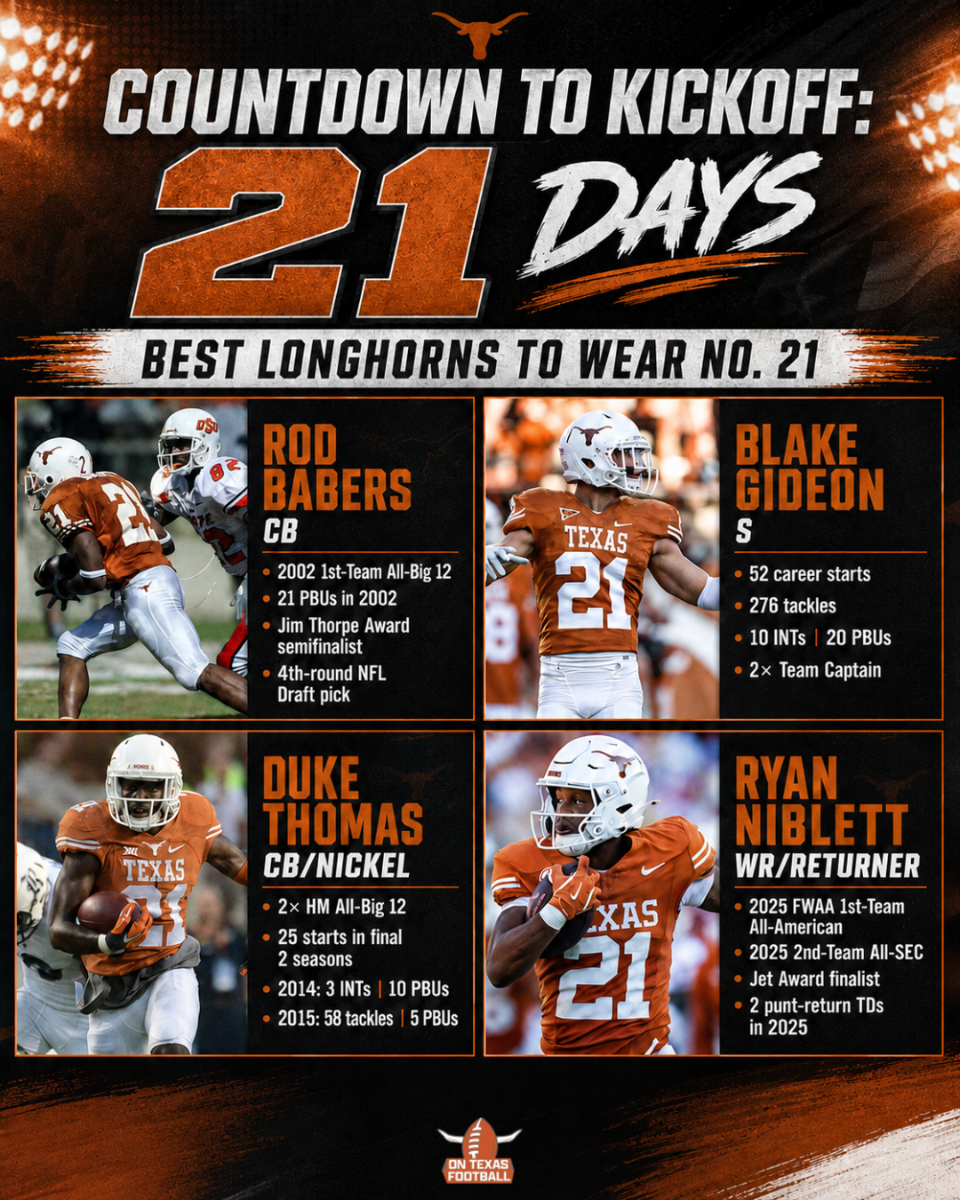
Today’s number is a pretty strong one. At No. 21, you’ve got Rod Babers, Blake Gideon, Duke Thomas and Ryan Niblett. Babers probably has the strongest peak of the group, earning First-Team All-Big 12 honors in 2002, finishing that season with 21 pass breakups and becoming a Jim Thorpe Award semifinalist. Gideon was the model of consistency, starting 52 games during his Texas career while piling up 276 tackles, 10 interceptions and 20 PBUs. He was also a two-time team captain and a fixture on some of the best Texas teams of the late 2000s. Duke Thomas put together a very solid final two seasons, earning Honorable Mention All-Big 12 twice, starting 25 games over that stretch and finishing 2014 with 3 interceptions and 10 PBUs. And Ryan Niblett has already added a major accolade to the No. 21 legacy, earning FWAA First-Team All-America honors in 2025 as a return specialist while also being named Second-Team All-SEC. So who yall got?

-
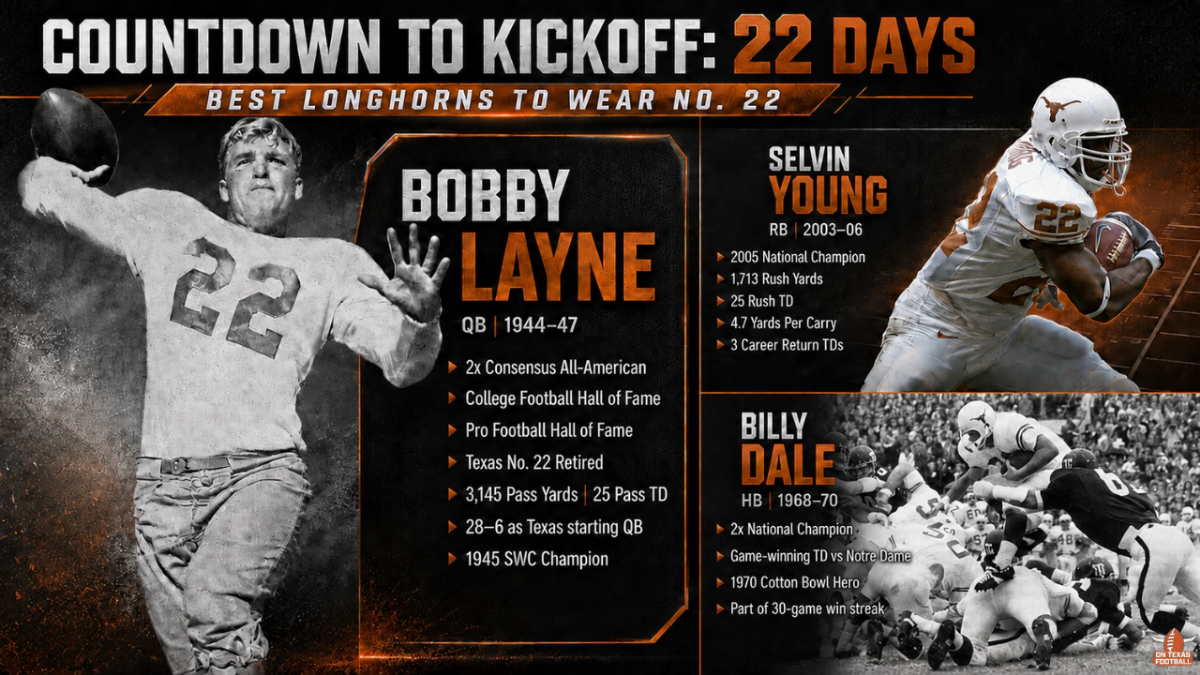
Today’s countdown takes us to No. 22 and this one starts with one of the true legends in Texas Football history. Bobby Layne is the headliner here for obvious reasons. A two-time consensus All-American, College Football Hall of Famer, Pro Football Hall of Famer and one of the most important players to ever come through Austin. He threw for 3,145 yards and 25 touchdowns at Texas, went 28-6 as a starting quarterback, helped lead the Longhorns to the 1945 SWC title and eventually had his No. 22 retired by the university. Behind Layne, Selvin Young gave the number a strong modern-era representative. Young finished his Texas career with 1,713 rushing yards and 25 touchdowns, averaged 4.7 yards per carry, scored three return touchdowns and was part of the 2005 national championship team. Billy Dale rounds out the group from the Darrell Royal era. Dale was part of back-to-back national championship teams and scored the game-winning touchdown against Notre Dame in the 1970 Cotton Bowl, one of the biggest plays of that championship run.
-
Glad to have you on the site! Let us know if you need anything (including requesting a ban on @Joe Zura and/or @Rocky P)
-
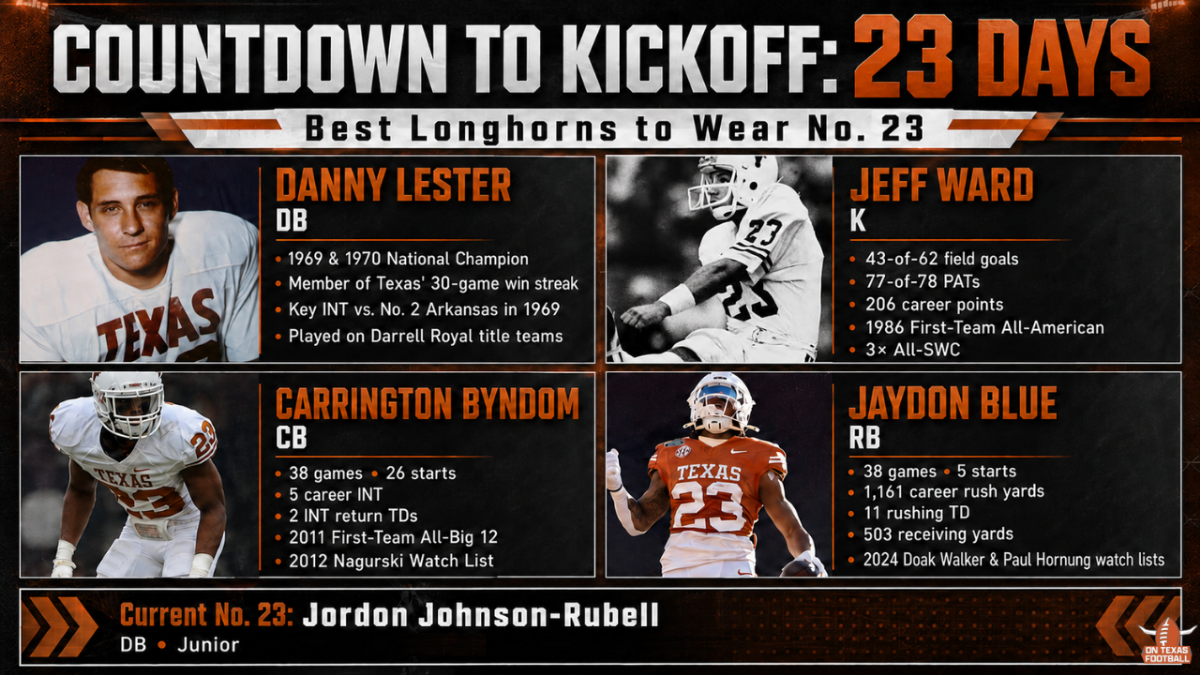
Today’s Countdown to Kickoff takes us to No. 23 and there’s a pretty interesting mix of Longhorns who have worn it over the years. Jeff Ward put together one of the best kicking careers in school history, finishing with 206 points while earning First-Team All-America honors in 1986 and three All-SWC selections. Danny Lester was part of Texas’ championship run under Darrell Royal, winning national titles in 1969 and 1970. His interception against No. 2 Arkansas in the 1969 “Game of the Century” helped keep Texas alive in the 15-14 comeback win. Carrington Byndom became a fixture in the secondary, appearing in 38 games with 26 starts, recording five interceptions and returning two of them for touchdowns. He was a First-Team All-Big 12 selection in 2011. And Jaydon Blue gave Texas another explosive weapon in the backfield, finishing his career with 1,161 rushing yards, 503 receiving yards and 11 rushing touchdowns while helping the Longhorns reach back-to-back College Football Playoffs. The current No. 23 is defensive back Jordon Johnson-Rubell. Who gets your vote as the best Longhorn to wear No. 23?
-
I was shocked he had enough to clench No. 15. There were numerous people I expected in front of him.
-
Just posted it in it's own (pinned) thread. Top six is universal.
-
I find it fascinating when it comes to the note on the top six. The fact that every staff member's votes lined up with what you guys (and gals) voted is amazing, imo.
-
We asked OTF subscribers to rank the best Texas Longhorns of the modern era (1992-present) and the results gave us some pretty fascinating takeaways. First and foremost, Vince Young absolutely ran away with the No. 1 spot. Vince received more than 82% of the first place vote, with only one ballot (out of hundreds) not including him in the top three spots. His lowest ranking from anyone who voted for him? No. 4. Ricky Williams was nearly as universal. Ricky appeared on 94.9% of ballots, and 88.1% of those voters had him inside the Top 3. In fact, Vince and Ricky were basically the consensus top two. On 76% ballots, they occupied the No. 1 and No. 2 spots in some order. Then things got really interesting. Colt McCoy did not receive a single first-place vote, yet still finished comfortably at No. 3. Derrick Johnson finished fourth. This created what looked like a pretty obvious Big Four among the fan base: Vince, Ricky, Colt, DJ After that, the debate really started. Cedric Benson edged Bijan Robinson for No. 5 despite Bijan appearing on more ballots. Bijan showed up on five more ballots than Cedric did, but the fans who voted for Cedric generally ranked him higher. Bijan was the only player, outside of Vince and Ricky, in the eventual top ten to receive a first-place vote. The tightest race came near the bottom of the Top 10, however: Michael Huff - 226 points Casey Hampton - 225 points Earl Thomas - 220 points Six total points separated three Texas legends. Hampton actually had stronger high-end support than Huff, with 19 Top-5 votes compared to Huff’s 11, but Huff appeared on more ballots and narrowly grabbed the No. 8 spot. When we compared the fan vote to the OTF staff composite, both groups independently produced the exact same Top 6 in the exact same order: Vince Young, Ricky Williams, Colt McCoy, Derrick Johnson, Cedric Benson, Bijan Robinson Ten staff voters and hundreds of fan voters somehow agreed on the top six perfectly. That’s pretty remarkable. Now let’s argue.... here is your Top 15, as selected by OTF Subscribers: View full news story
-
Fan Vote Results: Top 15 Longhorns of the Modern Era (1992-Present)
Blake Munroe posted news story in Articles
We asked OTF subscribers to rank the best Texas Longhorns of the modern era (1992-present) and the results gave us some pretty fascinating takeaways. First and foremost, Vince Young absolutely ran away with the No. 1 spot. Vince received more than 82% of the first place vote, with only one ballot (out of hundreds) not including him in the top three spots. His lowest ranking from anyone who voted for him? No. 4. Ricky Williams was nearly as universal. Ricky appeared on 94.9% of ballots, and 88.1% of those voters had him inside the Top 3. In fact, Vince and Ricky were basically the consensus top two. On 76% ballots, they occupied the No. 1 and No. 2 spots in some order. Then things got really interesting. Colt McCoy did not receive a single first-place vote, yet still finished comfortably at No. 3. Derrick Johnson finished fourth. This created what looked like a pretty obvious Big Four among the fan base: Vince, Ricky, Colt, DJ After that, the debate really started. Cedric Benson edged Bijan Robinson for No. 5 despite Bijan appearing on more ballots. Bijan showed up on five more ballots than Cedric did, but the fans who voted for Cedric generally ranked him higher. Bijan was the only player, outside of Vince and Ricky, in the eventual top ten to receive a first-place vote. The tightest race came near the bottom of the Top 10, however: Michael Huff - 226 points Casey Hampton - 225 points Earl Thomas - 220 points Six total points separated three Texas legends. Hampton actually had stronger high-end support than Huff, with 19 Top-5 votes compared to Huff’s 11, but Huff appeared on more ballots and narrowly grabbed the No. 8 spot. When we compared the fan vote to the OTF staff composite, both groups independently produced the exact same Top 6 in the exact same order: Vince Young, Ricky Williams, Colt McCoy, Derrick Johnson, Cedric Benson, Bijan Robinson Ten staff voters and hundreds of fan voters somehow agreed on the top six perfectly. That’s pretty remarkable. Now let’s argue.... here is your Top 15, as selected by OTF Subscribers:- 31 comments
-
- 11
-

-
Targeting penalties assessed in the second half of a game will no longer require the offending player to sit out the first half of his team's next game, offensive pass interference will become a 10-yard penalty and the little-used fair catch kick will be introduced to college football. Those are among the changes for the 2026 season, the National Football Foundation announced Tuesday in its annual summary of rules changes. The targeting penalty change will be an experimental rule for 2026. A player disqualified for targeting for the first time in the season may participate in the following game. The trial rule will apply regardless of which half the targeting penalty is called. A player who draws his second targeting penalty of the season will be required to miss the first half of the next game. A player who draws his third targeting of the season must sit out the full following game. A conference can choose to initiate an appeals process after a player's second targeting penalty. The appeal would be sent to the NCAA national coordinator of football officials for a video review. If the appeal is successful, the player would not be forced to sit out the first half of the following game. The penalty for offensive pass interference is being adjusted from 15 yards to 10 yards. The rules reserve 15-yard penalties primarily for personal fouls and unsportsmanlike conduct. Defensive pass interference will remain a spot foul, with a maximum of a 15-yard penalty. In a change to align Division I rules with those in the NFL and high school, a team could choose to attempt a fair catch kick after a completed or awarded fair catch. The kick would be a place kick with a holder or a drop kick from the spot where the returner caught the ball. The defense would be at least 10 yards from the spot of the kick. If the ensuing kick goes through the uprights, it would be worth three points. The rarely used play last came up in the NFL in 2024 when the Los Angeles Chargers' Cameron Dicker converted from 57 yards against the Denver Broncos. Unsportsmanlike conduct: An automatic unsportsmanlike conduct penalty will be called if a player initiates any of these five actions or gestures: any act of simulating the brandishing of a weapon; slashing of the throat or a nose wipe signal; removing helmet after the ball is dead (with exceptions for timeouts and equipment adjustments); dead-ball contact fouls, such as pushing, shoving, striking, etc., that occur clearly after the ball is dead and that are not part of the game action; using forcible contact to push or pull an opponent off the pile after the ball is dead. Two replay challenges: The head coach will now have two replay challenges per game. If a coach wins at least one of their first two challenges, they are awarded a third challenge. A challenge can be made only if the team has a timeout remaining and available; if the challenge is successful, the team's timeout will not be charged. Other changes: Coach-to-player communications through the helmet is now permissible for all NCAA divisions. ... Helmet attachments (e.g., Guardian Cap, SAFR Helmet Cover) that enhance player safety are allowed. All helmets, with or without the attachment, must be of the same color and design. ... Up to two sponsor patches are allowed on the jersey, with conference approval. A third patch is allowed in conference championship or postseason games. Logos may not exceed 4 square inches. One commercial logo, not to exceed 4 square inches, is permitted on the helmet.
- 1 reply
-
- 4
-
-
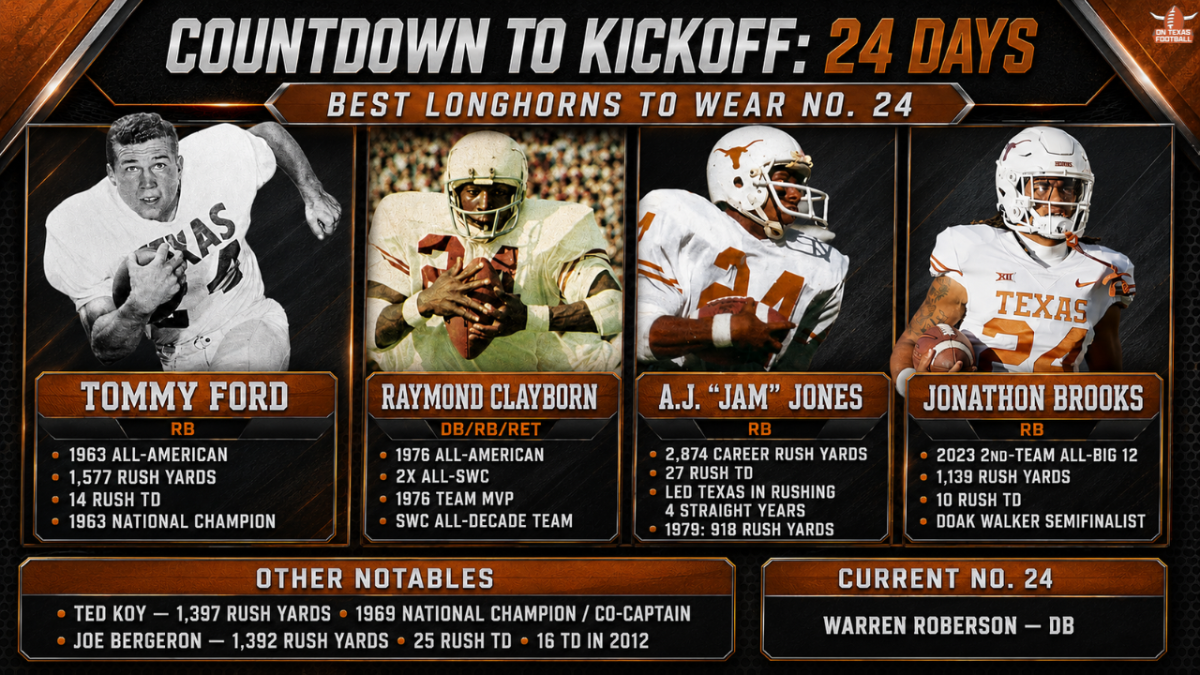
No. 24 has been worn by some outstanding Longhorns over the years. Tommy Ford was an All-American and co-captain of Texas’ 1963 national championship team. Raymond Clayborn earned All-America honors, was a two-time All-SWC selection and Texas’ team MVP in 1976. A.J. “Jam” Jones piled up 2,874 rushing yards and 27 touchdowns while leading Texas in rushing four straight seasons. And more recently, Jonathon Brooks rushed for 1,139 yards and 10 touchdowns in his breakout 2023 season. Also worth mentioning: 1969 national champion and co-captain Ted Koy, along with Joe Bergeron, who scored 25 career rushing touchdowns. And the current No. 24 for Texas: defensive back Warren Roberson. Who was the best to wear it?
-
Sent this to a buddy of mine who is an AD. He said it must’ve been a receiver if he didn’t realize it was in his helmet…. Because they don’t hit 😂
-
Me, Joe Z, and a night in Oregon
Blake Munroe replied to thatdude2's topic in On Texas Football Forum
Live look at Joe:
-
Found this on ESPN and wanted to share… Multiple Texas mentions in the article (link below) Here's what they believe college football players are now earning to start and compete at the Power 4 level entering Year 2 of the revenue sharing era. QB: 1-3 mil RB: 300-800k WR: 400k-1 mil TE: 300-600k OT: 600k-1.2 mil IOL: 400-800k EDGE: 500k-1.2 mil DT: 500k-1 mil LB: 300k-700k CB: 400-900k S: 300-900k K: 50-200k P: 50-150k LS: 10-50k Full article: https://www.espn.com/college-football/story/_/id/49568548/college-football-2026-position-cost-transfer-portal
-
Me, Joe Z, and a night in Oregon
Blake Munroe replied to thatdude2's topic in On Texas Football Forum
I bet @Joe Zura is weeping right now like the big crybaby he is. -
Good observation. It will be interesting to see if we see a DFW switch over the next decade or not.
-
I get it. And that was just a tad before my time lol. I was 7 his final year. But he’s also automatically disqualified from the list, as he didn’t play in the modern era. I guess technically 1992, but 75% of his career was pre-poll.
-
Someone voted Quinn No. 1… in the fan vote. Ill release the fan vote tomorrow.
-
I get what you’re saying, but to play devils advocate… 21-19 during his four years 37 TD. 46 INT. Only had one season where he threw more TD than INT (16:13). That doesn’t all fall on him by any means, but as you said… results. Not even close to sniffing this list, imo.
-
DE in CFB. LB in NFL. Just my .02.
-
Some interesting data points: 13 of the Top 25 appeared on all 10 staff ballots. The list is almost perfectly balanced by side of the ball: 13 offensive players and 12 defensive players. Running back is the most represented single position with five players: Ricky Williams, Cedric Benson, Bijan Robinson, Jamaal Charles and D’Onta Foreman. Secondary, as a whole, is even deeper: Michael Huff, Earl Thomas, Quentin Jammer, Jahdae Barron, Aaron Ross, Michael Griffin and Nathan Vasher. Seven of the 25 are defensive backs. 18 of the 25 played at least one season under Mack Brown. Even crazier, 13 of the Top 15 are Mack-era players. Bijan Robinson and Kelvin Banks Jr. are the only two members of the Top 15 who never played for Mack. Michael Huff is a fascinating case. He finished No. 8 despite appearing on only nine of the 10 ballots. His average rank when selected was 6.89, meaning the people who voted for him generally had him very high. Same phenomenon with Brian Orakpo: only nine ballots, yet he finished No. 10. His 8.33 average ranking when selected was much stronger than several players who appeared on every ballot. Byron Murphy II made the Top 25 despite appearing on only five ballots. That's the fewest appearances by anyone in the final 25. When people believed he belonged, though, they ranked him high enough to get him to No. 23. Meanwhile, D’Onta Foreman appeared on nine ballots but finished just No. 21. That's almost the opposite profile: broad agreement that he belonged somewhere on the list, but generally toward the bottom.
- 49 replies
-
- 10
-
-
After combining ten individual Top 25 ballots from the On Texas Football staff into one composite ranking, we now have our Top 25 Players of the Modern Era list. Each ballot was scored on a 25-to-1 points system, with 25 points awarded for a first-place vote, 24 for second place and so on. At the top, two of the most iconic players in Texas football history separated themselves from the rest of the field. Vince Young finished No. 1 overall, narrowly edging Ricky Williams for the top spot. Young totaled 247 points across the 10 ballots, while Williams finished just four points behind with 243. Young received seven first-place votes, while Williams received the other three. Every voter ranked both players either first or second. Behind them, Colt McCoy came in at No. 3 with 227 points, followed closely by Derrick Johnson at No. 4 with 223. The top four created a clear consensus among the OTF staff, but the rankings became much tighter from there. Cedric Benson rounded out the top five, followed by Bijan Robinson, Casey Hampton, Michael Huff, Kelvin Banks Jr. and Brian Orakpo. Banks, Orakpo and Earl Thomas were separated by just one point, with Banks finishing ninth at 160 points and Orakpo and Thomas tying at 159. Orakpo earned the No. 10 spot through the composite tiebreaker (using the highest individual placement on any ballot). The list features players spanning more than three decades of Texas football, from stars of the early 1990s to members of the Longhorns' recent College Football Playoff teams. It also highlights just how difficult it is to compare players across positions and eras. Quarterbacks and running backs dominate the very top of the ranking, but the Top 25 also includes elite linebackers, defensive backs, offensive linemen and defensive linemen who helped define their respective eras. Still, the biggest debate may be the one at the very top. Williams owns one of the greatest individual résumés in college football history, including the 1998 Heisman Trophy, while Young delivered perhaps the most iconic season and championship performance Texas football has ever seen. When the votes were totaled, Young had just enough support to claim the title of On Texas Football's No. 1 Longhorn. View full news story
- 49 replies
-
- 15
-
-
On Texas Football's Top 25 Players of the Modern Era (1992-Present)
Blake Munroe posted news story in Articles
After combining ten individual Top 25 ballots from the On Texas Football staff into one composite ranking, we now have our Top 25 Players of the Modern Era list. Each ballot was scored on a 25-to-1 points system, with 25 points awarded for a first-place vote, 24 for second place and so on. At the top, two of the most iconic players in Texas football history separated themselves from the rest of the field. Vince Young finished No. 1 overall, narrowly edging Ricky Williams for the top spot. Young totaled 247 points across the 10 ballots, while Williams finished just four points behind with 243. Young received seven first-place votes, while Williams received the other three. Every voter ranked both players either first or second. Behind them, Colt McCoy came in at No. 3 with 227 points, followed closely by Derrick Johnson at No. 4 with 223. The top four created a clear consensus among the OTF staff, but the rankings became much tighter from there. Cedric Benson rounded out the top five, followed by Bijan Robinson, Casey Hampton, Michael Huff, Kelvin Banks Jr. and Brian Orakpo. Banks, Orakpo and Earl Thomas were separated by just one point, with Banks finishing ninth at 160 points and Orakpo and Thomas tying at 159. Orakpo earned the No. 10 spot through the composite tiebreaker (using the highest individual placement on any ballot). The list features players spanning more than three decades of Texas football, from stars of the early 1990s to members of the Longhorns' recent College Football Playoff teams. It also highlights just how difficult it is to compare players across positions and eras. Quarterbacks and running backs dominate the very top of the ranking, but the Top 25 also includes elite linebackers, defensive backs, offensive linemen and defensive linemen who helped define their respective eras. Still, the biggest debate may be the one at the very top. Williams owns one of the greatest individual résumés in college football history, including the 1998 Heisman Trophy, while Young delivered perhaps the most iconic season and championship performance Texas football has ever seen. When the votes were totaled, Young had just enough support to claim the title of On Texas Football's No. 1 Longhorn. -
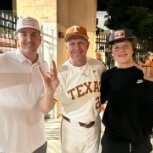
BIRMINGHAM, Ala. — The Southeastern Conference on Tuesday released its Women's Basketball league schedule for the upcoming 2026-27 season. The University of Texas opens conference action with a road contest against Georgia on Thursday, December 31 and concludes league play with a road game against Ole Miss on Sunday, February 28. The schedule consists of a single round robin of home or away (14 games) with one rotating opponent that will be played at home and away (2 games). Each team will play eight home games and eight away games. The rotating opponent changes annually. This marks the 18th season of the 16-game schedule for women's basketball. Texas will play Texas A&M both home and away in the 2025-26 season. Home games will be: South Carolina, Tennessee, Alabama, Vanderbilt, Missouri, Arkansas, Texas A&M and Florida. Texas will travel to: Georgia, Kentucky, Texas A&M, Mississippi State, Auburn, LSU, Oklahoma and Ole Miss. The regular season concludes with the 2027 SEC Women's Basketball Tournament being held for the 10th time at Bon Secours Wellness Arena in Greenville, S.C. The tournament, which will include all 16 teams, begins on Wednesday, March 3 and concludes with the championship game on Sunday, March 7. The women's basketball television schedule will be announced later, as will the time for all games.
-
- 1
-