






PaytonOTF
Supporters
-
Joined
-
Last visited
-
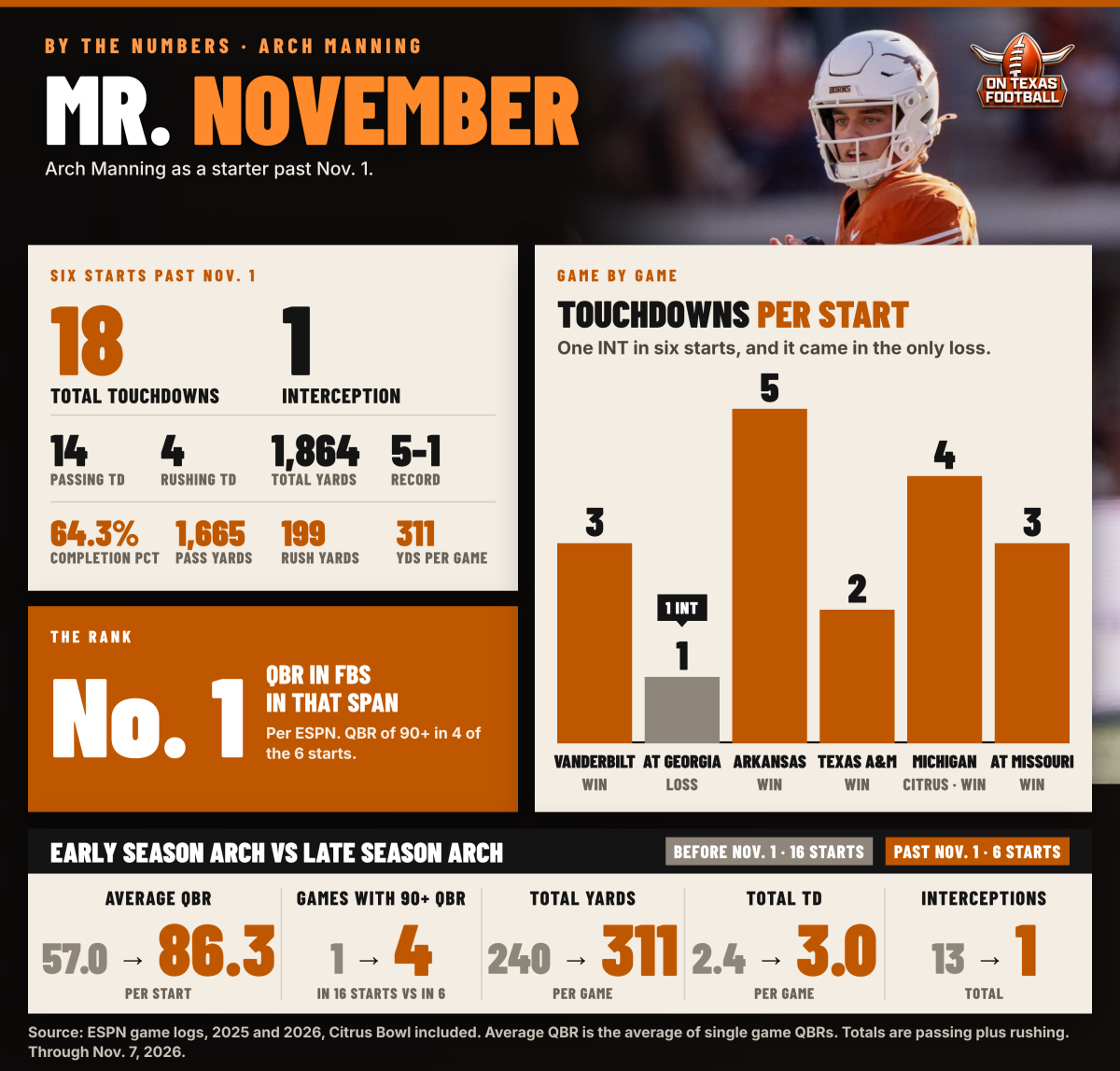
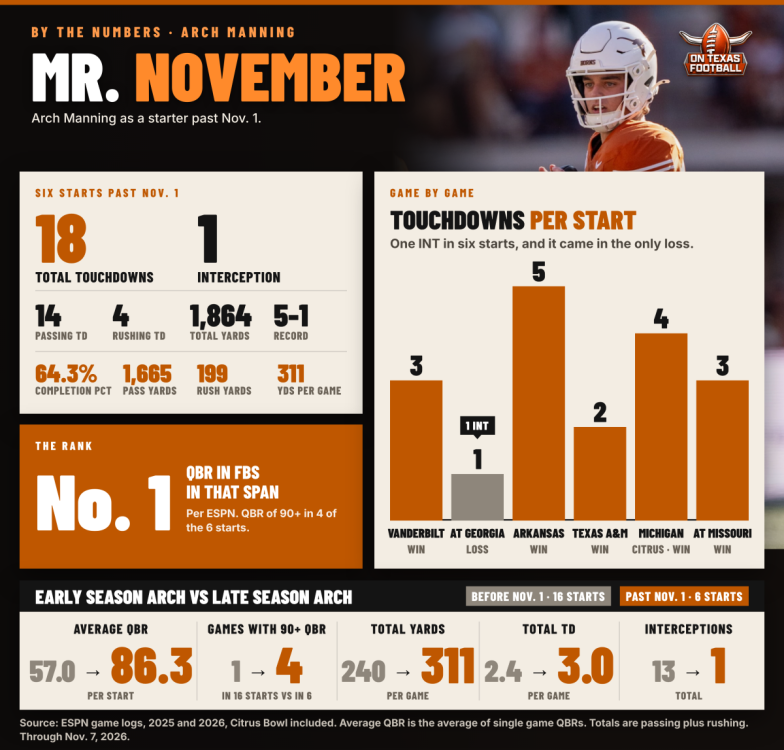
Hey everyone, Payton here, intern with On Texas Football, back with another By the Numbers. Arch Manning has made six starts past Nov. 1 in his career, and the numbers in those games look like a completely different quarterback. In those six starts he has 18 total touchdowns and one interception. That is 14 passing and four rushing, with 1,864 total yards, a 64.3% completion rate and 311 yards per game. Texas is 5-1 in those games. The gap from early season Arch is huge. In 16 starts before Nov. 1 over the last two years, his average QBR is 57.0. From Nov. 1 on, it is 86.3. He has topped a 90 QBR once in those 16 early starts and four times in the six late ones. He also has 13 interceptions before Nov. 1 and one after. It is not just good by his own standards. Per ESPN, Arch has the No. 1 QBR in all of FBS over that late season span. Here is how it breaks down game by game. Three touchdowns against Vanderbilt. One at Georgia. Five against Arkansas. Two against Texas A&M. Four against Michigan in the Citrus Bowl. Three last week at Missouri. The one interception came at Georgia, which is also the only loss. In the five wins he has 17 touchdowns and has not thrown a pick. That brings us to Saturday. LSU comes in with 36 sacks, third most in the country, so this is the toughest pass rush he has seen in one of these late season starts. Does Arch keep the late season run going in Baton Rouge? And is this stretch enough to call him the best finisher in college football?
-
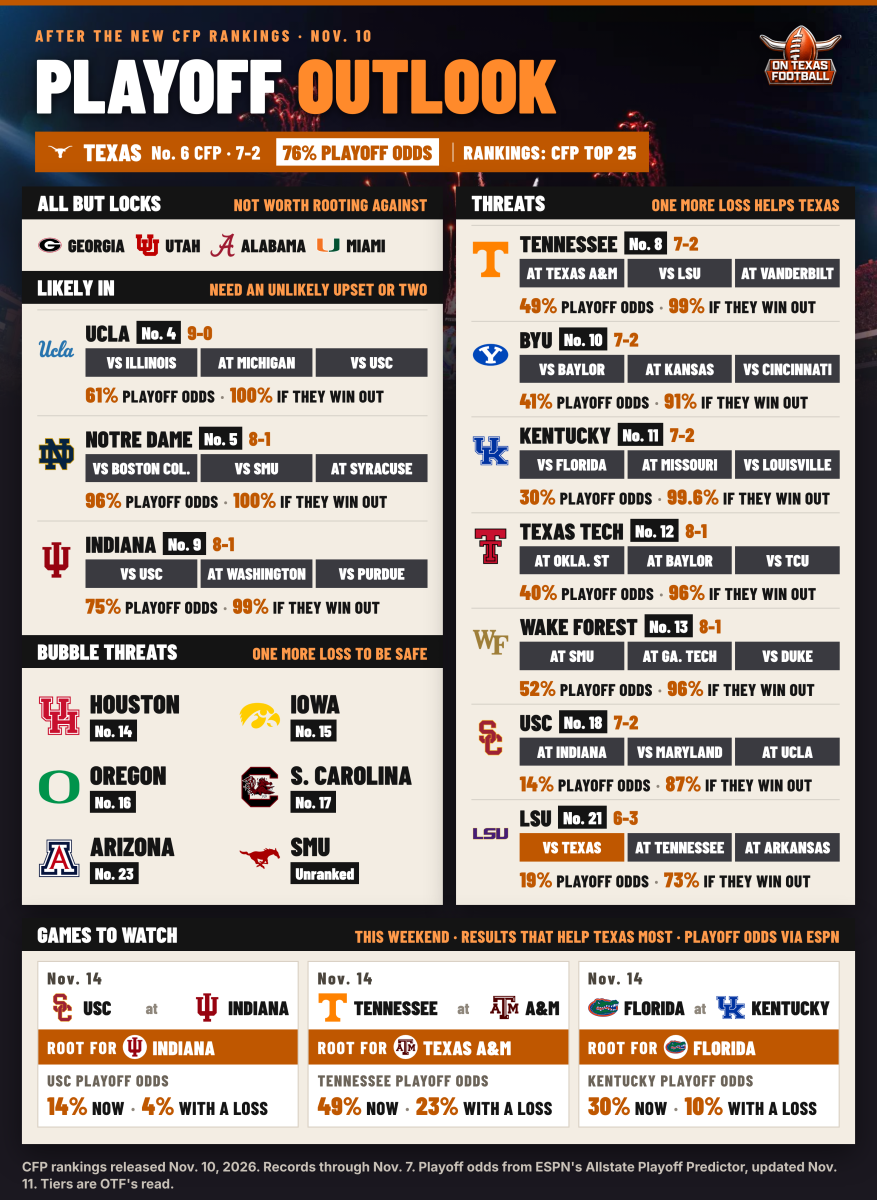
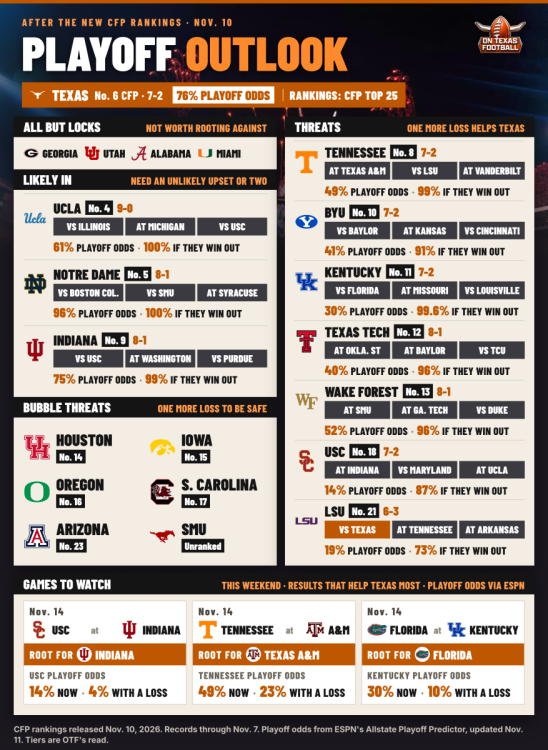
Hey everyone, Payton here, intern with On Texas Football. With the new CFP Rankings dropping last night, I wanted to see how the landscape shapes up, compiling the teams into tiers, with their remaining schedule where applicable. Here is where Texas stands and who Longhorn fans should be rooting against the rest of the way: Texas sits at No. 6 with a 7-2 record. Here is the top 12 as it stands: Georgia, Utah, Alabama, UCLA, Notre Dame, Texas, Miami, Tennessee, Indiana, BYU, Kentucky and Texas Tech. The SEC has five of the top 11. The biggest mover was Indiana, which fell from No. 4 to No. 9 without playing a game. The landscape is good for Texas but not safe. One of the 12 spots goes to the best Group of Five champion, and right now that is No. 24 Boise State. That means the real cut line sits at No. 11, and there are seven teams ranked between No. 8 and No. 21 that can still potentially play their way past a two or three loss Texas team in the committee's eyes. ESPN’s Allstate Playoff Predictor gives the Longhorns a 76% chance to make the field. This Saturday can decide most of it. If Texas beats LSU, that number jumps to 95% and LSU is finished at less than 1%. From there Texas could even drop one of its last two games and still sit around 85%. If Texas loses to LSU, the number falls to 58% and LSU climbs back to 37%. Texas would be 7-3 with no room left for error. Winning the last two would get the Longhorns back to 82%, at that point the committee is comparing resumes, and what the teams below do starts to matter a lot. I separated the teams in the race into tiers to make it more digestable. All But Locks: Georgia, Utah, Alabama and Miami. All four sit at about 90% or better. They are not worth rooting against because one loss probably does not knock any of them out. Likely In: UCLA, Notre Dame and Indiana. It would take an unlikely upset or two to push any of them out. UCLA is at 61% with Michigan and USC still on the schedule, and Indiana is at 75%, right around where Texas is sitting. Threats: Tennessee, BYU, Kentucky, Texas Tech, Wake Forest, USC and LSU. These teams are fighting for the same spots Texas is. Their odds range from 14% for USC to 52% for Wake Forest, but most of them climb past 90% if they win out. Every one of them is a loss away from likely elimination. Bubble Threats: Houston, Iowa, Oregon, South Carolina, Arizona and SMU. One more loss for each and Texas can stop worrying about them. Texas also holds the head to head over Ole Miss and Ohio State, who both already have three losses, which is why they weren't included. Outside of Texas and LSU, here are the five games to watch this weekend. Tennessee at Texas A&M. Root for the Aggies just this once. Tennessee dropping to the 9-3 cut line would ensure on Selection Sunday that they wouldn't take up a spot for us due to our H2H win. A loss drops the Vols from 49% to 23%, and ESPN is giving A&M about a 42% chance to do it. Florida at Kentucky. Root for Florida. Kentucky is only at 30% now, but the Wildcats jump to 99% if they win out, so this is the week that can end it. A loss takes them to 10%. A Gators win also makes the Texas schedule look stronger, which might matter when comparing resumes in the committee room. USC at Indiana. Root for Indiana. It might seem backwards to root for a team ranked near Texas, but a USC win wouldn't eliminate Indiana. Even with a loss to USC, Indiana would not be out of it. ESPN would still give the Hoosiers a 34% chance, and that climbs to 46% if they win their last two. The Trojans would jump from 14% to 48% with UCLA still on the schedule. An Indiana win drops USC to 4% and takes a team off the docket. Wake Forest at SMU. Root for SMU. Wake has the best odds of any Threat at 52%, and Miami is the favorite to take the ACC’s automatic spot, which means Wake is competing with Texas for an at large bid. A loss drops the Demon Deacons to 20%. Texas Tech at Oklahoma State. Root for Oklahoma State. The No. 25 Cowboys are at home and favored by 3.5 points, so this is one a Threat is actually expected to lose. Tech is 8-1 and would climb to 96% by winning out (although that may imply a CCG win), but a loss cuts the Red Raiders from 40% to 18%. Also keep an eye on Baylor at BYU, where a loss would drop the Cougars from 41% to 5%. Which of these five games matters most for Texas? And if the Longhorns lose Saturday, do you still think they get in?
-
Miss State +3.5 Vanderbilt +17.5 Texas A&M +2.5 Missouri +14.5 Ole Miss -2.5 Florida +3.5 Texas +4.5 (just moved) South Carolina -8.5
-
Would make a much better drive back and nice cap to the end of my last football regular season as a student, should be an amazing environment and experience nonetheless.
-
Turnovers will be imperative, not forcing any against Tennessee made that game closer than it should’ve been. Leavitt will put the ball in harms way, and winning 4th down defensively off Kiffin’s aggressiveness like we saw last week could turn the tide of that QB difference if the offense struggles.
-
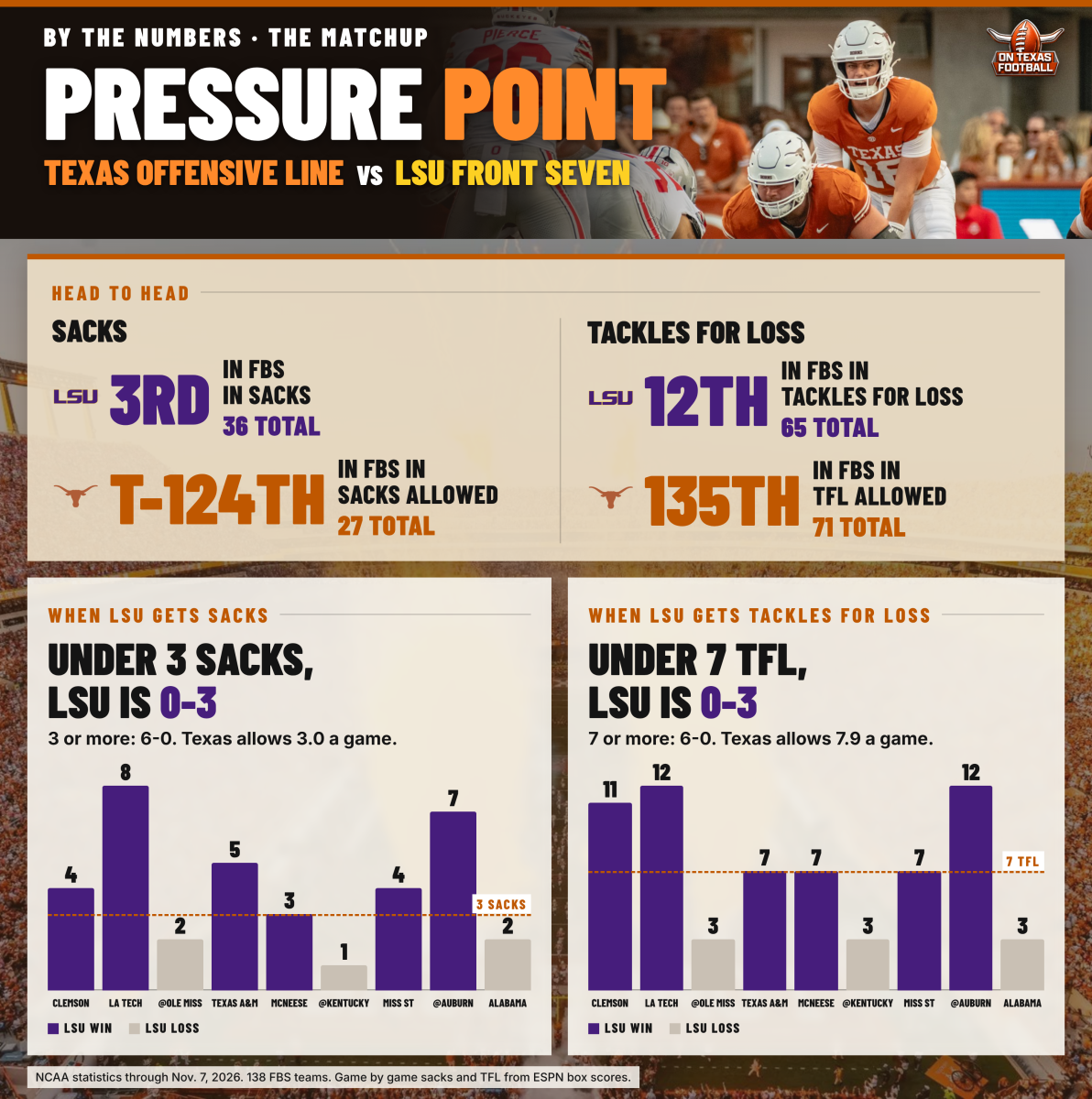
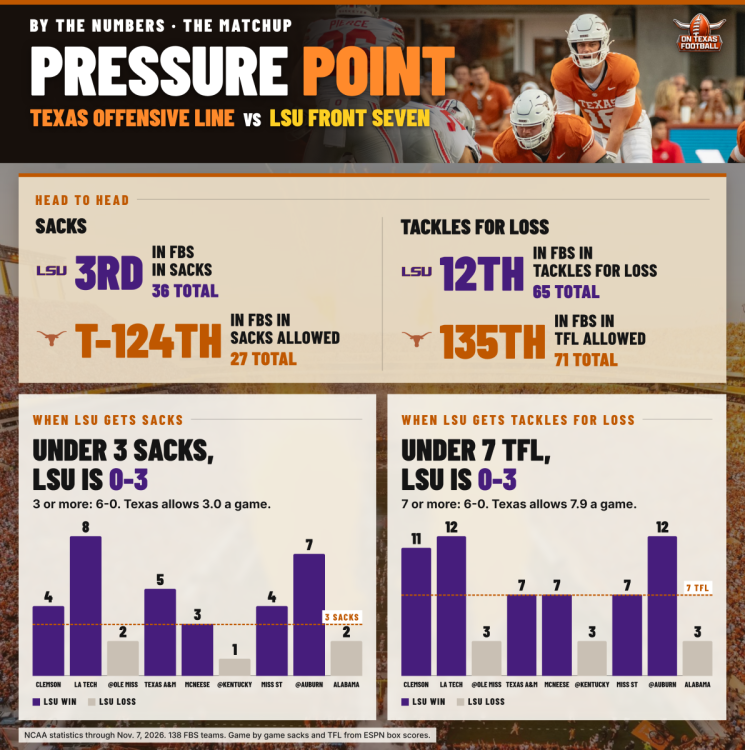
Payton here, one of the OTF interns, back with this week’s By the Numbers. With LSU up next, I dug into the matchup I think decides Saturday night: the Texas offensive line against the LSU front seven. The numbers are lopsided. LSU has 36 sacks through nine games, third in the FBS. Texas has allowed 27, which is tied for 124th out of 138 teams. Tackles for loss tell a similar story. LSU ranks 12th in the country with 65. Texas ranks 135th in tackles for loss allowed with 71. For LSU, pressure has been the whole season. When the Tigers get three or more sacks, they are 6-0. When they get fewer than three, they are 0-3. The tackles for loss split is identical: 6-0 with seven or more, 0-3 with fewer. In all three losses, to Ole Miss, Kentucky and Alabama, LSU finished with exactly three tackles for loss. That is the problem for Texas this saturday. The Longhorns allow 3.0 sacks and 7.9 tackles for loss a game, both above the benchmark where LSU has not lost. And it has gotten even worse in conference play. Of the 27 sacks Texas has allowed, 23 have come in six SEC games. Texas has given up three or more sacks in four of those six, and seven or more tackles for loss in five of them. The good news is that Texas has shown it can win anyway. The Longhorns gave up five sacks against Mississippi State and won. Pressure has not decided Texas’s season the way it has decided LSU’s. Texas has also seen a front like this once already. Tennessee leads the country in sacks and got to Arch Manning six times in Knoxville, and Texas still won. LSU ranks third. If the line holds the Tigers under three sacks, history says Texas wins. If it does not, the Longhorns will have to do what they did at Tennessee and win despite the pressure. Can this line keep LSU under three sacks in Death Valley, or does Texas need to win it the way it did at Tennessee?
-
The 3rd quarter and 4th quarters are complete opposites of each other, I know what I’ll be expecting. Good stuff Kumar.
-
So would you still lean one way or another on Simmons playing?
-
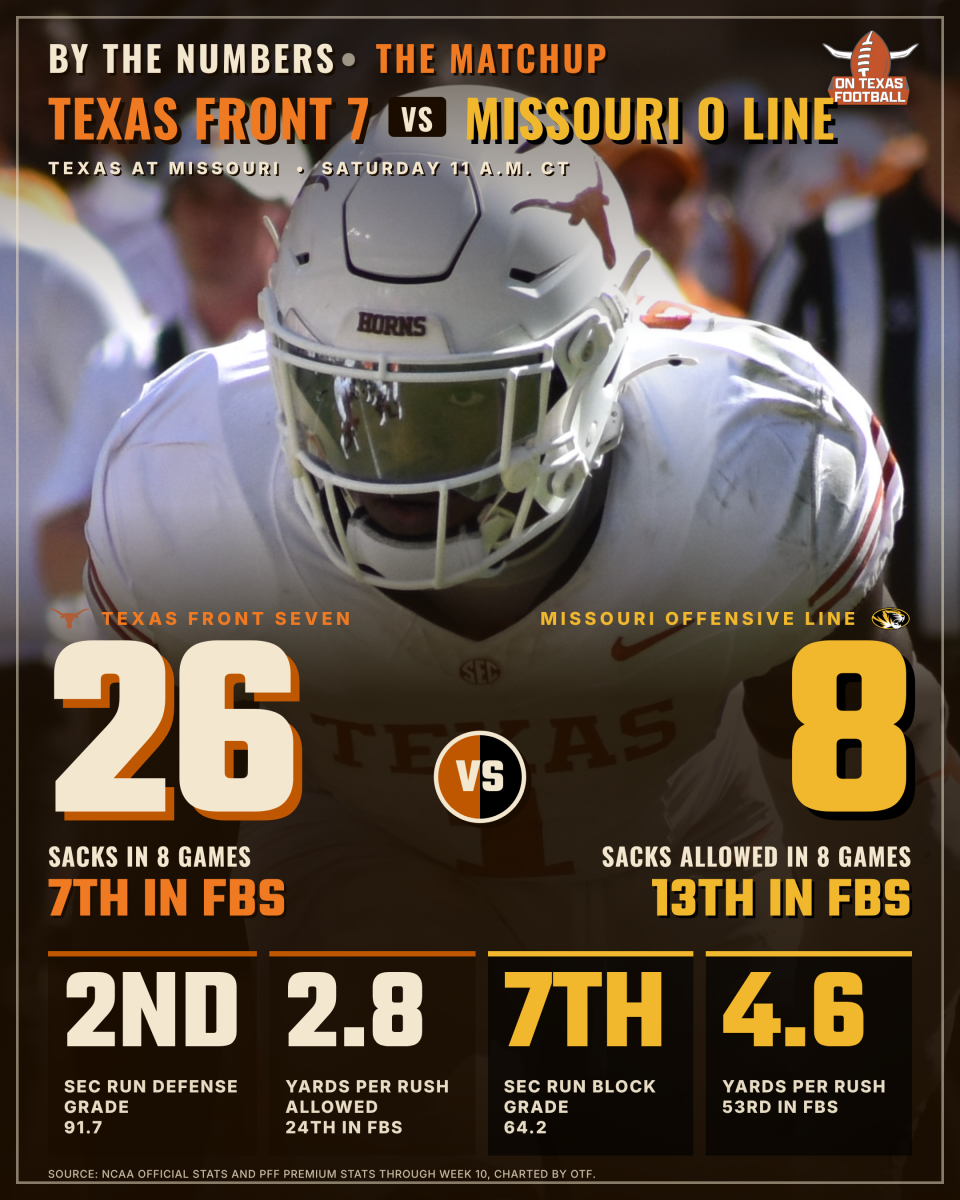
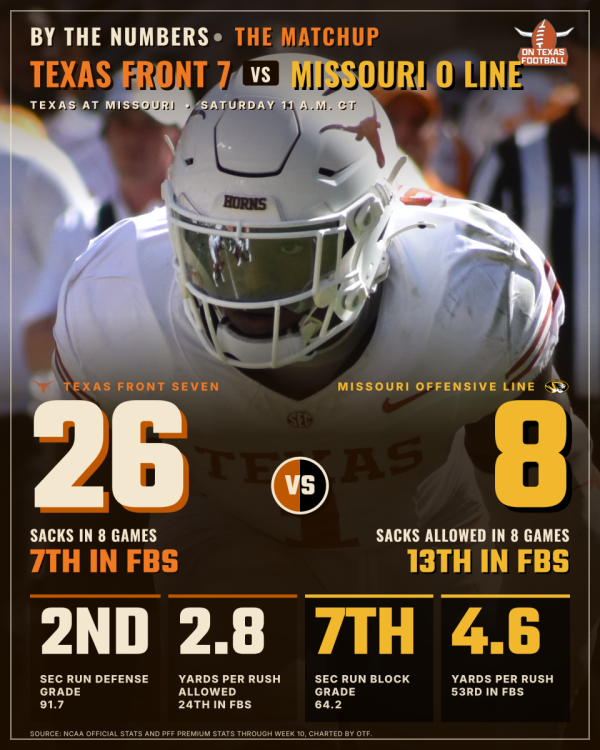
Payton here, one of the OTF interns. For Missouri week I went through the position group matchups with the PFF numbers and the NCAA rankings, and this is the one where the two sides are strongest, so wanted to give it a breakdown. The matchup that decides Saturday is up front. Texas has 26 sacks through eight games defensively, 7th in the country. Missouri has allowed 8, 13th fewest. Neither side has faced a unit at this level. The run game splits similarly. Texas allows 2.8 yards per rush, 24th nationally, and grades 2nd in the SEC in run defense per PFF. Missouri's line is the best pass blocking unit in the SEC by PFF grade but grades 7th in run blocking, and the Tigers average 4.6 a carry, 53rd in the country. So Missouri protects Austin Simmons well and but has been hit or miss moving people off the ball. The Tigers average 5.2 yards a carry with 9 rushing touchdowns in Columbia and 4.0 with 3 touchdowns on the road, including 39 yards on 26 carries at Ole Miss, where they posted their season-low in points with 3. The key here is to stop the run against Missouri, and Texas is at its best when it can slow the run game and then get home on the opposing teams’ passing downs. One caveat on the Texas side: Colin Simmons is listed as questionable on the Thursday report. He has 10.5 of the 26 sacks. If he sits, expect more of the same; blitzing from Rasheem Biles, who has had success getting home this year amid Collin Simmons absence. That brings pressure, but it also pulls a linebacker out of coverage, and with Graceson Littleton and Kade Phillips questionable too, the question becomes whether the secondary can hold up on the back end while Texas sends extra rushers. Does the Texas pass rush keep its pace against the best protection it has faced this year, or does Missouri's line change how this defense plays? And if Collin Simmons is out, can the secondary hold on the back end when Texas blitzes to replace him?
-
21-19 Texas (missed missouri 2 point conversion at the end)
-
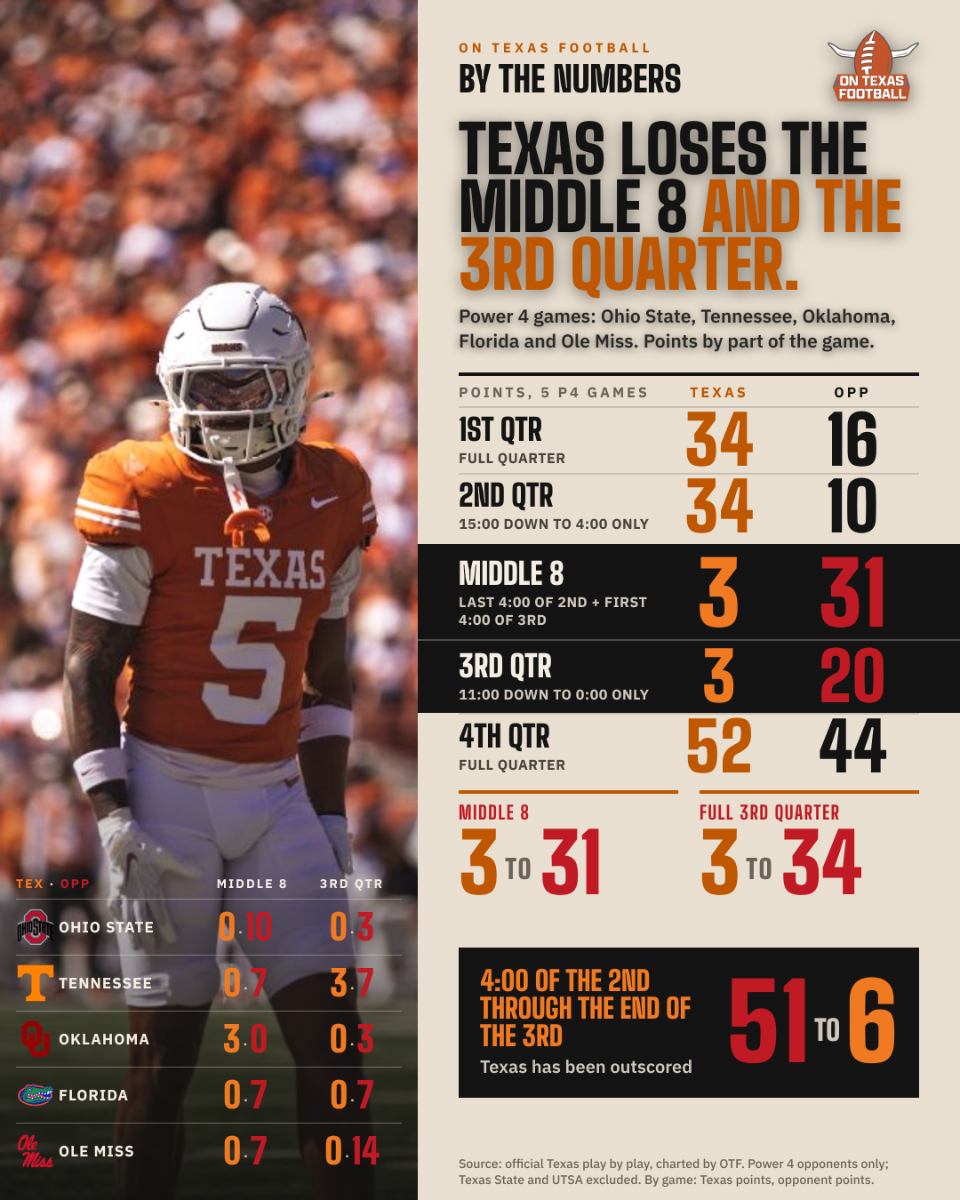
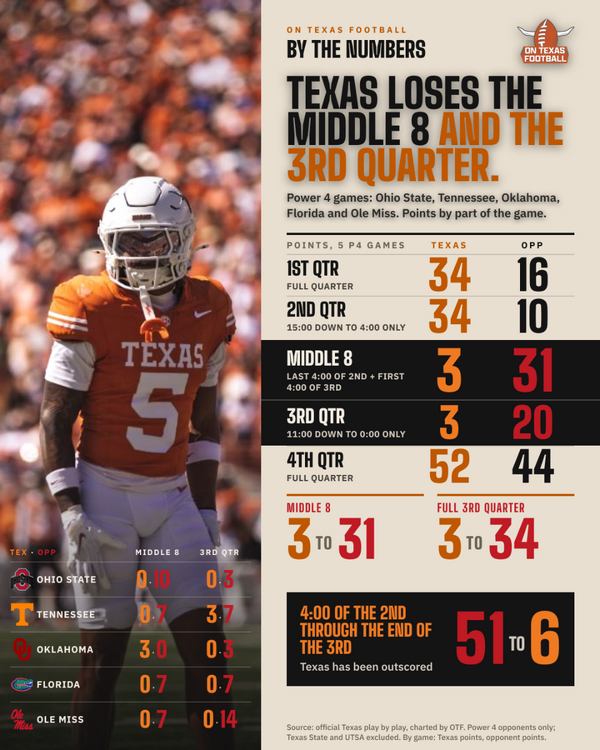
Hey guys it’s Payton again with another By the Numbers graphic. Against its five Power 4 opponents, Texas has outscored teams in the 1st, 2nd and 4th quarters. From 4:00 left in the 2nd quarter through the end of the 3rd, opponents have outscored Texas 51 to 6. That's 3 to 31 in the middle 8 and 3 to 34 across the full 3rd quarter. Most recently, against Ole Miss, a 24 to 3 lead was 24 to 17 by the end of the 3rd. Is this a halftime adjustment problem or a play calling problem coming out of the break? And what does the 4th quarter edge say about this team, that it can close games or that it only plays its best when there’s a real sense of urgency?
-
Wonder if we could somehow use AVG Time to Throw, to somehow compare sack rates to other similar AVG Time to Throw Numbers from other teams.
-
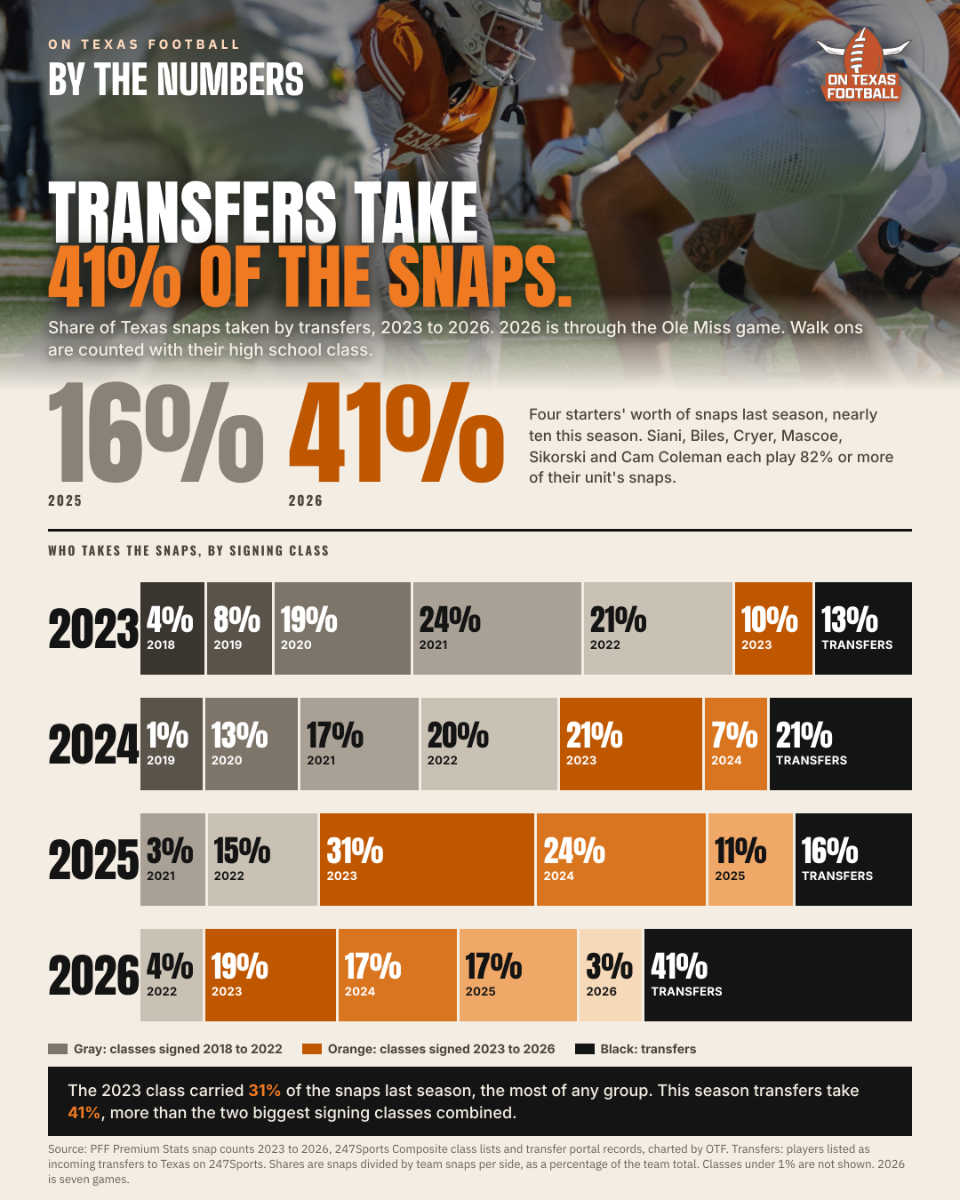
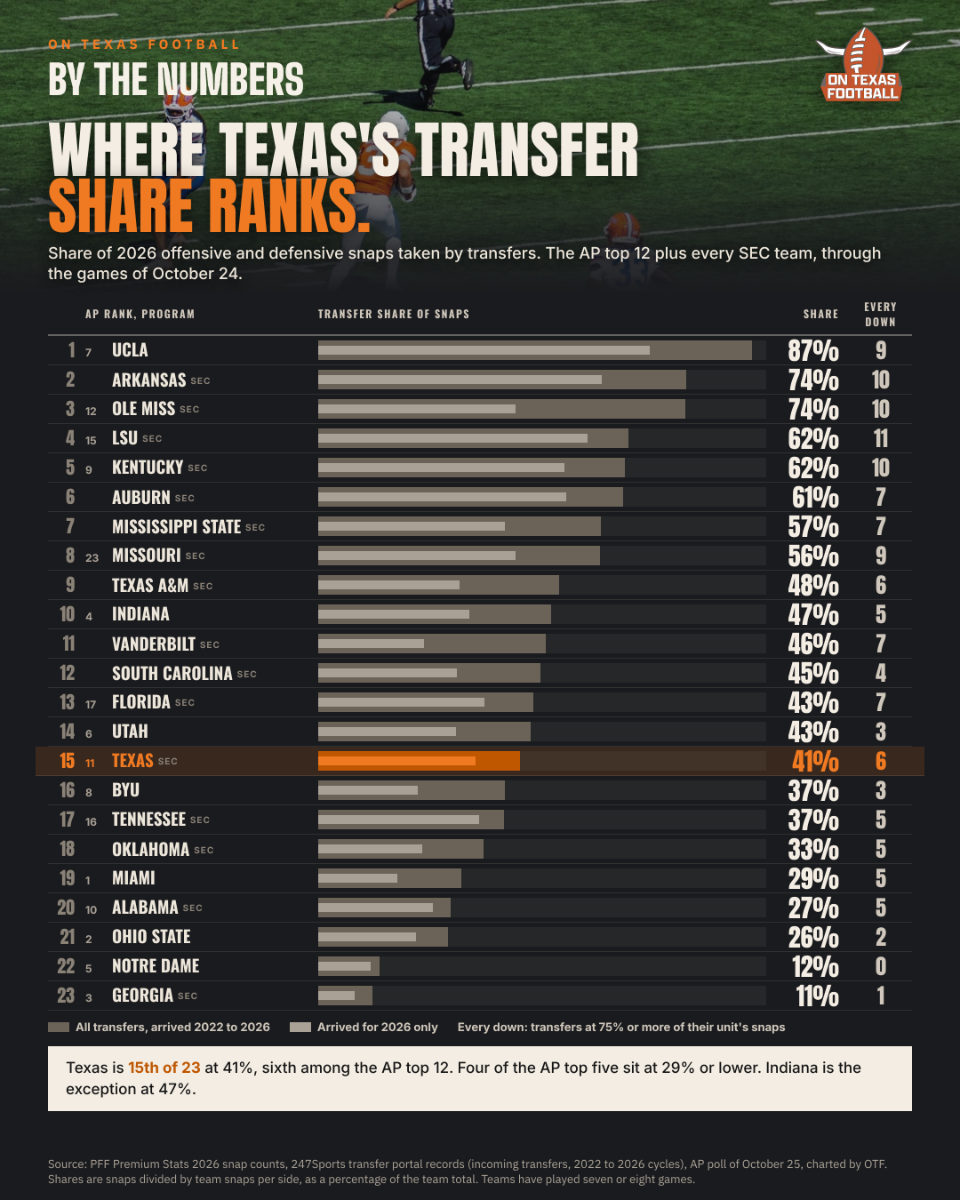
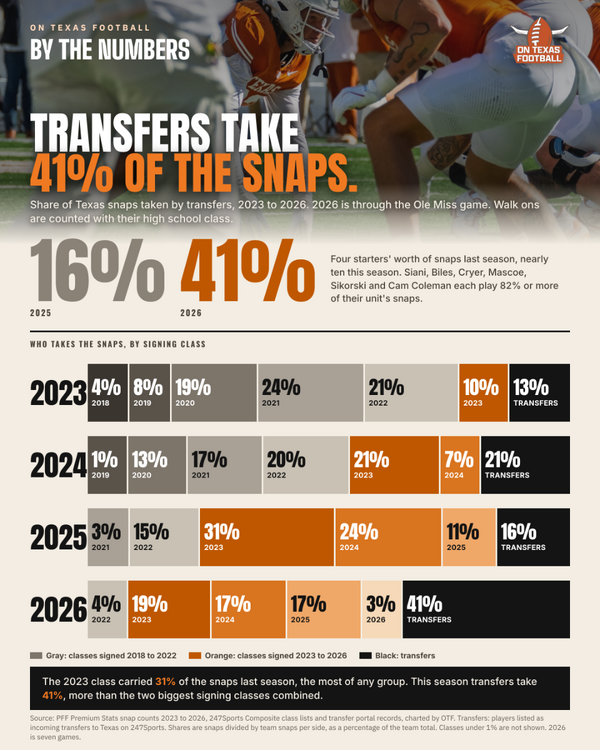
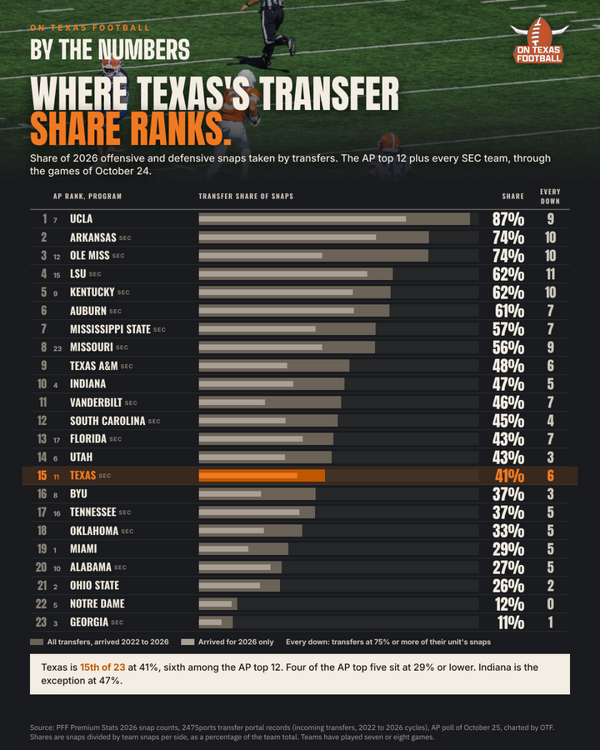
Hey this is Payton, one of the interns again, I wanted to take a deeper look into the roster makeup by recruiting class and transfers and was able to find some intriguing data. Here are two new By the Numbers graphics on roster makeup from the past few years, and how Texas’ transfer number compares nationally. The first breaks down who has taken Texas's snaps by signing class from 2023 to 2026, and shows transfers jumping from 16% last season to 41% this season. The second puts that 41% next to the AP top 12 and every SEC team, where Texas lands 15th of 23. I started by charting how many plays each Texas recruiting class gets as freshmen, sophomores, juniors and seniors. The 2025 class's numbers stood out, so I looked at where those snaps were going. The answer was transfers, who now take more snaps than the two biggest signing classes combined. That raised the next question: is 41% a lot? So I ran the same numbers for the AP top 12 and every SEC team. UCLA, Arkansas and Ole Miss are above 70%, while Georgia and Notre Dame are around 12%. Four of the AP top five are at 29% or lower. Do you think this is rise of transfer numbers at Texas is a bad thing? Should they continue to be above that magic 29% number?
-
Missing a Worthy PR TD against BYU 2023, and allowed OU to convert a fake FG in first quarter in 2022, although it didn’t end up mattering whatsoever.
-
Very fair, you can also see how the punt return unit as a whole so far this year has been completely down compared to last year. Good plays off the top of my head: Niblett against OU, Miss State, and Kentucky. And then obviously Silas Bolden in Quarterfinal against ASU. I know we had almost an identical blocked punt TD in that 2023 OU game as to what they had this year, albeit in a loss. We also had a kick return TD against Texas Tech in that 2023 game as well. The real questions I think is what is just a player making a play? And what’s a result of scheme and coaching? And recently we have seen a whole lot of getting caught with our pants down (2 onside kicks in 2 years, directional punt messed up leading to a score, multiple blocked punts, and 2 fake punts converted within 3 games in the 2024 Postseason), and not a whole lot of us making those kind of game-changing plays from a scheme or decision-making perspective.