


BurntOrangeMD
-
Posts
416 -
Joined
-
Last visited
1 Follower

About BurntOrangeMD

BurntOrangeMD's Achievements


-

Ole Miss-Texas prediction thread
BurntOrangeMD replied to Hank South's topic in On Texas Football Forum
~^~ 🏈 TEXAS * LONGHORNS 🏈 ~^~ 31 ole P i s s 💩 30 -
Texas-Florida prediction thread
BurntOrangeMD replied to Hank South's topic in On Texas Football Forum
I appreciate the support. Hook'em! 🤘 🤠 🇨🇱 -
Texas-Florida prediction thread
BurntOrangeMD replied to Hank South's topic in On Texas Football Forum
~^~ 🏈 TEXAS * LONGHORNS 🏈 ~^~ 31 to 10 floor ida gators. Hook'em! 🤘 🤠 🇨🇱 -
Welcome to OTF -- Class No. 1
BurntOrangeMD replied to Bobby Burton's topic in On Texas Football Forum
Outstanding! What a cool opportunity and a 🏈 Win-Win 🏈 situation for everyone involved. Hook'em! 🤘 🤠 🇨🇱 -
I know you guys are only joking, but... I've seen both in the ICU, then to the morgue.
-
Turf Toe Treatment and Rehabilitation Non-surgical treatment is effective for the vast majority of turf toe injuries, focusing on stabilizing the joint and progressively restoring function: The R.I.C.E. Protocol: Rest, Ice, Compression, and Elevation are crucial during the first 48 to 72 hours to manage acute pain and swelling. Immobilization: Grade 1 injuries can often be stabilized by taping the big toe to the second toe (buddy taping) or using rigid orthotic shoe inserts to stop the joint from bending. Grade 2 and 3 injuries usually require an orthopedic walking boot or cast shoe to fully unload weight. Physical Therapy: Once pain subsides, rehabilitation moves from simple, non-weight-bearing range-of-motion movements to strengthening exercises for the bottom foot muscles (like the flexor hallucis longus). Eventually, patients transition to flat-foot leg presses, calf raises, and sports-specific cutting drills. Surgery: Reserved for high-level athletes or severe Grade 3 cases involving completely torn ligaments, a fractured sesamoid bone, or lasting joint instability. An accurate medical diagnosis often utilizes physical manipulation and an MRI scan to confirm tissue integrity. This is the safest approach to prevent long-term complications like chronic stiffness (hallux rigidus) or bunions.
-
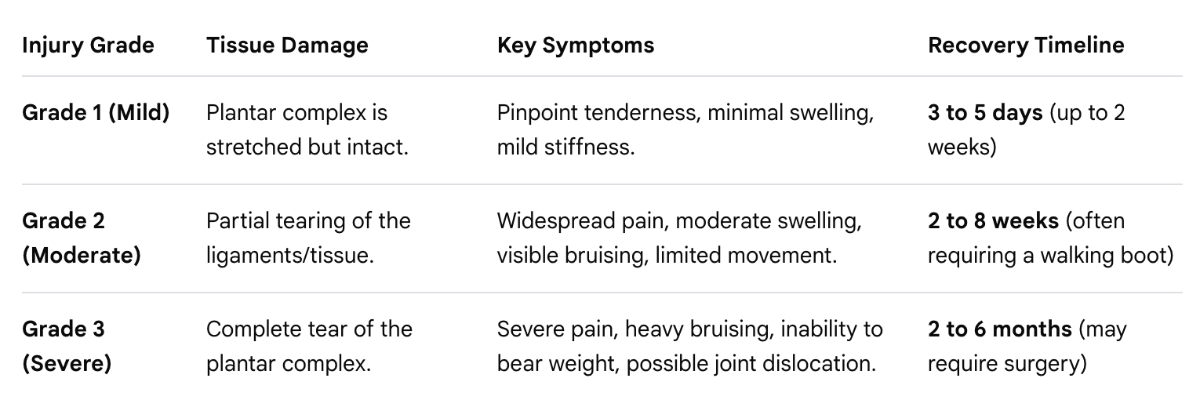
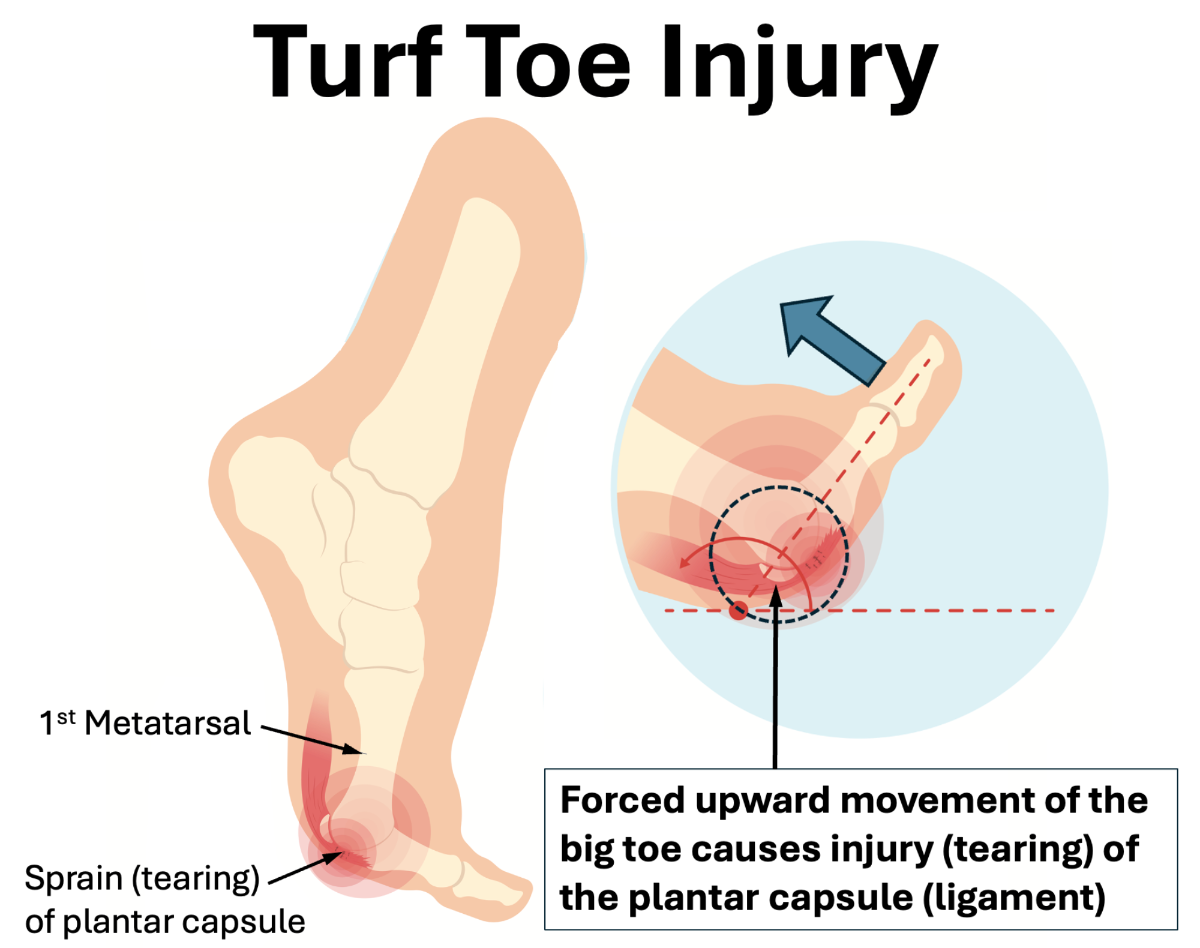
A turf toe injury is a sprain of the main joint at the base of the big toe, known as the metatarsophalangeal (MTP) joint. It occurs when the big toe is forcefully bent upward (hyperextended) while the forefoot is planted on the ground and the heel is raised. This action stretches or tears the supporting soft tissues, ligaments, and tendons under the joint, collectively called the plantar complex. It is most commonly associated with football players on hard artificial turf, although it can happen on a grass field as well. Common Symptoms Symptoms can appear suddenly after a specific trauma or build gradually from repetitive hyper-extension. Pain and Tenderness: Constant throbbing or sharp pain when pushing off during walking, running, or jumping. Swelling and Bruising: Localized inflammation around the ball of the foot that can spread across the big toe. Limited Mobility: Inability to bend the toe up or down, coupled with a distinct loss of "push-off" strength. Joint Instability: A popping sensation at the moment of injury, or a feeling that the joint is loose or sliding out of place. Injury Grading & Recovery Timelines Physicians use a grading scale from 1 to 3 to classify the severity of the damage to the plantar complex:

-
It is time to GIRD YOUR LOINS! Hook'em! 🤘 🤠 🇨🇱
-
Red River Shootout prediction thread!
BurntOrangeMD replied to Hank South's topic in On Texas Football Forum
ou fans at halftime.
-
Pick Your Surprise Player of the Game
BurntOrangeMD replied to Bobby Burton's topic in On Texas Football Forum
john mateer will be "Bomared" by Colin Simmons, and it will forever be known as "SmeartheMateer." Then, Rasheem BIles or Lance Jackson will scoop and score a touchdown with the 🏈 fumble! Hook'em! 🤘 🤠 🇨🇱 -
Red River Shootout prediction thread!
BurntOrangeMD replied to Hank South's topic in On Texas Football Forum
~^~ TEXAS 🏈 37 ~^~ ou 6 ~^~ TEXAS 🏈 37 ~^~ ou 6 ~^~ TEXAS 🏈 37 ~^~ ou 6 Hook'em! 🤘 🤠 🇨🇱 -
...and then there were those... that were not counted! This was a safety, and it ended up being the difference in the game. Hook'em! 🤘 🤠 🇨🇱
-
I'm so glad that you got to meet me.