


Jeff Howe
-
Posts
17779 -
Joined
-
Last visited
Content Type
Profiles
Texas Longhorns News
2025 Recruits
2024 Schedule
2026 Recruits
2025 Schedule
2027 Recruits
2026 Schedule
2028 Recruits
Gallery
Downloads
Forums
Blogs
Store
Everything posted by Jeff Howe
-
 The score prediction is mine, which will run with the rest of the OTF staff's predictions tomorrow.
-
It’s time for the 2026 debut of "Who Has the Edge?," an On Texas Football in-season feature that looks at how the Texas Longhorns stack up with their opponent. This week, it’s Texas State, with the Bobcats making the short drive up Interstate 35 for No. 5 Texas' season opener at Royal-Texas Memorial Stadium on Saturday (2:30 p.m., ESPN). WHEN TEXAS RUNS THE FOOTBALL Exiting the game healthy and keeping penalties to a minimum are two significant boxes the Longhorns can check on Saturday. So too is putting a better product on the field when running the football. Steve Sarkisian overhauled the offensive line and reloaded the running back room after last season’s lackluster ground output. The offseason moves were in response to Texas finishing in the bottom half of the SEC in rushing offense (10th with 4.19 yards per attempt and 11th with 137.77 yards per game), which is why the ground attack won’t get a grace period from the masses. The Longhorns also need to execute when trying to pound the rock on critical downs; the Bobcats ranked 114th in FBS last season in rushing yards allowed on third down with three or fewer yards to go, allowing 4.73 yards per attempt (tied for 105th in FBS), with 29 of the 37 times Texas State faced such situations resulting in first downs. EDGE: Texas WHEN TEXAS STATE RUNS THE FOOTBALL Even with Brad Jackson and his team-leading 17 rushing touchdowns back behind center, the Bobcats are going through a rebuilding year in the backfield. Leading rusher Lincoln Pare (1,128 yards, 5.4 yards per attempt and five touchdowns) exhausted his eligibility in 2025. Greg Burrell (671 yards, 6.7 yards per attempt and three rushing touchdowns in 2025) was dismissed from the program in April. Running backs coach and program legend Barrick Nealy stepped down in July to spend more time with his family. Even with college football’s biggest offensive line paving the way, GJ Kinne and Texas State don't have reliable, proven ball carriers. That's not where the Bobcats want to be against a Texas run defense that was stout in camp and has more than enough mass to match the Bobcats’ offensive trench beef. EDGE: Texas WHEN TEXAS THROWS THE FOOTBALL If Arch Manning is on, this is where the game can get away from the Bobcats. The offense wasn’t clicking on all cylinders in camp. Still, Sarkisian praised their ability to create explosive plays, which Manning connected on when targeting Cam Coleman and Ryan Wingo down the field. Whether Trevor Goosby plays or not, the Texas offensive line should be much better in pass protection and give Manning more time to operate than he had last season. Manning was one of the most pressured quarterbacks in the country (pressured on 165 dropbacks, according to Pro Football Focus, which was the sixth-highest total in FBS), which shouldn't be the case in 2026. DonTerry Russell, Texas State’s top returning pass rusher, is reportedly a game-time decision. Even if Russell plays, the Bobcats will likely have to send multiple defenders at Manning in their quest for negative plays and turnover opportunities. At best, that’s a roll of the dice. Manning was one of the best quarterbacks in college football last season when opponents blitzed him, completing 57.8 percent of his passes for 1,550 yards and 13 touchdowns, with just two interceptions. EDGE: Texas WHEN TEXAS STATE THROWS THE FOOTBALL Not only do the Longhorns have to deal with Jackson and a pair of 1,000-yard receivers (Beau Sparks had 1,200 yards and 10 touchdowns on 84 catches while Chris Dawn Jr. caught 65 passes for 1,007 yards and four touchdowns), but they’ll be going against an offensive line that was an elite pass-blocking unit in 2025. With 6-foot-7-inch, 327-pound tackle Sully Burns (No. 57 on Bruce Feldman’s Freaks List) back to lead the Bobcats in the trenches, Texas State was tied for No. 16 in FBS in pass-blocking efficiency rating (91.0), according to PFF, allowing only 69 pressures (tied for 20th in FBS) on 448 opportunities. With that said, we’ve yet to see how Will Muschamp will unleash Colin Simmons and Rasheem Biles, who was one of the nation’s best pass-rushing linebackers last season. Expect an experienced, explosive Bobcat offense to make plays against Muschamp's defense. For Sarkisian and Muschamp, the Longhorns will hopefully continue the camp trend of the defense making more plays (five interceptions in two scrimmages) than it gives up. EDGE: Texas SPECIAL TEAMS Both teams are breaking in new punters. Hopefully, we see more of Texas State’s Tom Flintoff than Mac Chiumento, who will kick to Sparks (72 yards on 13 returns last season) when he’s called upon. Something to monitor when the Bobcats punt is whether they gamble and kick to Ryan Niblett. Also, could Jeff Banks shake things up and decide to come after Flintoff, a freshman from Australia, early? Gianni Spetic is the more experienced transfer kicker in the game. He was solid in the team’s two camp scrimmages. Still, it’ll be good for Spetic to attempt a field goal on Saturday rather than have his first try in a Texas uniform come under the lights against Ohio State. Dylan Cunanan was 23-for-32 in two seasons at Toledo, including an 8-for-11 mark in 2025 (long of 46 yards). Field goals won’t keep Texas State in the game, but the Bobcats lining up for three will give one of the 11 Longhorns on the field a chance to fill Ethan Burke’s shoes as the team’s next field goal-blocking specialist. EDGE: Texas COACHES Sarkisian is 12-0 at Texas against non-Power Four opponents, winning those games by a combined score of 536-95. The Longhorns haven’t allowed a Group of Six opponent to score more than 10 points since a 41-20 win over UTSA on Sept. 17, 2022 (the week after a last-second 20-19 loss to No. 1 Alabama), a span of eight games. Whether that streak continues will largely hinge on the matchup between Kinne’s offense and Muschamp’s defense. Muschamp hasn’t been an in-game defensive play-caller since 2020 (his last season as South Carolina’s head coach). That gives Muschamp, who spent the last five seasons in various roles on Kirby Smart’s Georgia staff, an edge on Kinne, who doesn’t know what to expect on Saturday. Sarkisian is facing a new defensive coordinator for the second consecutive season opener. Needless to say, Matt Patricia’s Ohio State defense, loaded with future NFL draft picks, was a much tougher challenge than the one Texas will get from Texas State’s defense, led by Will Windham. Previously the defensive coordinator for Major Applewhite at South Alabama, Windham's approach is the opposite of what Sarkisian wanted when he hired Muschamp. Kinne ditched a high-risk, high-reward style of play in favor of Windham, an experienced play-caller who wants to confuse opponents with active, multiple fronts and simple coverages on the back end (front multiplicity and coverage simplicity are how Windham has described his defensive style). Unfortunately for Windham, his debut for the Bobcats is against an offense eying a fast start to a season it enters with national championship aspirations. EDGE: Texas SCORE PREDICTION Texas 41, Texas State 14 View full news story
-
It’s time for the 2026 debut of "Who Has the Edge?," an On Texas Football in-season feature that looks at how the Texas Longhorns stack up with their opponent. This week, it’s Texas State, with the Bobcats making the short drive up Interstate 35 for No. 5 Texas' season opener at Royal-Texas Memorial Stadium on Saturday (2:30 p.m., ESPN). WHEN TEXAS RUNS THE FOOTBALL Exiting the game healthy and keeping penalties to a minimum are two significant boxes the Longhorns can check on Saturday. So too is putting a better product on the field when running the football. Steve Sarkisian overhauled the offensive line and reloaded the running back room after last season’s lackluster ground output. The offseason moves were in response to Texas finishing in the bottom half of the SEC in rushing offense (10th with 4.19 yards per attempt and 11th with 137.77 yards per game), which is why the ground attack won’t get a grace period from the masses. The Longhorns also need to execute when trying to pound the rock on critical downs; the Bobcats ranked 114th in FBS last season in rushing yards allowed on third down with three or fewer yards to go, allowing 4.73 yards per attempt (tied for 105th in FBS), with 29 of the 37 times Texas State faced such situations resulting in first downs. EDGE: Texas WHEN TEXAS STATE RUNS THE FOOTBALL Even with Brad Jackson and his team-leading 17 rushing touchdowns back behind center, the Bobcats are going through a rebuilding year in the backfield. Leading rusher Lincoln Pare (1,128 yards, 5.4 yards per attempt and five touchdowns) exhausted his eligibility in 2025. Greg Burrell (671 yards, 6.7 yards per attempt and three rushing touchdowns in 2025) was dismissed from the program in April. Running backs coach and program legend Barrick Nealy stepped down in July to spend more time with his family. Even with college football’s biggest offensive line paving the way, GJ Kinne and Texas State don't have reliable, proven ball carriers. That's not where the Bobcats want to be against a Texas run defense that was stout in camp and has more than enough mass to match the Bobcats’ offensive trench beef. EDGE: Texas WHEN TEXAS THROWS THE FOOTBALL If Arch Manning is on, this is where the game can get away from the Bobcats. The offense wasn’t clicking on all cylinders in camp. Still, Sarkisian praised their ability to create explosive plays, which Manning connected on when targeting Cam Coleman and Ryan Wingo down the field. Whether Trevor Goosby plays or not, the Texas offensive line should be much better in pass protection and give Manning more time to operate than he had last season. Manning was one of the most pressured quarterbacks in the country (pressured on 165 dropbacks, according to Pro Football Focus, which was the sixth-highest total in FBS), which shouldn't be the case in 2026. DonTerry Russell, Texas State’s top returning pass rusher, is reportedly a game-time decision. Even if Russell plays, the Bobcats will likely have to send multiple defenders at Manning in their quest for negative plays and turnover opportunities. At best, that’s a roll of the dice. Manning was one of the best quarterbacks in college football last season when opponents blitzed him, completing 57.8 percent of his passes for 1,550 yards and 13 touchdowns, with just two interceptions. EDGE: Texas WHEN TEXAS STATE THROWS THE FOOTBALL Not only do the Longhorns have to deal with Jackson and a pair of 1,000-yard receivers (Beau Sparks had 1,200 yards and 10 touchdowns on 84 catches while Chris Dawn Jr. caught 65 passes for 1,007 yards and four touchdowns), but they’ll be going against an offensive line that was an elite pass-blocking unit in 2025. With 6-foot-7-inch, 327-pound tackle Sully Burns (No. 57 on Bruce Feldman’s Freaks List) back to lead the Bobcats in the trenches, Texas State was tied for No. 16 in FBS in pass-blocking efficiency rating (91.0), according to PFF, allowing only 69 pressures (tied for 20th in FBS) on 448 opportunities. With that said, we’ve yet to see how Will Muschamp will unleash Colin Simmons and Rasheem Biles, who was one of the nation’s best pass-rushing linebackers last season. Expect an experienced, explosive Bobcat offense to make plays against Muschamp's defense. For Sarkisian and Muschamp, the Longhorns will hopefully continue the camp trend of the defense making more plays (five interceptions in two scrimmages) than it gives up. EDGE: Texas SPECIAL TEAMS Both teams are breaking in new punters. Hopefully, we see more of Texas State’s Tom Flintoff than Mac Chiumento, who will kick to Sparks (72 yards on 13 returns last season) when he’s called upon. Something to monitor when the Bobcats punt is whether they gamble and kick to Ryan Niblett. Also, could Jeff Banks shake things up and decide to come after Flintoff, a freshman from Australia, early? Gianni Spetic is the more experienced transfer kicker in the game. He was solid in the team’s two camp scrimmages. Still, it’ll be good for Spetic to attempt a field goal on Saturday rather than have his first try in a Texas uniform come under the lights against Ohio State. Dylan Cunanan was 23-for-32 in two seasons at Toledo, including an 8-for-11 mark in 2025 (long of 46 yards). Field goals won’t keep Texas State in the game, but the Bobcats lining up for three will give one of the 11 Longhorns on the field a chance to fill Ethan Burke’s shoes as the team’s next field goal-blocking specialist. EDGE: Texas COACHES Sarkisian is 12-0 at Texas against non-Power Four opponents, winning those games by a combined score of 536-95. The Longhorns haven’t allowed a Group of Six opponent to score more than 10 points since a 41-20 win over UTSA on Sept. 17, 2022 (the week after a last-second 20-19 loss to No. 1 Alabama), a span of eight games. Whether that streak continues will largely hinge on the matchup between Kinne’s offense and Muschamp’s defense. Muschamp hasn’t been an in-game defensive play-caller since 2020 (his last season as South Carolina’s head coach). That gives Muschamp, who spent the last five seasons in various roles on Kirby Smart’s Georgia staff, an edge on Kinne, who doesn’t know what to expect on Saturday. Sarkisian is facing a new defensive coordinator for the second consecutive season opener. Needless to say, Matt Patricia’s Ohio State defense, loaded with future NFL draft picks, was a much tougher challenge than the one Texas will get from Texas State’s defense, led by Will Windham. Previously the defensive coordinator for Major Applewhite at South Alabama, Windham's approach is the opposite of what Sarkisian wanted when he hired Muschamp. Kinne ditched a high-risk, high-reward style of play in favor of Windham, an experienced play-caller who wants to confuse opponents with active, multiple fronts and simple coverages on the back end (front multiplicity and coverage simplicity are how Windham has described his defensive style). Unfortunately for Windham, his debut for the Bobcats is against an offense eying a fast start to a season it enters with national championship aspirations. EDGE: Texas SCORE PREDICTION Texas 41, Texas State 14
- 14 comments
-
- 16
-

-

-
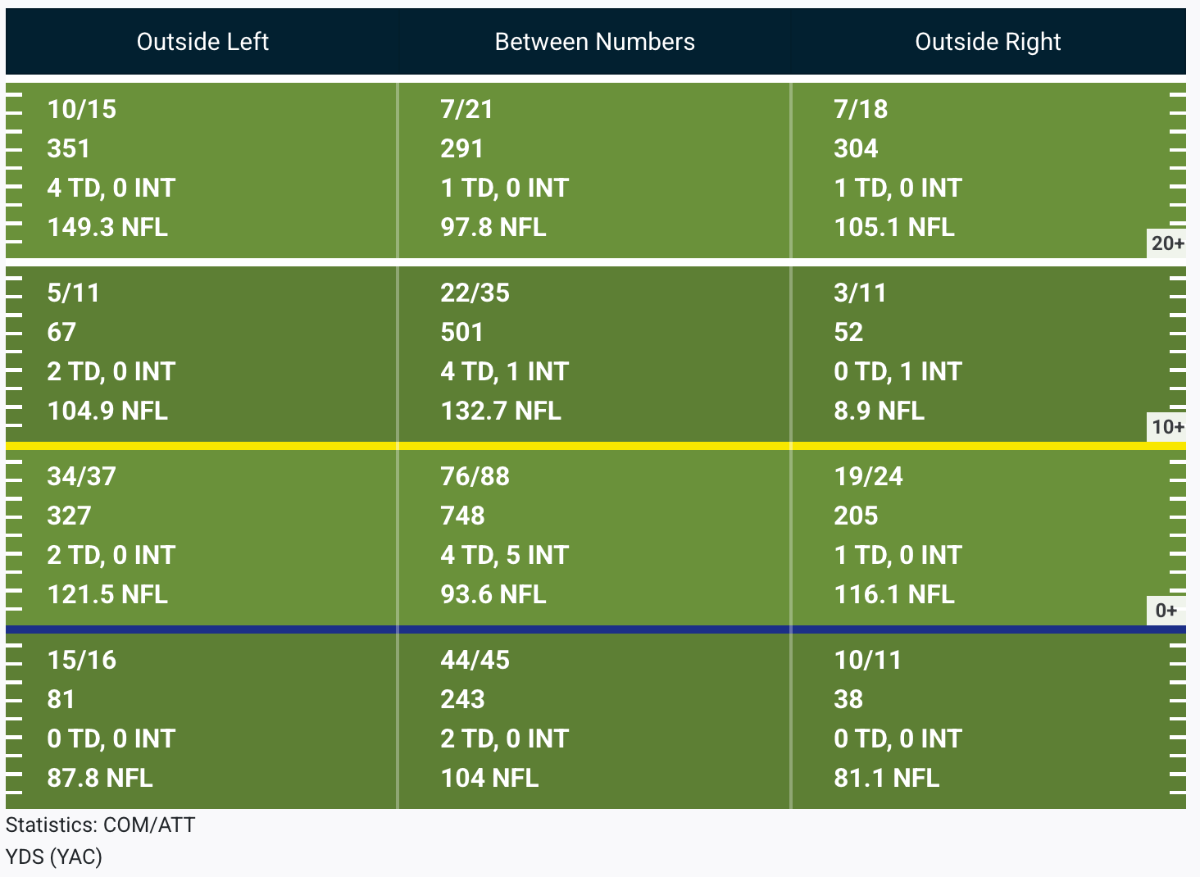
This is Jackson's passing depth chart, according to Pro Football Focus. When he threw the ball beyond the line of scrimmage last season, he was more efficient outside the numbers than in the middle of the field. The Gus Malzahn/Chad Morris offense that GJ Kinne's offense is rooted in is similar to the Art Briles veer-and-shoot in that the middle of the field opening up is to support the running game. Malzahn and his disciples use the middle of the field in the passing game a lot more than the guys who are descendants of the veer-and-shoot. Regardless, if you're looking for the path of least resistance against Texas, you'll try to make Cryer make plays in space. Saturday is a tremendous opportunity for him to get off on the right foot and set the tone because it won't be the last time teams come after him.

-
AUSTIN, Texas — Justin Cryer earned the opportunity to be a significant piece of what Steve Sarkisian believes is a championship-caliber puzzle because of the work he’s put in since joining the Texas program in January. Cryer will wear the green dot on his helmet as the Longhorn defender who will receive in-helmet communication from Will Muschamp when he’s on the field in Saturday’s season opener against Texas State (2:30 p.m., ESPN). According to Sarkisian, that happened because the 6-foot-1-inch, 241-pound Cryer “immersed himself to the process and the schemes” after transferring to Texas from Florida State, establishing himself as a leader and key defensive cog for the Longhorns before logging his first snap in burnt orange. “This guy is very, very smart,” Sarkisian said. “He's a really good communicator and it's not just communication with the players. He's a really good communicator with the coaches. He can talk and say exactly what he sees. Half of communicating is listening, right? His ability to listen to a call from Coach Muschamp, maybe a reminder, and then relay that communication to the defensive front or the other 'backers or the DBs, I think all of that is really important. “He's earned that because he's immersed himself in the scheme,” he added. “I think he knows it as good or better than anybody.” Cryer’s ability to operate efficiently within Muschamp’s scheme will be tested against a Bobcat offense led by Brad Jackson, one of the top returning dual-threat quarterbacks in the country. As an inside linebacker, Cryer should face more run/pass conflicts than any other Texas defender on Saturday. The design and function of GJ Kinne’s balanced, up-tempo offense (Kinne played for Gus Malzahn and Chad Morris at Tulsa and was with Chip Kelly in the NFL for three seasons, all of whom have influenced Kinne's offensive ethos) will keep Cryer on his toes. Cryer’s biggest challenge is the role he’ll play in defending Jackson, who finished seventh in the country in total offense in 2025 (305.2 yards per game). Jackson completed his redshirt freshman season with 3,968 total yards (3,224 yards passing and 744 yards rushing), breaking a program record that Barrick Nealy (who led Texas State to the then-Division I-AA semifinals in 2005, with Tom Herman calling the offensive plays for David Bailiff in San Marcos) held for two decades. “You don't get over 700 yards rushing on accident,” said Sarkisian, who acknowledged that defending Jackson requires accounting for three things. The game plan starts with preparing for Jackson’s ability to get the football out quickly to Beau Sparks (84 receptions, 1,200 yards and 10 touchdowns last season) and Chris Dawn Jr. (65 catches for 1,007 yards and four touchdowns in 2025). It also means dealing with intricately designed quarterback runs, with Jackson’s prowess as a scrambler (his 391 yards gained on scrambles tied for the ninth-most in FBS, according to Pro Football Focus) adding another degree of difficulty. Whether he’s trying to stop Jackson from gaining yards with his legs or protecting the middle of the field as a pass defender, where the Longhorns will be most vulnerable to play-action passes and Jackson’s ability to manipulate the eyes of defenders at the mesh point, Cryer will be under the microscope from the jump. If Cryer, who allowed 13 receptions for 105 yards (8.1 yards per reception) and a touchdown on the 20 times he was targeted last season, according to PFF (a 41.5 season-long coverage grade was the third-worst among the 42 Seminole defenders who recorded at least one coverage snap across Florida State's 12 games), holds his own against one of the most potent offenses in the country (the Bobcats tied for 21st in FBS with 70 plays from scrimmage of 20 or more yards and averaged 6.68 yards per play last season, tying Ole Miss for No. 15 nationally), it’ll send a signal to opposing offense to think twice before immediately identifying him as the path of least resistance when trying to move the football against the Longhorns. TEXAS SAFETIES vs. TEXAS STATE WIDE RECEIVERS It’s a safe bet that Kinne and Jackson will force Cryer to make plays in space. The same is true for the Longhorn safeties, who will likely find themselves in one-on-one situations against Sparks and Dawn, the Bobcats’ 1,000-yard receiving tandem. Whenever Jelani McDonald, Derek Williams Jr., Jonah Williams or Kobe Black find themselves all alone against one of Jackson’s downfield threats, the goal should be to minimize the damage. Above all else, that means stopping the ball where it’s caught and limiting yards after the catch, a category in which Sparks (558 yards after the catch) and Dawn (535) ranked seventh and ninth among FBS wide receivers last season, respectively, according to PFF. TEXAS OFFENSIVE LINE vs. TEXAS STATE DEFENSIVE LINE After an offseason chock-full of talk about the Longhorns running the football more effectively and efficiently than they did in 2025, it would be a welcome sight to see Kyle Flood’s group lean on the Bobcats’ defensive front. Although Texas State made a coordinator change on defense, with Will Windham coming over from South Alabama, and attempted to bolster their defensive front through the transfer portal, the Bobcats allowed 164.9 yards per game (91st in FBS) and 4.24 yards per attempt (71st in FBS) last season, while opponents recorded 74 rushing attempts of 10 or more yards in 13 games (tied for 28th in FBS). The Texas ground game needs to make a statement out of the gate that 2026 will be different when it comes to pounding the rock. A revamped running back room must do its part. Still, Longhorn fans would feel a lot better going into the Ohio State game (and beyond) if the new-look offensive line can generate a consistent push and clearly win the line-of-scrimmage battle against Texas State. View full news story
-
AUSTIN, Texas — Justin Cryer earned the opportunity to be a significant piece of what Steve Sarkisian believes is a championship-caliber puzzle because of the work he’s put in since joining the Texas program in January. Cryer will wear the green dot on his helmet as the Longhorn defender who will receive in-helmet communication from Will Muschamp when he’s on the field in Saturday’s season opener against Texas State (2:30 p.m., ESPN). According to Sarkisian, that happened because the 6-foot-1-inch, 241-pound Cryer “immersed himself to the process and the schemes” after transferring to Texas from Florida State, establishing himself as a leader and key defensive cog for the Longhorns before logging his first snap in burnt orange. “This guy is very, very smart,” Sarkisian said. “He's a really good communicator and it's not just communication with the players. He's a really good communicator with the coaches. He can talk and say exactly what he sees. Half of communicating is listening, right? His ability to listen to a call from Coach Muschamp, maybe a reminder, and then relay that communication to the defensive front or the other 'backers or the DBs, I think all of that is really important. “He's earned that because he's immersed himself in the scheme,” he added. “I think he knows it as good or better than anybody.” Cryer’s ability to operate efficiently within Muschamp’s scheme will be tested against a Bobcat offense led by Brad Jackson, one of the top returning dual-threat quarterbacks in the country. As an inside linebacker, Cryer should face more run/pass conflicts than any other Texas defender on Saturday. The design and function of GJ Kinne’s balanced, up-tempo offense (Kinne played for Gus Malzahn and Chad Morris at Tulsa and was with Chip Kelly in the NFL for three seasons, all of whom have influenced Kinne's offensive ethos) will keep Cryer on his toes. Cryer’s biggest challenge is the role he’ll play in defending Jackson, who finished seventh in the country in total offense in 2025 (305.2 yards per game). Jackson completed his redshirt freshman season with 3,968 total yards (3,224 yards passing and 744 yards rushing), breaking a program record that Barrick Nealy (who led Texas State to the then-Division I-AA semifinals in 2005, with Tom Herman calling the offensive plays for David Bailiff in San Marcos) held for two decades. “You don't get over 700 yards rushing on accident,” said Sarkisian, who acknowledged that defending Jackson requires accounting for three things. The game plan starts with preparing for Jackson’s ability to get the football out quickly to Beau Sparks (84 receptions, 1,200 yards and 10 touchdowns last season) and Chris Dawn Jr. (65 catches for 1,007 yards and four touchdowns in 2025). It also means dealing with intricately designed quarterback runs, with Jackson’s prowess as a scrambler (his 391 yards gained on scrambles tied for the ninth-most in FBS, according to Pro Football Focus) adding another degree of difficulty. Whether he’s trying to stop Jackson from gaining yards with his legs or protecting the middle of the field as a pass defender, where the Longhorns will be most vulnerable to play-action passes and Jackson’s ability to manipulate the eyes of defenders at the mesh point, Cryer will be under the microscope from the jump. If Cryer, who allowed 13 receptions for 105 yards (8.1 yards per reception) and a touchdown on the 20 times he was targeted last season, according to PFF (a 41.5 season-long coverage grade was the third-worst among the 42 Seminole defenders who recorded at least one coverage snap across Florida State's 12 games), holds his own against one of the most potent offenses in the country (the Bobcats tied for 21st in FBS with 70 plays from scrimmage of 20 or more yards and averaged 6.68 yards per play last season, tying Ole Miss for No. 15 nationally), it’ll send a signal to opposing offense to think twice before immediately identifying him as the path of least resistance when trying to move the football against the Longhorns. TEXAS SAFETIES vs. TEXAS STATE WIDE RECEIVERS It’s a safe bet that Kinne and Jackson will force Cryer to make plays in space. The same is true for the Longhorn safeties, who will likely find themselves in one-on-one situations against Sparks and Dawn, the Bobcats’ 1,000-yard receiving tandem. Whenever Jelani McDonald, Derek Williams Jr., Jonah Williams or Kobe Black find themselves all alone against one of Jackson’s downfield threats, the goal should be to minimize the damage. Above all else, that means stopping the ball where it’s caught and limiting yards after the catch, a category in which Sparks (558 yards after the catch) and Dawn (535) ranked seventh and ninth among FBS wide receivers last season, respectively, according to PFF. TEXAS OFFENSIVE LINE vs. TEXAS STATE DEFENSIVE LINE After an offseason chock-full of talk about the Longhorns running the football more effectively and efficiently than they did in 2025, it would be a welcome sight to see Kyle Flood’s group lean on the Bobcats’ defensive front. Although Texas State made a coordinator change on defense, with Will Windham coming over from South Alabama, and attempted to bolster their defensive front through the transfer portal, the Bobcats allowed 164.9 yards per game (91st in FBS) and 4.24 yards per attempt (71st in FBS) last season, while opponents recorded 74 rushing attempts of 10 or more yards in 13 games (tied for 28th in FBS). The Texas ground game needs to make a statement out of the gate that 2026 will be different when it comes to pounding the rock. A revamped running back room must do its part. Still, Longhorn fans would feel a lot better going into the Ohio State game (and beyond) if the new-look offensive line can generate a consistent push and clearly win the line-of-scrimmage battle against Texas State.
- 6 comments
-
- 16
-
-
I'm not a huge fan of the Fanatics exclusive deals, but Arch signing one was only a matter of time. There's no upside to doing the exclusive deal with Panini, especially once he's done at Texas.
-
This is a good post because there's some nuance here. I'm not saying Arch needs to be a statue. I'm saying he needs to be smart when he has to scramble and the offensive line, tight ends and backs need to do what they can from a protection standpoint to make sure those opportunities are few and far between. I'm coming around to the idea that Arch is more Josh Allen than Matthew Stafford. He doesn't have clean mechanics and doesn't operate as well in structure as he does in chaos when things break down around him. That's why @Rod Babers made the point recently that, as good as Arch is and as good as Sark is, Arch isn't the best fit for what Sark wants to do offensively. With that said, Arch needs to get better and show growth playing within the structure of the offense. He needs to hit more of the timing throws and get into a better rhythm to fully maximize what he can do in Sark's offense. As for the comparison with Brad Jackson, the only way Texas State has a chance to stay in the game is if Jackson is turned loose. Texas should be able to control the game even while minimizing the risk of Arch running and exposing his body, which is the point I was trying to get across. Regarding the backs and tight ends, it's less about Arch checking the ball down in the traditional sense and more about the new pieces of the offense figuring out sooner rather than later how to operate in scramble drill situations. Wingo and Mosley got better in that area as the season went on last year. When your quarterback is on the move off schedule, go find open space and become a target for him so that Arch isn't the one trying to win a one-on-one battle in space with a defender. Getting good at the scramble drill takes time and it's something that you can't fully work on until the quarterback is live in a game. I hope that answers any lingering questions.
-
Yes
-
AUSTIN, Texas — Hopefully, the season opener against Texas State is the sloppiest game No. 5 Texas plays in 2026. While Steve Sarkisian doesn’t question the effort, intent or physicality he'll see against the Bobcats, he’s not expecting the Longhorns to be a finished product. After watching a few of the games during college football’s limited Week 0 slate, Sarkisian knows his club won’t be perfect on Saturday (2:30 p.m., ESPN). “You see guys jumping offsides, you see formations, you see personal foul penalties after a catch that's a little bit of a different rule, you see 12 guys on the field — you see some of the stuff,” Sarkisian said on Monday. “To me, the situational masters piece of how important those special situations are in early Week 1, Week 2 type games, those are the things that we're really trying to focus in on to make sure that we don't have those lapses. Only 10 guys on punt return or 12 guys on defense. Hard count, we jump offsides. Those little things are the things that we're really trying to focus in on.” For a Texas squad that finished the 2025 season ranked 134th in the country in penalties per game (8.3), getting off to a clean start is hugely important, especially with No. 1 Ohio State coming to town for a game on Sept. 12 with major College Football Playoff implications at stake. The same can be said for Texas State, whose seven penalties for 61.4 yards per game last season ranked 104th and 106th in FBS, respectively. Other than limiting penalties, which would be a long overdue, welcome sight for the Longhorn faithful, here are a few other statistical categories to monitor when Texas squares off with the Bobcats. TURNOVERS The focus on takeaways throughout the offseason has centered around Will Muschamp’s defense forcing the issue and creating havoc. When it comes to the opener, however, the attention shifts away from the defense and to how well Arch Manning and the offense can protect the football, something the Longhorns did at an elite level last season. Only four FBS offenses committed fewer turnovers than the nine charged to Texas in 13 games, one of which was a special teams miscue in the Citrus Bowl. While the offense turned the ball over six times in two camp scrimmages, the Longhorns should find better fortune against Texas State. The Bobcats tied for 106th nationally with 12 takeaways last season. That’s one of the reasons why GJ Kinne hired Will Windham off Major Applewhite’s South Alabama staff to run Texas State’s defense, even though the Jaguars recorded five fewer takeaways in 2025 (15 in 12 games) than they did in Windham’s first season as defensive coordinator, tying for 43rd in FBS with 20 turnovers forced in 13 games. Turning the football over is a sure-fire way to let an inferior opponent hang around longer than they should. The better the Longhorns are at protecting the football, the quicker Sarkisian can get the starters out of the game. PLAY DIFFERENTIAL Paired together, third-down conversion percentage and time of possession paint a good picture of how well a team controlled a game. The play differential (the difference between the number of plays run on offense and the number of plays defended) between two teams does the same thing. And with the elements being what they’re expected to be on Saturday, total snaps are arguably more important than the aforementioned metrics. It’s also an area where Texas struggled last season. The Longhorns had a season-long play differential of minus-47 (minus-3.6 per game), which ranked 14th in the SEC; it got worse in conference play, with Texas’ minus-79 play differential (minus-9.9 per game) ranking last in the league. The defense forcing turnovers and/or getting off the field on third down are significant factors in how the play differential plays out. But the offense also has to sustain drives, which the Longhorns should be better equipped to do in 2026, thanks to a revamped running game and an offensive line (with help from Michael Masunas as an in-line blocker) better built to control the line of scrimmage. QUARTERBACK RUSHING YARDS Manning finishing the game with as close to zero rushing yards as possible would be a great outcome for the offense. It would mean he avoided getting sacked and, instead of using his legs to escape the pocket and keep the offense on schedule, Manning has more (and more viable) options to check the ball down to with Raleek Brown and Hollywood Smothers in the backfield. The fewer hits Manning has to absorb against the Bobcats, the better everyone will feel heading into the Ohio State game. Brad Jackson’s legs, on the other hand, can put stress on the Texas defense in multiple ways. According to Pro Football Focus, Jackson rushed for 391 yards on scrambles (No. 9 in FBS) and gained 478 yards on designed runs (No. 23 in FBS). The Bobcats’ signal-caller was one of only seven FBS quarterbacks to rack up at least 450 yards on designed runs and scramble for at least 350 yards (Jackson’s 58 rushing attempts on scrambles were the second-most in FBS, according to PFF). Whether it’s Justin Cryer, Derek Williams Jr. or another Longhorn defender, Kinne would be smart to look for the path of least resistance (i.e., limiting the number of times his offense challenges Rasheem Biles, Colin Simmons or another proven playmaker) when targeting Texas players to put in a run/pass conflict. View full news story
-
AUSTIN, Texas — Hopefully, the season opener against Texas State is the sloppiest game No. 5 Texas plays in 2026. While Steve Sarkisian doesn’t question the effort, intent or physicality he'll see against the Bobcats, he’s not expecting the Longhorns to be a finished product. After watching a few of the games during college football’s limited Week 0 slate, Sarkisian knows his club won’t be perfect on Saturday (2:30 p.m., ESPN). “You see guys jumping offsides, you see formations, you see personal foul penalties after a catch that's a little bit of a different rule, you see 12 guys on the field — you see some of the stuff,” Sarkisian said on Monday. “To me, the situational masters piece of how important those special situations are in early Week 1, Week 2 type games, those are the things that we're really trying to focus in on to make sure that we don't have those lapses. Only 10 guys on punt return or 12 guys on defense. Hard count, we jump offsides. Those little things are the things that we're really trying to focus in on.” For a Texas squad that finished the 2025 season ranked 134th in the country in penalties per game (8.3), getting off to a clean start is hugely important, especially with No. 1 Ohio State coming to town for a game on Sept. 12 with major College Football Playoff implications at stake. The same can be said for Texas State, whose seven penalties for 61.4 yards per game last season ranked 104th and 106th in FBS, respectively. Other than limiting penalties, which would be a long overdue, welcome sight for the Longhorn faithful, here are a few other statistical categories to monitor when Texas squares off with the Bobcats. TURNOVERS The focus on takeaways throughout the offseason has centered around Will Muschamp’s defense forcing the issue and creating havoc. When it comes to the opener, however, the attention shifts away from the defense and to how well Arch Manning and the offense can protect the football, something the Longhorns did at an elite level last season. Only four FBS offenses committed fewer turnovers than the nine charged to Texas in 13 games, one of which was a special teams miscue in the Citrus Bowl. While the offense turned the ball over six times in two camp scrimmages, the Longhorns should find better fortune against Texas State. The Bobcats tied for 106th nationally with 12 takeaways last season. That’s one of the reasons why GJ Kinne hired Will Windham off Major Applewhite’s South Alabama staff to run Texas State’s defense, even though the Jaguars recorded five fewer takeaways in 2025 (15 in 12 games) than they did in Windham’s first season as defensive coordinator, tying for 43rd in FBS with 20 turnovers forced in 13 games. Turning the football over is a sure-fire way to let an inferior opponent hang around longer than they should. The better the Longhorns are at protecting the football, the quicker Sarkisian can get the starters out of the game. PLAY DIFFERENTIAL Paired together, third-down conversion percentage and time of possession paint a good picture of how well a team controlled a game. The play differential (the difference between the number of plays run on offense and the number of plays defended) between two teams does the same thing. And with the elements being what they’re expected to be on Saturday, total snaps are arguably more important than the aforementioned metrics. It’s also an area where Texas struggled last season. The Longhorns had a season-long play differential of minus-47 (minus-3.6 per game), which ranked 14th in the SEC; it got worse in conference play, with Texas’ minus-79 play differential (minus-9.9 per game) ranking last in the league. The defense forcing turnovers and/or getting off the field on third down are significant factors in how the play differential plays out. But the offense also has to sustain drives, which the Longhorns should be better equipped to do in 2026, thanks to a revamped running game and an offensive line (with help from Michael Masunas as an in-line blocker) better built to control the line of scrimmage. QUARTERBACK RUSHING YARDS Manning finishing the game with as close to zero rushing yards as possible would be a great outcome for the offense. It would mean he avoided getting sacked and, instead of using his legs to escape the pocket and keep the offense on schedule, Manning has more (and more viable) options to check the ball down to with Raleek Brown and Hollywood Smothers in the backfield. The fewer hits Manning has to absorb against the Bobcats, the better everyone will feel heading into the Ohio State game. Brad Jackson’s legs, on the other hand, can put stress on the Texas defense in multiple ways. According to Pro Football Focus, Jackson rushed for 391 yards on scrambles (No. 9 in FBS) and gained 478 yards on designed runs (No. 23 in FBS). The Bobcats’ signal-caller was one of only seven FBS quarterbacks to rack up at least 450 yards on designed runs and scramble for at least 350 yards (Jackson’s 58 rushing attempts on scrambles were the second-most in FBS, according to PFF). Whether it’s Justin Cryer, Derek Williams Jr. or another Longhorn defender, Kinne would be smart to look for the path of least resistance (i.e., limiting the number of times his offense challenges Rasheem Biles, Colin Simmons or another proven playmaker) when targeting Texas players to put in a run/pass conflict.
- 14 comments
-
- 13
-
-
-
I used Sark's quotes from Monday to kind of empty my thoughts on Arch before the opener. Everything around him and the things out of his control look to be more in his favor now compared to where he was last season. We'll see how it plays out in three days.
- 14 replies
-
- 13
-
-
AUSTIN, Texas — Steve Sarkisian won’t know much about his team until No. 5 Texas gets on the field and squares off with Texas State at Royal-Texas Memorial Stadium on Saturday (2:30 p.m., ESPN). One thing Sarkisian can take to the bank heading into the opening game of his sixth season on the Forty Acres, however, is that he and Arch Manning are in a much different place than they were at this time last year. And by different, Manning and the Longhorn offense are better positioned for success. “I think last year, offensively, was a little bit of a work in progress,” Sarkisian said on Monday. “We were probably a little too young around Arch as much as it was Arch's first year starting. Trying to figure out what he felt very good with, but also what the other guys could do well.” The first half of Manning’s 13-game starting campaign was largely forgettable. When Texas traveled to Florida for last season’s SEC opener in early October, Manning averaged 222 passing yards per game, ranking ninth out of 16 qualifying quarterbacks in the conference. Manning also ranked ninth in the league in pass efficiency rating (154.0) and yards per pass attempt (8.4) and 15th out of 16 SEC quarterbacks in completion percentage (61.3). Fortunately, Manning wrapped up his third year in the program playing as well as any quarterback in the country. In November, a month in which the Longhorns won three of their four games, including victories over No. 9 Vanderbilt and No. 3 Texas A&M, Manning ranked third in the SEC in passing yards per game (286.6) and passing touchdowns (nine) while completing 62.2 percent of his passes and committing just one turnover. The hard lessons throughout the first half of 2025 will, hopefully, lead to Manning and the offense enjoying a faster, more prosperous start to 2026. An older, more seasoned Manning should also benefit from the talent Sarkisian’s organization acquired in the offseason to bolster Manning’s supporting cast. The transfer portal additions should make the conditions ripe for Manning to do his job without feeling undue pressure to carry the offense on his shoulders. At the same time, the Bobcats will face a more experienced Longhorn offense than the one Sarkisian fielded in last season’s 14-7 loss to Ohio State. Manning led an offense into the much-ballyhooed battle with the Buckeyes for his third career start with four of the 10 starters around him making their collegiate starting debuts (Brandon Baker, Parker Livingstone, Connor Stroh and Ryan Wingo). Even with DJ Campbell (30 starts entering his senior season), Jack Endries (26 starts at Cal) and Tre Wisner (12 starts) boasting significant starting experience, the 10 starters who took the field with Manning for the first snap inside the Horseshoe combined for 93 career starts. Even if Trevor Goosby’s injured left knee forces him to miss Saturday’s game (Andre Cojoe is in line to make his starting debut if Goosby can’t go), Baker, Wingo, Raleek Brown, Cam Coleman, Connor Robertson, Laurence Seymore, Melvin Siani, Hollywood Smothers and Michael Masunas enter Saturday’s game with 139 career starts between them. The defense got the better of the offense in the team’s two camp scrimmages, with Sarkisian acknowledging Monday that Will Muschamp’s unit ended camp ahead of the offense. Nevertheless, Sarkisian came out of camp encouraged by the new-look offense, specifically with the group’s ability to create explosive plays. “The explosive play component to our offense is really important, that we can generate those,” said Sarkisian, whose offense tallied 59 20-plus-yard plays from scrimmage last season, which tied for eighth in the SEC and 51st in FBS. “Now, the level of efficiency — my goal is that it continues to improve when the defense isn't going against the same plays over and over and over, and the windows maybe aren't quite as tight and the run holes aren't quite as tight.” It will take time for Sarkisian’s offense to build the chemistry and consistency it needs to operate at a championship-caliber level. What must show signs of improvement right out of the gate, however, is a running game that fell well below the program’s standard in 2025. Texas averaged a lowly 3.27 yards per attempt against SEC defenses last season and wrapped up conference play with the league’s second-worst rushing offense (93.1 yards per game), with Manning becoming a much bigger part of the rushing attack than Sarkisian anticipated. “It wasn't great that we didn't really have a run game around him to where he became the run game, but that was what we needed to do to try to be successful,” Sarkisian said of Manning, who led the Longhorns with 21 rushing attempts of 10 or more yards, according to Pro Football Focus. Manning also finished second on the team with 15 missed tackles forced and recorded 358 yards on scrambles, according to PFF, ranking fourth in the SEC and No. 14 nationally. Sarkisian’s goal is for the 2026 offense to operate with more balance. That can only happen if Texas plays cleaner football. Last season, the Longhorns ranked 134th nationally in penalties per game (8.3). They finished the season ranked 132nd in the country in penalty yards per game (69.7), which contributed to the offense getting behind the chains and recording a Sarkisian-era low 39.2 percent conversion rate on third down (No. 73 in FBS). “The goal is that we can put ourselves in more manageable situations, most notably third down,” Sarkisian said. “Staying out of third-and-seven-plus, third-and-10-plus situations — that's not fun for any quarterback and that's not fun for an offensive line.” Everything around Manning improving should raise the offense’s floor. To what extent Manning and Sarkisian are on the same page could significantly raise the ceiling on that side of the ball. Although Sarkisian is giving Manning more freedom at the line of scrimmage, the quarterback can begin to put his spin on the play-caller’s offense and put himself in the best position to succeed on Saturday based on what happens Friday. That’s when the tone of the conversations between Sarkisian and the Longhorn quarterbacks shifts. That’s also when Sarkisian might get his best feeling for how far Manning has grown since making his road starting debut in Columbus more than a year ago. “On Friday, I sit with them (the quarterbacks) and we talk game plan, we talk play calls, we talk situational football; 'here's what I'm thinking, do you like it? Do you not like it?' I don't want to call anything that he doesn't feel great about and I try not to do that to him,” Sarkisian said. “The key to me in, now, Year 2 as a starter with Arch, is him having the ability to tell me he doesn't like one of the plays. You're not offending me, but I think, sometimes, a younger quarterback can be like, 'I don't want to tell him I don't like that play because he likes it.' I don't have to execute the play; I just call it. I want to make sure we're calling the plays for him that he believes in, that he has great faith in. That's what Friday's meeting is really for, that just because it's on the call sheet doesn't mean I have to call it. I want to call the things that he really likes and the things that he feels comfortable with.” View full news story
- 14 replies
-
- 11
-
-
AUSTIN, Texas — Steve Sarkisian won’t know much about his team until No. 5 Texas gets on the field and squares off with Texas State at Royal-Texas Memorial Stadium on Saturday (2:30 p.m., ESPN). One thing Sarkisian can take to the bank heading into the opening game of his sixth season on the Forty Acres, however, is that he and Arch Manning are in a much different place than they were at this time last year. And by different, Manning and the Longhorn offense are better positioned for success. “I think last year, offensively, was a little bit of a work in progress,” Sarkisian said on Monday. “We were probably a little too young around Arch as much as it was Arch's first year starting. Trying to figure out what he felt very good with, but also what the other guys could do well.” The first half of Manning’s 13-game starting campaign was largely forgettable. When Texas traveled to Florida for last season’s SEC opener in early October, Manning averaged 222 passing yards per game, ranking ninth out of 16 qualifying quarterbacks in the conference. Manning also ranked ninth in the league in pass efficiency rating (154.0) and yards per pass attempt (8.4) and 15th out of 16 SEC quarterbacks in completion percentage (61.3). Fortunately, Manning wrapped up his third year in the program playing as well as any quarterback in the country. In November, a month in which the Longhorns won three of their four games, including victories over No. 9 Vanderbilt and No. 3 Texas A&M, Manning ranked third in the SEC in passing yards per game (286.6) and passing touchdowns (nine) while completing 62.2 percent of his passes and committing just one turnover. The hard lessons throughout the first half of 2025 will, hopefully, lead to Manning and the offense enjoying a faster, more prosperous start to 2026. An older, more seasoned Manning should also benefit from the talent Sarkisian’s organization acquired in the offseason to bolster Manning’s supporting cast. The transfer portal additions should make the conditions ripe for Manning to do his job without feeling undue pressure to carry the offense on his shoulders. At the same time, the Bobcats will face a more experienced Longhorn offense than the one Sarkisian fielded in last season’s 14-7 loss to Ohio State. Manning led an offense into the much-ballyhooed battle with the Buckeyes for his third career start with four of the 10 starters around him making their collegiate starting debuts (Brandon Baker, Parker Livingstone, Connor Stroh and Ryan Wingo). Even with DJ Campbell (30 starts entering his senior season), Jack Endries (26 starts at Cal) and Tre Wisner (12 starts) boasting significant starting experience, the 10 starters who took the field with Manning for the first snap inside the Horseshoe combined for 93 career starts. Even if Trevor Goosby’s injured left knee forces him to miss Saturday’s game (Andre Cojoe is in line to make his starting debut if Goosby can’t go), Baker, Wingo, Raleek Brown, Cam Coleman, Connor Robertson, Laurence Seymore, Melvin Siani, Hollywood Smothers and Michael Masunas enter Saturday’s game with 139 career starts between them. The defense got the better of the offense in the team’s two camp scrimmages, with Sarkisian acknowledging Monday that Will Muschamp’s unit ended camp ahead of the offense. Nevertheless, Sarkisian came out of camp encouraged by the new-look offense, specifically with the group’s ability to create explosive plays. “The explosive play component to our offense is really important, that we can generate those,” said Sarkisian, whose offense tallied 59 20-plus-yard plays from scrimmage last season, which tied for eighth in the SEC and 51st in FBS. “Now, the level of efficiency — my goal is that it continues to improve when the defense isn't going against the same plays over and over and over, and the windows maybe aren't quite as tight and the run holes aren't quite as tight.” It will take time for Sarkisian’s offense to build the chemistry and consistency it needs to operate at a championship-caliber level. What must show signs of improvement right out of the gate, however, is a running game that fell well below the program’s standard in 2025. Texas averaged a lowly 3.27 yards per attempt against SEC defenses last season and wrapped up conference play with the league’s second-worst rushing offense (93.1 yards per game), with Manning becoming a much bigger part of the rushing attack than Sarkisian anticipated. “It wasn't great that we didn't really have a run game around him to where he became the run game, but that was what we needed to do to try to be successful,” Sarkisian said of Manning, who led the Longhorns with 21 rushing attempts of 10 or more yards, according to Pro Football Focus. Manning also finished second on the team with 15 missed tackles forced and recorded 358 yards on scrambles, according to PFF, ranking fourth in the SEC and No. 14 nationally. Sarkisian’s goal is for the 2026 offense to operate with more balance. That can only happen if Texas plays cleaner football. Last season, the Longhorns ranked 134th nationally in penalties per game (8.3). They finished the season ranked 132nd in the country in penalty yards per game (69.7), which contributed to the offense getting behind the chains and recording a Sarkisian-era low 39.2 percent conversion rate on third down (No. 73 in FBS). “The goal is that we can put ourselves in more manageable situations, most notably third down,” Sarkisian said. “Staying out of third-and-seven-plus, third-and-10-plus situations — that's not fun for any quarterback and that's not fun for an offensive line.” Everything around Manning improving should raise the offense’s floor. To what extent Manning and Sarkisian are on the same page could significantly raise the ceiling on that side of the ball. Although Sarkisian is giving Manning more freedom at the line of scrimmage, the quarterback can begin to put his spin on the play-caller’s offense and put himself in the best position to succeed on Saturday based on what happens Friday. That’s when the tone of the conversations between Sarkisian and the Longhorn quarterbacks shifts. That’s also when Sarkisian might get his best feeling for how far Manning has grown since making his road starting debut in Columbus more than a year ago. “On Friday, I sit with them (the quarterbacks) and we talk game plan, we talk play calls, we talk situational football; 'here's what I'm thinking, do you like it? Do you not like it?' I don't want to call anything that he doesn't feel great about and I try not to do that to him,” Sarkisian said. “The key to me in, now, Year 2 as a starter with Arch, is him having the ability to tell me he doesn't like one of the plays. You're not offending me, but I think, sometimes, a younger quarterback can be like, 'I don't want to tell him I don't like that play because he likes it.' I don't have to execute the play; I just call it. I want to make sure we're calling the plays for him that he believes in, that he has great faith in. That's what Friday's meeting is really for, that just because it's on the call sheet doesn't mean I have to call it. I want to call the things that he really likes and the things that he feels comfortable with.”
- 14 comments
-
- 15
-
-
-
The one true Muser!
-
If you need the rundown of who's where, here's where things stand after Jaydon Blue signed with the Eagles as a member of their practice squad: Longhorns in the NFL: 53 On the 53: 43 Practice Squad: 6 Injured Reserve: 4 *** Arizona Cardinals (2): Hayden Conner, Devin Duvernay Atlanta Falcons (2): Bijan Robinson, Cameron Williams Baltimore Ravens (1): Ethan Burke Carolina Panthers (2): Jonathan Brooks, Ja’Tavion Sanders Chicago Bears (3): Roschon Johnson, Christian Jones*, Malik Muhammad Cincinnati Bengals (1): Jack Endries Cleveland Browns (1): Isaiah Bond Dallas Cowboys (2): PJ Locke, Demarvion Overshown Denver Broncos (5): Jahdae Barron, Sam Ehlinger, Lil’Jordan Humphrey, Brandon Jones, Malcolm Roach Green Bay Packers (2): Matthew Golden, Barryn Sorrell Jacksonville Jaguars (1): Quinn Ewers Kansas City Chiefs (2): Cole Brevard*, Xavier Worthy Los Angeles Chargers (1): Cameron Dicker Los Angeles Rams (5): Jack Bouwmeester*, Matthew Caldwell#, Poona Ford, Bill Norton*, Jordan Whittington Miami Dolphins (3): DJ Campbell, Trey Moore#, Michael Taaffe New England Patriots (1): Brenden Schooler New Orleans Saints (3): Kelvin Banks Jr., Vernon Broughton, Jaylan Ford# New York Jets (4): Andrew Beck, Adonai Mitchell, Joseph Ossai, T’Vondre Sweat Philadelphia Eagles (4): Jaydon Blue*, Jake Majors*, Andrew Mukuba, Moro Ojomo Pittsburgh Steelers (1): DeShon Elliott# San Francisco 49ers (1): Alfred Collins Seattle Seahawks (2): Michael Dickson, Byron Murphy II Tennessee Titans (2): Gunnar Helm, Anthony Hill Jr. Washington Commanders (2): Samuel Cosmi, Charles Omenihu * — Practice Squad # — Injured Reserve
- 1 reply
-
- 2
-
-
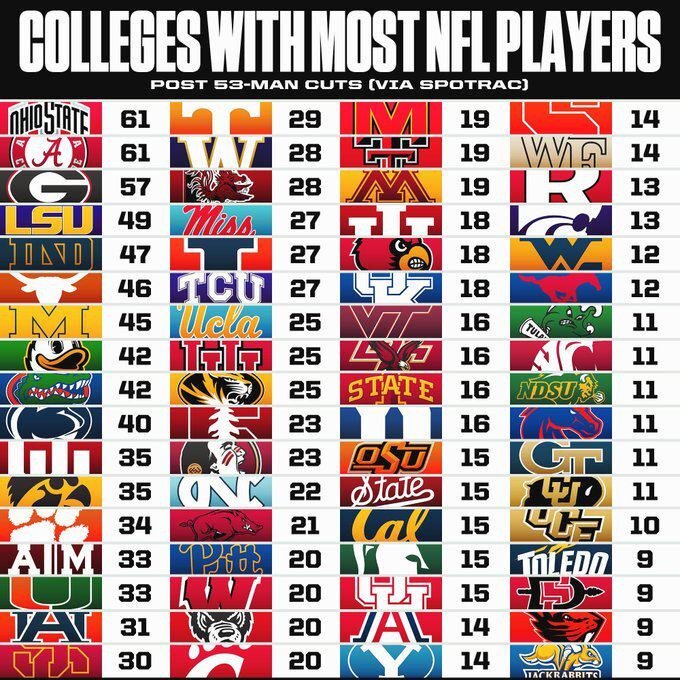
According to this graphic, which is the latest data Spotrac has published, Texas has the sixth-most active NFL players among FBS schools with 46. I believe these numbers were tallied before Cameron Williams was claimed by the Falcons and added to their 53-man roster. Williams' landing in Atlanta brings the number of active-roster Longhorns in the NFL to 47 (43 on the 53-man roster and four on injured reserve).
- 1 reply
-
- 2
-
-
Four Days Until Kickoff: Who Was The Best No. 4?
Jeff Howe replied to Blake Munroe's topic in On Texas Football Forum
Take four minutes out of your day and watch Roy Williams destroy a Nick Saban/Will Muschamp defense. -
NFL cut day: Tracking Longhorns on 53-man rosters
Jeff Howe replied to Hank South's topic in On Texas Football Forum
Jaydon Blue has a new home: -
NFL cut day: Tracking Longhorns on 53-man rosters
Jeff Howe replied to Hank South's topic in On Texas Football Forum
The original post has been edited to reflect all of the roster movement after waiver claims were made on Monday. -
NFL cut day: Tracking Longhorns on 53-man rosters
Jeff Howe replied to Hank South's topic in On Texas Football Forum
Nobody put in a waiver claim for Jaydon Blue. -
1. Whether he starts or not, Masunas will be the primary tight end. That's the way it was through camp. 2. Yes, it's the depth chart in general, not specifically for the Texas State game. 3. Kosi Okpala is the most ready to play among the freshmen linebackers. As it stands, Darius Snow would be on the field before Atkinson based on how things have unfolded in camp.
-
NFL cut day: Tracking Longhorns on 53-man rosters
Jeff Howe replied to Hank South's topic in On Texas Football Forum
Christian Jones has been added to the Bears' practice squad. -
There’s absolutely concern. That’s becoming more of the norm in college football, but Texas still technically has one of the youngest rosters in the country. This year’s team just has a higher percentage of portal additions in featured spots compared to previous seasons. That’s partly a byproduct of Sark correcting the mistakes that were made last year by not using the portal enough.
-
NFL cut day: Tracking Longhorns on 53-man rosters
Jeff Howe replied to Hank South's topic in On Texas Football Forum
Looks right at first glance. FWIW, Kitan Crawford doesn’t officially count as a Texas alum in the NFL since he finished his career at Nevada.