
All Activity
- Past hour
-
 Any time Texas’ potential to win the national championship in 2026 is discussed, penalties will almost certainly be cited as a legitimate lingering issue that could derail the Longhorns’ efforts to return to the College Football Playoff. After Steve Sarkisian’s first season, when Texas averaged 5.8 penalties (No. 55 in FBS) and 48.3 penalty yards per game (No. 48 in FBS), both per-game averages continued to steadily rise. The 2023 squad ranked 95th in the country in penalties per game (6.6) and finished a 14-game season tied for 70th nationally in penalty yards per game (52.2). The Longhorns appeared to be at least leveling off in 2024, averaging 6.4 penalties and 51.8 penalty yards per game en route to 13 wins and a second consecutive trip to the CFP semifinals. Unfortunately, things took an unexpected turn in 2025, resulting in the penalty issues under Sarkisian coming to a head. Texas ranked 134th nationally in penalties per game (8.3) last season, making the Longhorns the most penalized Power Four team in the country and the third-most penalized team in FBS. An average of 69.7 penalty yards per game was the second worst in the Power Four (SMU averaged 70.8 penalty yards per game) and the fifth worst in FBS. Sarkisian’s 2026 club doesn’t need to be as disciplined as Indiana was in 2025 (3.8 penalties per game tied for the fifth fewest in the country and 27.6 penalty yards per game was the second best average in FBS) to be the last team standing when the dust settles on the 12-team CFP. Nevertheless, Texas can’t be as undisciplined as it was last season (108 total penalties were a school record and only nine Longhorn teams averaged more penalty yards per game than the 2025 team) and expect to reach the summit unscathed. Each of the last five national champions (Indiana, Ohio State in 2024, Michigan in 2023 and Georgia in 2022 and 2021) finished inside the top 30 nationally in penalties per game and inside the top 40 in the country in penalty yards per game. Furthermore, the last three champions finished tied for first (Michigan), tied for 11th (Ohio State) and tied for fifth (Indiana) nationally in penalties per game, while ranking third (Michigan), 16th (Ohio State) and second (Indiana) in FBS in penalty yards per game, respectively. College football's talent is disbursed more equitably, thanks to dynamics like NIL, revenue sharing and the transfer portal. It’s arguably more important than ever to play disciplined football because the talent gap at the top of the sport isn’t as wide as it was a few years ago. Still, of the 12 national champions in the CFP era, LSU in 2019 and Clemson in 2016 are the only two that finished ranked outside of the top 60 nationally in penalties and penalty yards per game. It took Joe Burrow leading one of the most prolific offenses in college football history, along with a defense chock-full of future NFL players, for Ed Orgeron’s team to overcome a No. 107 ranking in penalty yards per game (62.4), which the worst among any national champion in the CFP era. Quarterbacked by Deshaun Watson, who was one of five future first-round draft picks suiting up for the Tigers in 2016, the first title-winning squad coached by Dabo Swinney averaged 6.3 penalties per game, making them the most penalized national champion in the CFP since the CFP replaced the Bowl Championship Series in 2014. The Longhorns are talented, perhaps historically so, entering Sarkisian’s sixth season. Are they talented enough to absorb an absurd number of self-inflicted wounds and hit their ceiling? Regardless, the Texas faithful can view the program’s potential improvement in a glass-half-full light because Sarkisian has shown he can right the ship. After Tom Herman’s 2020 team was one of the most penalized in the country, averaging 8.1 penalties and 77 penalty yards per game, Sarkisian oversaw those marks improving by 2.3 penalties and 28.7 penalty yards per game in his first season on the Forty Acres. Such an improvement would put the 2026 Longhorns on track for an average of six penalties and 41 penalty yards per game, which would’ve tied for 65th and 26th in FBS last season, respectively. Six penalties per game would match the number committed by Alabama in 2020, when Sarkisian was the offensive coordinator for Nick Saban’s record-breaking seventh national title as a head coach; 41 penalty yards per game would be on par with Ryan Day’s Buckeyes in 2024 (40.8 penalty yards per game) among recent national champions. Whether Texas makes those specific strides or gets within the ballpark of doing so, the numbers show how much more disciplined the Longhorns must be year over year to reach their desired destination. View full news story
 -
Any time Texas’ potential to win the national championship in 2026 is discussed, penalties will almost certainly be cited as a legitimate lingering issue that could derail the Longhorns’ efforts to return to the College Football Playoff. After Steve Sarkisian’s first season, when Texas averaged 5.8 penalties (No. 55 in FBS) and 48.3 penalty yards per game (No. 48 in FBS), both per-game averages continued to steadily rise. The 2023 squad ranked 95th in the country in penalties per game (6.6) and finished a 14-game season tied for 70th nationally in penalty yards per game (52.2). The Longhorns appeared to be at least leveling off in 2024, averaging 6.4 penalties and 51.8 penalty yards per game en route to 13 wins and a second consecutive trip to the CFP semifinals. Unfortunately, things took an unexpected turn in 2025, resulting in the penalty issues under Sarkisian coming to a head. Texas ranked 134th nationally in penalties per game (8.3) last season, making the Longhorns the most penalized Power Four team in the country and the third-most penalized team in FBS. An average of 69.7 penalty yards per game was the second worst in the Power Four (SMU averaged 70.8 penalty yards per game) and the fifth worst in FBS. Sarkisian’s 2026 club doesn’t need to be as disciplined as Indiana was in 2025 (3.8 penalties per game tied for the fifth fewest in the country and 27.6 penalty yards per game was the second best average in FBS) to be the last team standing when the dust settles on the 12-team CFP. Nevertheless, Texas can’t be as undisciplined as it was last season (108 total penalties were a school record and only nine Longhorn teams averaged more penalty yards per game than the 2025 team) and expect to reach the summit unscathed. Each of the last five national champions (Indiana, Ohio State in 2024, Michigan in 2023 and Georgia in 2022 and 2021) finished inside the top 30 nationally in penalties per game and inside the top 40 in the country in penalty yards per game. Furthermore, the last three champions finished tied for first (Michigan), tied for 11th (Ohio State) and tied for fifth (Indiana) nationally in penalties per game, while ranking third (Michigan), 16th (Ohio State) and second (Indiana) in FBS in penalty yards per game, respectively. College football's talent is disbursed more equitably, thanks to dynamics like NIL, revenue sharing and the transfer portal. It’s arguably more important than ever to play disciplined football because the talent gap at the top of the sport isn’t as wide as it was a few years ago. Still, of the 12 national champions in the CFP era, LSU in 2019 and Clemson in 2016 are the only two that finished ranked outside of the top 60 nationally in penalties and penalty yards per game. It took Joe Burrow leading one of the most prolific offenses in college football history, along with a defense chock-full of future NFL players, for Ed Orgeron’s team to overcome a No. 107 ranking in penalty yards per game (62.4), which the worst among any national champion in the CFP era. Quarterbacked by Deshaun Watson, who was one of five future first-round draft picks suiting up for the Tigers in 2016, the first title-winning squad coached by Dabo Swinney averaged 6.3 penalties per game, making them the most penalized national champion in the CFP since the CFP replaced the Bowl Championship Series in 2014. The Longhorns are talented, perhaps historically so, entering Sarkisian’s sixth season. Are they talented enough to absorb an absurd number of self-inflicted wounds and hit their ceiling? Regardless, the Texas faithful can view the program’s potential improvement in a glass-half-full light because Sarkisian has shown he can right the ship. After Tom Herman’s 2020 team was one of the most penalized in the country, averaging 8.1 penalties and 77 penalty yards per game, Sarkisian oversaw those marks improving by 2.3 penalties and 28.7 penalty yards per game in his first season on the Forty Acres. Such an improvement would put the 2026 Longhorns on track for an average of six penalties and 41 penalty yards per game, which would’ve tied for 65th and 26th in FBS last season, respectively. Six penalties per game would match the number committed by Alabama in 2020, when Sarkisian was the offensive coordinator for Nick Saban’s record-breaking seventh national title as a head coach; 41 penalty yards per game would be on par with Ryan Day’s Buckeyes in 2024 (40.8 penalty yards per game) among recent national champions. Whether Texas makes those specific strides or gets within the ballpark of doing so, the numbers show how much more disciplined the Longhorns must be year over year to reach their desired destination.
-

The National College Football League - NCFL
Dallas Horns Fan replied to Buck Travis's topic in On Texas Football Forum
Great stuff, I would put SMU in ahead of Okie State. Probably need to include UCLA, North Carolina and Mich State somewhere....but its tough to pick only 32. -

4-star++ RB Landen Williams-Callis | Wednesday 7:15am CT
Paul L replied to Gerry Hamilton's topic in On Texas Football Forum
Unless he commits somewhere else and cancels all his other visits. But we will pretend that’s not a possibility. -

25-26 Director's Cup Thread
f1revo replied to DirectorsCupUpdates's topic in On Texas Football Forum
Baseball won't score what they're slotted to, id be shocked. Softball will have a competitive super regional for sure too -

OTF Premium For Sure CFB Hall of Famers in the Last 10 Years?
CJ Vogel replied to CJ Vogel's topic in On Texas Football Forum
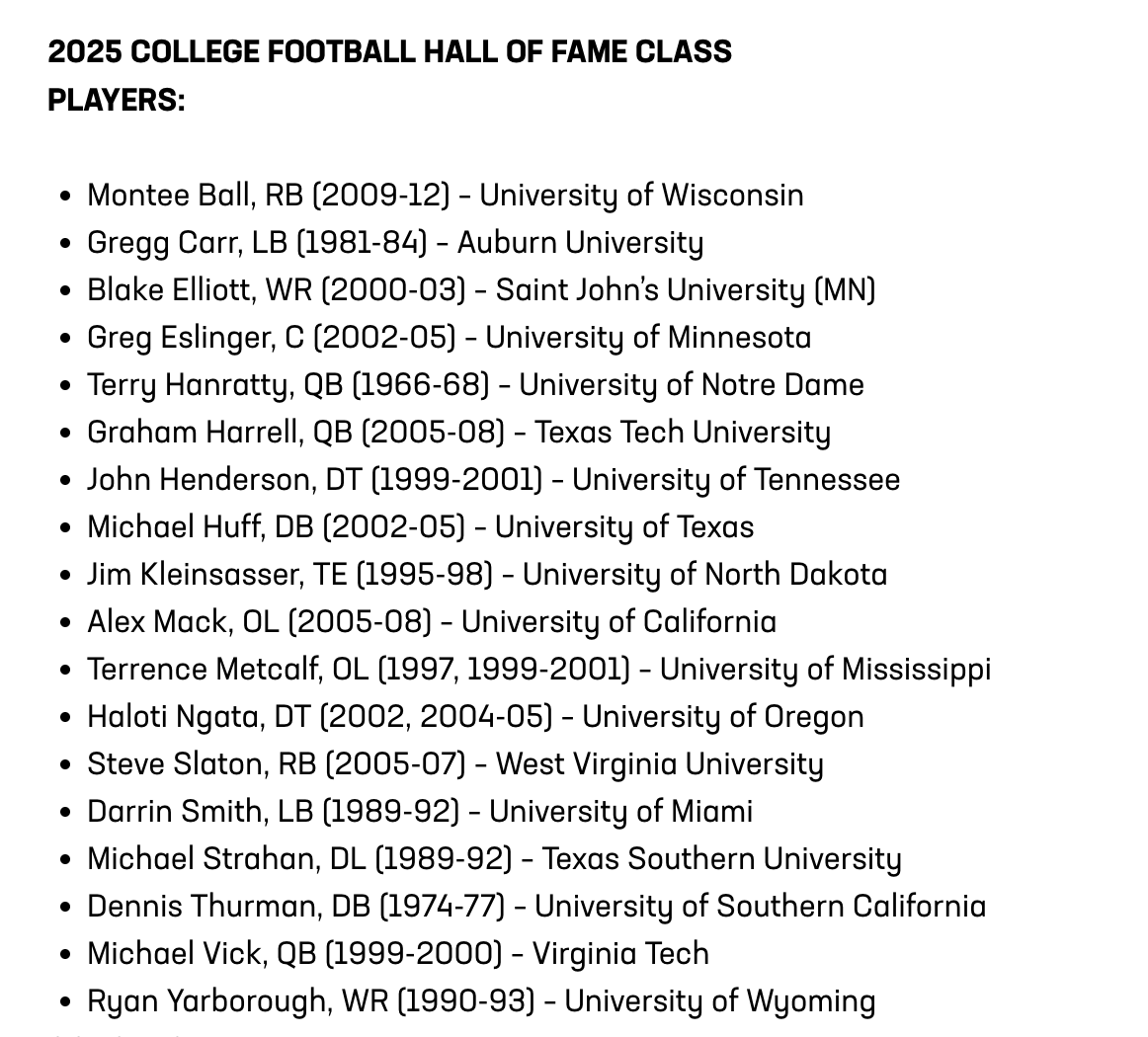
the 2025 Class:
-
 I really want us to land him, Meredith, Fakatou, Brock Williams, Garor, Swanson and Royal. Anything else on top of these guys would be gravy.
 -

25-26 Director's Cup Thread
HookemTexas replied to DirectorsCupUpdates's topic in On Texas Football Forum
Texas' highly ranked teams need to at least hold serve - Softball being #2 rank is a lot of estimated points, same with baseball at #6. -
Since the playoffs have been a hot topic of late, let's see what the ultimate professionalization of CFB looks like: National College Football League (NCFL) – an NFL-mirrored 32-team college football league and playoff format. Selected Top 32 Programs. These are chosen based on a blend of all-time success (winning percentage, national titles, AP rankings history), recent performance (including Indiana’s 2025 national championship), fanbase size/TV value, facilities, and sustained competitiveness. This creates a closed, elite league with no promotion/relegation (just like the NFL). All the other programs fall into DII because...who cares. Alabama Crimson Tide Auburn Tigers Boise State Broncos BYU Cougars Clemson Tigers Florida Gators Florida State Seminoles Georgia Bulldogs Indiana Hoosiers Iowa Hawkeyes LSU Tigers Miami (FL) Hurricanes Michigan Wolverines Missouri Tigers Nebraska Cornhuskers Notre Dame Fighting Irish Ohio State Buckeyes Oklahoma Sooners Oklahoma State Cowboys Ole Miss Rebels Oregon Ducks Penn State Nittany Lions TCU Horned Frogs Tennessee Volunteers Texas A&M Aggies Texas Longhorns Texas Tech Red Raiders USC Trojans Utah Utes Virginia Cavaliers Washington Huskies Wisconsin Badgers League Structure (Exact NFL Mirror) 32 teams divided into 2 conferences of 16 teams each: American Football Conference (AFC) and National Football Conference (NFC). Each conference has 4 divisions (East, North, South, West) of exactly 4 teams each. Divisions are aligned geographically where possible while preserving major rivalries (e.g., Michigan–Ohio State, Alabama–Auburn–Georgia–Florida) and balancing competitive strength. AFC Divisions East: Clemson Tigers, Florida State Seminoles, Miami (FL) Hurricanes, Virginia Cavaliers North: Michigan Wolverines, Ohio State Buckeyes, Penn State Nittany Lions, Notre Dame Fighting Irish South: Alabama Crimson Tide, Auburn Tigers, Florida Gators, Georgia Bulldogs West: LSU Tigers, Oklahoma Sooners, Texas Longhorns, Texas A&M Aggies NFC Divisions East: Indiana Hoosiers, Oklahoma State Cowboys, TCU Horned Frogs, Utah Utes North: Iowa Hawkeyes, Nebraska Cornhuskers, Wisconsin Badgers, Missouri Tigers South: Ole Miss Rebels, Tennessee Volunteers, BYU Cougars, Boise State Broncos West: Oregon Ducks, USC Trojans, Washington Huskies, Texas Tech Red Raiders Regular Season Format (Mirrors NFL) 17-game schedule per team (exact NFL length). Every team plays its 3 division opponents twice (home-and-away = 6 games). Remaining games rotate among intra-conference and inter-conference opponents (just like NFL scheduling formulas). College scheduling constraints (academics, bowl tie-ins) would be restructured for this closed league; conference championship games are replaced by the NFL-style playoff seeding. Playoff Format (Exact NFL Mirror – 14-team playoff) 7 teams qualify per conference (total 14-team postseason): The 4 division winners (seeded 1–4 based on record). The 3 wild-card teams (best non-division winners, seeded 5–7). First round (Wild Card): Lower seeds (5 vs. 4, 6 vs. 3, 7 vs. 2) play single-elimination games. Top seed in each conference gets a bye. Divisional round: Winners advance; higher seeds host. Conference Championship: Two games (AFC and NFC). NCFL Championship Game (the “College Super Bowl”): AFC champion vs. NFC champion at a neutral site (rotating or fixed like SoFi Stadium/Las Vegas). This format keeps the drama of NFL playoffs while giving the top 32 programs a true pro-style structure with balanced divisions, protected rivalries, and a clear path to a national title. It would revolutionize college football by creating stability, massive TV revenue, and an NFL-like product while retiring the chaotic current bowl/playoff system for these elite programs.
-
 If Florida has the OL ... can see them inning 7/8 games Missouri is interesting ... not sure how they can be as good on D this year. But reality with Drink is if he doesn't lose 1st and 2nd team QB's to injury last year he wins 10 games or more for a third straight season and three straight top 25 finishes If Hardy can't play this season, tough to see that level of W's in 2026
 -
OTF Premium For Sure CFB Hall of Famers in the Last 10 Years?
CJ Vogel replied to CJ Vogel's topic in On Texas Football Forum
Michael Dickson and DeShon Elliott will receive some looks for the pre-Sark era. -

25-26 Director's Cup Thread
DirectorsCupUpdates replied to DirectorsCupUpdates's topic in On Texas Football Forum
UCLA and Florida are basically out of it at this point. UNC is more of a threat for 3rd place than Florida at this point. Stanford will most likely score within 25 points in either direction of their current ranking - 1225-1275. Texas has a much broader range, anywhere from 1215 to 1375. A lot of dominoes would have to fall in Stanford's favor for things to get interesting, but we of course must wait for the on the field action to play out. -
absolutely!
-
Came across this idea on the r/CFB thread earlier today and wanted to share it: How many for sure College Football Hall of Famers would you consider to be waiting for their induction from the Texas Longhorns over the last ten years? You could even condense it to just the Sark era – probably what it come down to most likely anyways. The requirements to make the CFB HOF as a former player: Must be a First-Team All-American (NCAA recognized), 10+ seasons removed from college, played within the last 50 years (with Veteran Committee exceptions), and not currently in the pros. *** 1. Bijan Robinson 2. Kelvin Banks 3. T'Vondre Sweat 4. Jahdae Barron 5. Michael Taaffe 6. Colin Simmons ... eventually 7. Xavier Worthy (?) Let me know what you think.
-
25-26 Director's Cup Thread
DirectorsCupUpdates replied to DirectorsCupUpdates's topic in On Texas Football Forum
-
25-26 Director's Cup Thread
DirectorsCupUpdates replied to DirectorsCupUpdates's topic in On Texas Football Forum
Teams ranked 8, 12, 13, 14, 15, 23 and 28 failed to advance. Texas has their sites on a top 5 finish so these teams don't exactly make that much easier - but it does slightly decrease the overall competition to advance to match play. -
I will post some pics when I get home tonight. Daughter is big into hockey and pulled a Matthew Schaefer Young Gun a couple of weekends ago and I got a Schaefer orange dazzler today. Already had a Celebrini Young Gun. I mostly grab Bowman 1st baseball cards and have a bunch of those in chrome and have about 8-10k coming in the paper form by the end of the week. Should have quite a few McGonigle and Griffin 1sts among them. I will buy random Texas Longhorn stuff when it comes up. Got some good ones recently. Just got a Skenes Chrome 1st that I’m pretty excited about. I’ll post a bunch of pics tonight.
-

OTF Premium New offers this week | Wednesday 3:50 p.m.
Hank South replied to Hank South's topic in On Texas Football Forum
2029 DL from Crosby (Texas) 6-3, 290 Texas Tech has also offered. Freshman film: https://www.hudl.com/video/3/27276349/69f26a5b5a4240af4e668e35 - Today
-

25-26 Director's Cup Thread
nozatx replied to DirectorsCupUpdates's topic in On Texas Football Forum
Women's golf regionals finished up today, mostly going chalk in terms of which schools qualify for NCAAs (UT women won by 11 strokes in regional at UNC, Stanford won by 38 at home), with one significant DC-relevant exception. In the Tallahassee regional, a Kentucky golfer holed out for eagle on the 18th hole which caused Kentucky to jump over 15th-ranked UCLA by one shot for the 5th and final qualifying spot there. UCLA drops 19.5 points from their projection in women's golf with no potential to improve. Final 30 includes 10 SEC schools - OU, Vandy, MsSt failed to advance. -
 Thanks Jeff 👍🏻
 -
I'm a buyer on Florida this year. Out on Tennessee and Missouri.
-
Must be nice... I had season tickets for the past 11 seasons straight since graduating from Texas. Been to all Texas OU games, recent playoff games, etc. Due to unexpected circumstances, I couldn't afford to renew my season tickets for last season. I was hoping my loyalty points over the years would help my position in the waiting list for this year's season tickets. Called consistently the past few months and reached out to CDC through social media... Texas and CDC's response... was donate more money and MAYBE you can move up the waiting list. Their recommended amount to donate was over $2000 just to move up the list. I had a feeling it wasn't going to work out in my favor, but I donated the $2000+ anyways. I guess loyalty really doesn't matter unless you donate several thousands. The cherry on top was Texas emailing me thank you supporting Texas athletics and that my donation is non-refundable and to try again next season.
-

CBS Top 25 post spring ranking not for the faint of heart
HonkEm replied to Gerry Hamilton's topic in On Texas Football Forum
Patterson does not have North Carolina on his list - no bias -
Maybe the best part is if not for a random screen grab, no one would know except your friends. CDC did the right thing because it was the right thing. Sometimes, leadership is not hard to describe.
-
Maybe, but I doubt it. They might try Bing again. I wouldn't be surprised if, in a fourth starter role needed for an elimination game in a regional, they went with someone like Leffew as an opener and it would be a bullpen game from there.